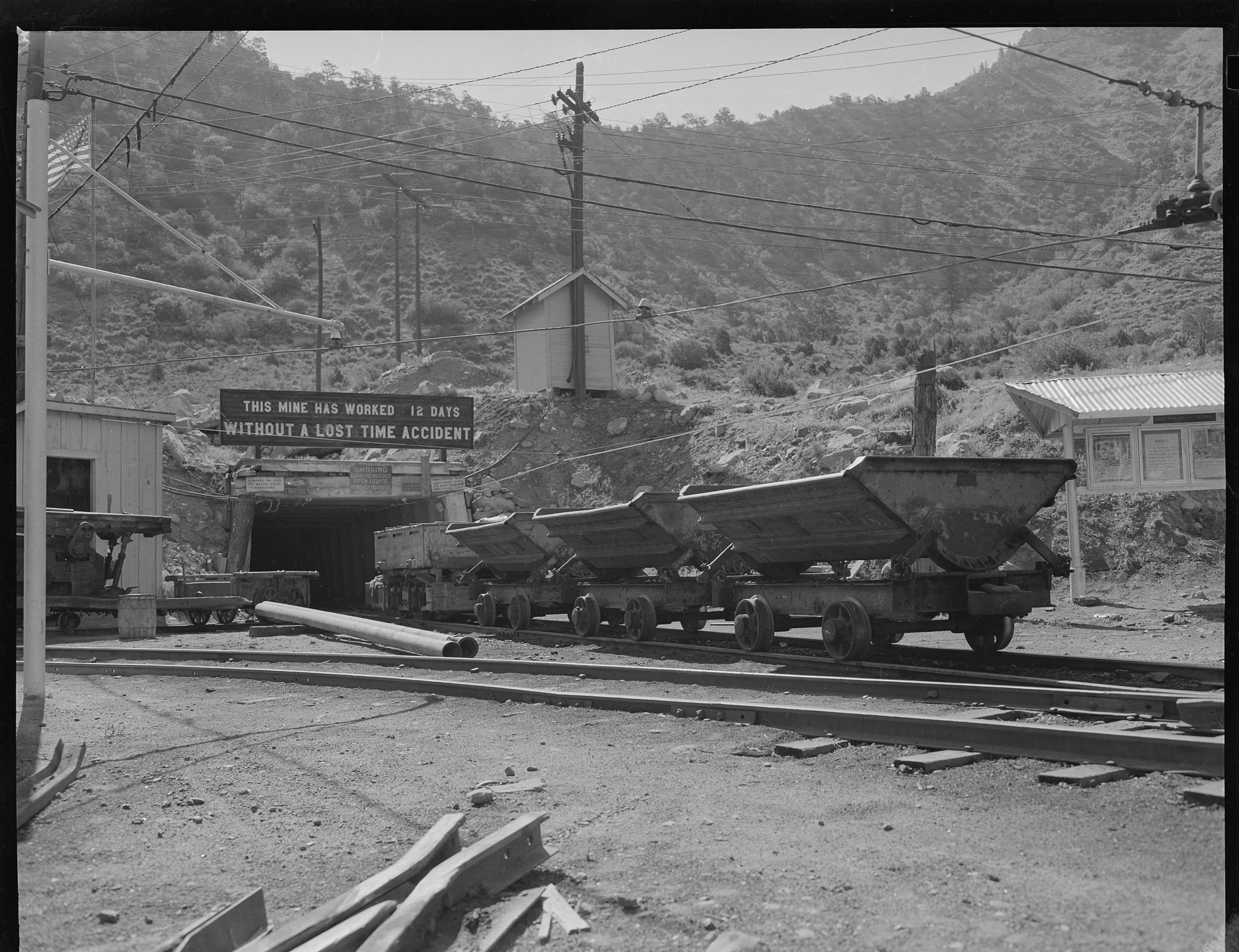
In 1894, the territorial legislature carved a new county off the northern end of Emery County and named it, with unusual honesty, for the thing everyone had come to take out of the ground. Not for a president or a prophet or a river, the way most of Utah's counties were named, but for an element: Carbon. The men who chose the name meant coal, and there was a great deal of coal beneath the new county's seat at Price. But coal is only one of the shapes the element takes — an early county history noted, almost poetically, that the amorphous forms of carbon are soot, charcoal, graphite, and diamond — and coal turned out to be only half of what Carbon County would spend its existence pulling out of the rock. The other half is far older, and it has teeth.
The older harvest
Thirty miles south of Price, in a fold of the San Rafael Swell, lies a layer of gray-green mudstone that holds the densest concentration of Jurassic dinosaur bones ever found anywhere on Earth. The Cleveland-Lloyd Dinosaur Quarry has given up more than twelve thousand bones from at least seventy-four animals, and roughly seven in ten of them belong to a single species — Allosaurus, the great predator of the late Jurassic, here in numbers that turn up nowhere else on the planet. Why so many hunters died in one place is a question paleontologists have argued for a century, and this is not the page that settles it. What matters here is the plainer fact: a hundred and fifty million years ago, this ground was already in the business of burying monsters.
It did not stop with the Jurassic. Rock a little higher in the stack, and a little younger, produced the animal that paleontologist James Kirkland lifted out of the Cedar Mountain Formation in 1991 — Utahraptor, which turned out to be the raptor the movies should have been afraid of: twenty-three feet long, better than a thousand pounds, with a sickle claw on each foot the length of a chef's knife. Jurassic Park had just inflated its turkey-sized Velociraptors into screen monsters; Utah's ground, it emerged, had buried the real thing, larger than the fiction. The original skeleton now stands a few miles from where it was found, in the Prehistoric Museum in Price, beside a Columbian mammoth pulled from a canyon south of town — one more drawer in a county that has been filing away its dead for a very long time.
The swamp that became money
The coal came later, and from the opposite kind of life. Around eighty million years ago, in the late Cretaceous, a shallow inland sea split North America down its middle, and the western shore of that sea ran across what is now Utah. Along the shore lay a belt of warm coastal swamps, and the dead plants of those swamps piled up faster than they could rot, pressed down under their own weight and the mud above them until, across the eons, the peat cooked into coal. Those seams are the dark bands you can read in the Book Cliffs that wall the horizon north of town — a long escarpment of Cretaceous rock stacked like a shelf of books, the buried swamps laid in black lines between the sandstone.
So the two harvests are really the same harvest, separated only by which kind of life got buried. The coal is fossil sunlight — swamp plants that pulled carbon out of the Cretaceous air and locked it underground before they could give it back. The bone beds are fossil animals, Jurassic flesh gone to stone. Both are ancient life turned solid and shelved in the rock of a single county, and both, in the end, became something a person could dig up and carry off. The county was named for the element that ties them together.
The town that coal built
Coal is what people came for, because coal could be burned now. The Denver and Rio Grande Western pushed its rails up the Price River in 1883, the mines opened along the side canyons, and the work drew people the rest of Utah mostly did not have. The companies recruited where labor was cheap and willing — Greece, Italy, Japan, the Slavic countries of central Europe — and the camps filled with families who shared neither the language nor the faith of the Mormon farm towns over the ridge. Helper, the railroad town at the mouth of the canyon, became known as the Town of Fifty-Seven Varieties for the nationalities packed into it, and was for a time one of the most genuinely diverse places in the American West, with an Orthodox church, a Greek festival, and a main street that answered in a dozen tongues.
The ground that paid them also killed them, and it killed them in numbers. In 1900 an explosion in the mines at Scofield, up in the county's high western valley, killed about two hundred men and boys in a single morning — at the time the deadliest mine disaster the country had ever seen. In 1924 the mine at Castle Gate blew and took a hundred and seventy-two more. The strikes that followed — in 1903 and 1904, again in 1922, again in 1933 — were bitter and sometimes bloody, and out of them came the union that finally made the work survivable. Carbon County learned early what the rest of Utah's resource towns would learn later: the ground gives, and then it hands you the bill.
What's left to dig
The coal is finished now — not the seams, which still hold more than the county could burn in a century, but the business of it. Cheaper gas and cleaner power did what no strike ever managed; California, which once drew as much as a quarter of Los Angeles's electricity from Utah coal, stopped buying it, and the mines fell silent one after another. The last working coal mine in Carbon County closed in 2019. For the first time since the 1880s, the county named for coal mines none of it.
So the county has fallen back on the only trade it has ever known, which is to make its living off what lies buried in its ground — except that now it sells the older harvest. Helper, all but a ghost town thirty-five years ago, has remade itself into a street of galleries and cafes. Price leans on its university and its hospital and the Prehistoric Museum, whose Allosaurus and Utahraptor catch the travelers streaming through toward Moab; the county now markets the dinosaur byways and the rock-art canyons it spent a hundred years driving coal trucks past. Even the plans to bring industry back tend to circle the same element — carbon fiber, coke — and a solar farm is going up on ground that used to feed a coal-fired power plant.
There is a symmetry to it the county might not enjoy having pointed out. Carbon County has really only ever been in one business: unearthing the ancient dead and selling them to the living. For a hundred and thirty years that meant the fossilized swamps, which is to say the coal. Now, more and more, it means the fossilized animals in the same rock, which is to say the dinosaurs. The product changed; the work did not. And through all of it — a buried Jurassic, a drowned Cretaceous, a hundred and thirty years of mining and the thin decades since — the county has kept the name it gave itself in 1894, for the element that was the entire point of the place.