The Story
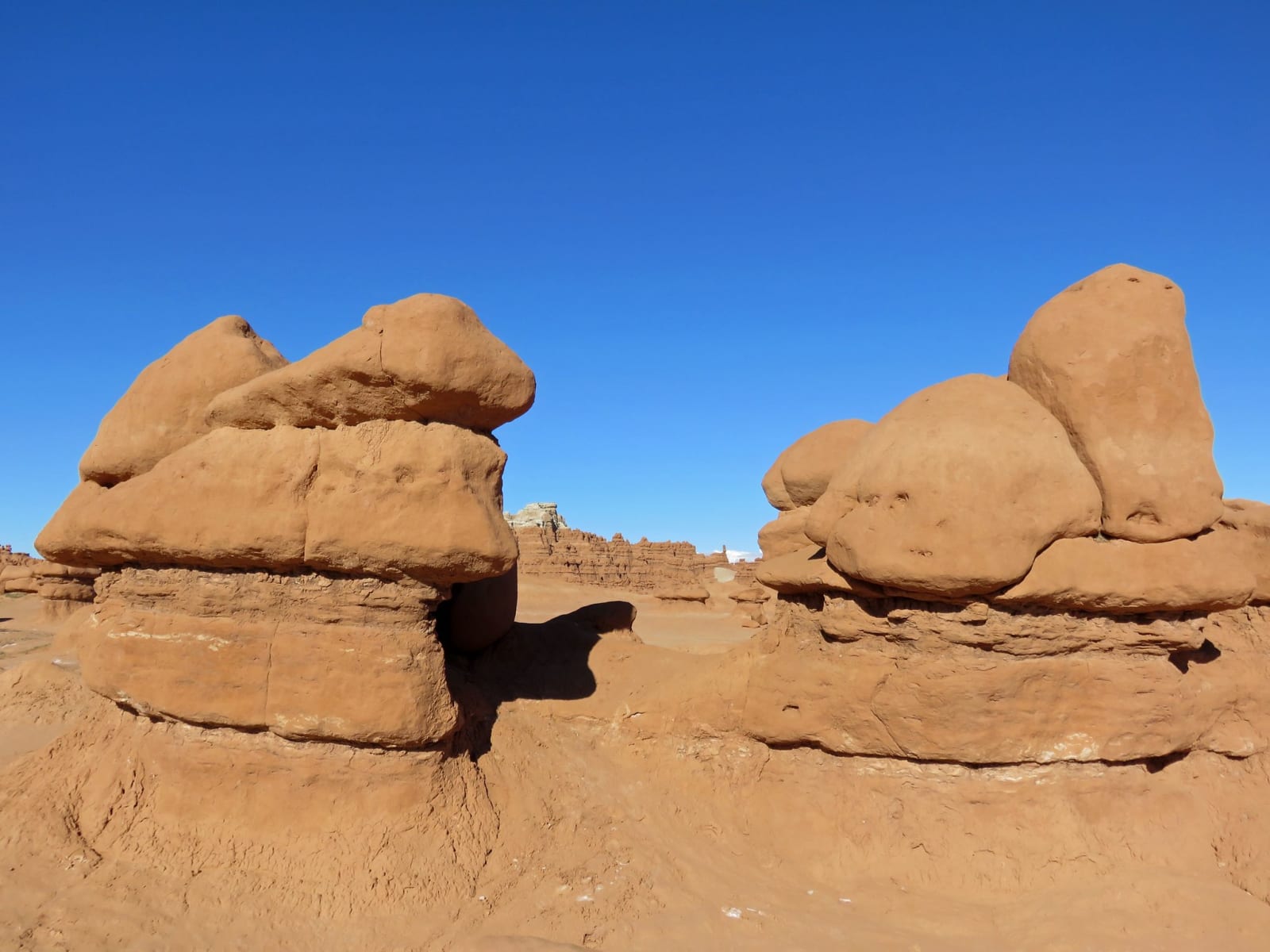
Goblin Valley looks like a place that should not exist on Earth. Thousands of mushroom-shaped rock formations — some knee-high, some towering twenty feet — stand in clusters across a wide desert valley, their bulbous heads balanced on narrow stems, their surfaces eroded into faces, figures, and shapes that seem deliberately sculpted by a mind with a very strange sense of humor. The landscape is so alien that scientists use it as a Mars analog for research, and the movie Galaxy Quest filmed its desert planet scenes here. Both choices make perfect sense. This place does not look real.
The formations are carved from Entrada Sandstone, the same rock that forms the arches in Arches National Park roughly 100 miles to the southeast. But here the erosion took a different path. Instead of fins and windows, the combination of soft mudstone layers beneath harder sandstone caps created thousands of individual pillars and pedestals. Wind and water wore away the softer lower layers while the harder caps protected the rock directly beneath them, producing the distinctive top-heavy shapes that give the valley its name. The goblins are technically called hoodoos, but they lack the vertical elegance of Bryce Canyon's spires. These are squat, lumpy, and weird — and that is precisely their charm.
What makes Goblin Valley different from almost every other geological attraction in Utah is that you are allowed to walk among the formations. There are no fences, no roped-off areas, no stay-on-the-trail signs in the main valley. You can wander freely between the goblins, duck under overhangs, squeeze through narrow gaps, and explore at your own pace. For families with children, this is transformative. Kids who might last twenty minutes on a national park trail will spend hours scrambling over and around the formations, inventing stories about the shapes, playing hide and seek in a landscape that feels like a giant natural playground.
The valley is divided into three main goblin areas, each with a slightly different character. Valley 1 is the most accessible and popular, with the densest concentration of formations. Valley 2 has taller, more widely spaced goblins and a quieter atmosphere. Valley 3 requires a bit more walking and rewards you with formations that see very few visitors. A network of trails connects the valleys, but the real joy is in going off-trail and simply wandering.
The colors shift dramatically with the light. In the midday sun the formations look pale and washed out — interesting but not spectacular. At sunrise and sunset the Entrada Sandstone catches the low-angle light and turns deep orange, amber, and chocolate brown, and the shadows cast by the goblin shapes create an entirely new layer of visual complexity. Photographers who visit only at midday miss the best version of this place by hours.
Goblin Valley also serves as a gateway to some of the finest slot canyon hiking in the San Rafael Swell. Little Wild Horse Canyon and Bell Canyon form a loop that is widely considered one of the best beginner slot canyon hikes in Utah — narrow enough to touch both walls at once, deep enough to block out the sky, and short enough to complete in half a day. The trailhead is just minutes from the park entrance.
The park added a set of yurts and a small campground in recent years, and spending the night here is worth the effort. The San Rafael Swell is one of the least light-polluted areas in the state, and the night sky from the campground is extraordinary. The Milky Way arcs directly overhead, and the silence is so complete that you can hear your own heartbeat.
There is something about Goblin Valley that resists the seriousness that settles over most geological attractions. Arches is awe-inspiring. Bryce is otherworldly. Canyonlands is humbling. Goblin Valley is fun. The shapes are inherently playful — lumpy, cartoonish, vaguely anthropomorphic — and the freedom to explore without restriction gives the place an energy that feels more like recess than reverence. It is the rare geological wonder that makes you laugh out loud, and Utah is lucky to have it.
Visitor Info
On the Map
A story featuring this place
Go deeper into the history and character of this stop
Nearby
The closest stops worth working into your route
Historical markers nearby
Roadside plaques and monuments within a short detour