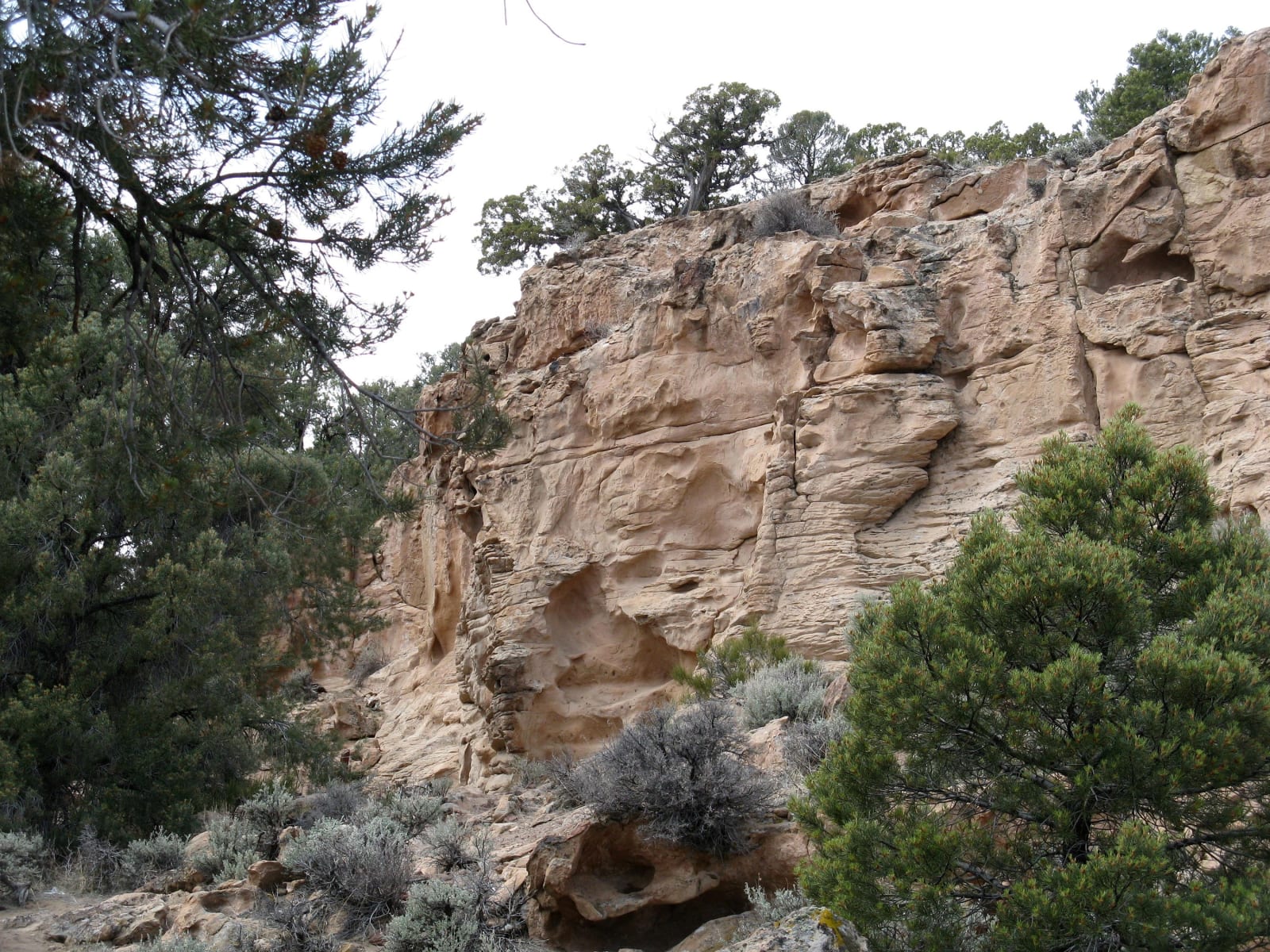
 Finetooth / CC BY-SA 3.0
The Story
Twenty-four miles east of Austin, US-50 climbs to a wooded summit at sixty-five hundred feet, and at the top — improbably, after all that bare valley — there are juniper and pinyon for shade, a quiet campground, and pale outcrops of soft white rock carved over with petroglyphs. This is Hickison, the high point of the loneliest road's rock art and the easiest place on the whole route to walk up and meet it. The carvings are the work of the Newe, the Western Shoshone, who lived across this country, hunted its passes, and gathered pine nuts in these same trees. A short loop trail leads you straight to the panels, no climbing required.
The setting is half the point. Down in the basins the loneliest road runs through sun and sagebrush, but Hickison Summit is a green island on a high pass, cool and shaded, with three-hundred-sixty-degree views over Big Smoky Valley to the west and Monitor Valley to the east. Both held lakes once, in the wetter centuries after the ice age, and the people who first came here knew the summit as a crossroads — a place to take game moving between the valleys, to harvest pine nuts in fall, and to camp where there was shade and a long view in every direction. It is still, by a wide margin, the most pleasant place to stop between Austin and Ely.
The rock itself sets Hickison apart. Where the petroglyphs at Grimes Point were pecked through the hard black varnish of basalt, here the canvas is volcanic tuff — compacted ash from ancient eruptions, soft and pale and easy to cut. Some of the carvings are scratched lightly; others are gouged surprisingly deep into the chalky stone. The motifs are mostly abstract: circles and concentric rings, wavy and zigzag lines, grids and hatching, a few shapes that suggest animals or human figures. On the white rock they read more clearly than most Great Basin rock art, which is part of why the BLM built a trail to them.
What they meant is, as always, the open question. The interpretive signs lean toward hunting — the summit as a natural funnel for deer and antelope moving between the valleys, the carvings bound up somehow with the hunt — and visitors have long noted circles and looping forms that some read as fertility symbols. Both are guesses, and honest archaeology holds them loosely; the Newe who carved these lines are the only real authority on what they say, and much of the meaning was never written down for outsiders to recover. Better to stand in front of a panel and let it stay a little mysterious than to flatten it into a caption.
For all its prehistory, Hickison Summit is also a crossroads of the overland era. John C. Frémont came through this country in the 1840s, and in 1859 the army surveyor James Simpson crossed this very summit while scouting the shortest line across Nevada — the route the Pony Express would ride the next year, and the Overland Stage the year after that. Silver turned up at Austin, twenty-two miles west, in 1862, and the rush was on. So the carvings on this hilltop, already thousands of years old, looked down on wagons, mail riders, and stagecoaches passing within sight — the deep past and the frontier sharing one narrow pass.
The threat now is people. Graffiti and casual vandalism are the slow death of Great Basin rock art, and a soft tuff that carves easily carves easily for anyone; what took a culture centuries to make, a bored hand can ruin in a minute. The site is protected by law, and the rules are the usual ones, which is to say the important ones: stay on the trail, keep off the fragile soil crust, photograph freely, and add nothing — no new marks, no chalk, no touch. The descendants of the people who made these still live in this country, and the panels are theirs more than ours.
As a stop, Hickison is almost too easy. It is free, open all year, and equipped with sixteen first-come campsites, picnic tables, fire grills, and pit toilets — though no water, so bring your own. The interpretive loop runs about half a mile past the main panels, with an optional spur up to an overlook on the ridge that earns the few extra minutes for the view alone. Whether you stretch your legs for twenty minutes or spend the night under some of the darkest skies in the state, Hickison is the loneliest road at its most generous: shade, history, and very old company, right at the top of the pass.
Visitor Info
On the Map
Stories featuring this place
Go deeper into the history and character of this stop
Nearby
The closest stops worth working into your route
Historical markers nearby
Roadside plaques and monuments within a short detour