 Chris M Morris / CC BY 2.0
The Story
Of all the towns the loneliest road strings together, Eureka is the one that still feels like a town. US-50 runs straight down a Main Street of two-story brick buildings with iron shutters and slate roofs, past a restored opera house and a courthouse that has been doing county business since the 1870s, and the place has leaned so hard into its own survival that it bills itself, on signs at both ends, as the Friendliest Town on the Loneliest Road in America. Seventy miles east of Austin, it is the best-preserved of central Nevada's mining towns and, with a few hundred residents, one of the few that never became a ghost.
What built it was a kind of ore the Comstock never had. In September 1864 a party out of Austin found silver here, but locked up in complex lead ore that the usual methods could not crack — the first major silver-lead strike in America, and for five years more curse than fortune. The fix came in 1869, when new smelters finally learned to cook the metal out of the lead, and Eureka exploded. By the late 1870s sixteen smelters were treating ore from more than fifty mines, the town held close to ten thousand people — second in Nevada only to Virginia City — and the furnaces poured out so much lead-and-arsenic smoke that Eureka earned a grim nickname: the Pittsburgh of the West. The black slag heaps still stand at the edges of town.
All that smelting ran on charcoal, and the charcoal ran on the backs of immigrants. The furnaces burned through some sixteen thousand bushels a day, and feeding them fell mostly to Italian and Swiss-Italian carbonari, skilled charcoal burners who cut and slow-burned the forests for fuel — five thousand acres a year, until by 1878 the hills were stripped of trees for fifty miles around. When the price they were paid failed to keep up, about five hundred of them formed a protective association in 1879 and stopped the charcoal moving. The town called it a war. The governor sent the militia, and on August 18, 1879, a posse confronted the burners at Fish Creek, south of town, and killed five of them. The smelters cut the price anyway. It is the darkest chapter in Eureka's history, and worth remembering that the wealth in those brick buildings was paid for partly in their lives.
Fire shaped the town as much as ore did. A blaze in 1879 leveled much of the wooden downtown, and Eureka rebuilt in stone and brick, with slate roofs and heavy iron shutters meant to choke off the next fire before it spread. That hard-won fireproofing is the reason so much of the place is still standing a century and a half later: the buildings that survived were the ones built to survive, and they set the pattern for everything raised after.
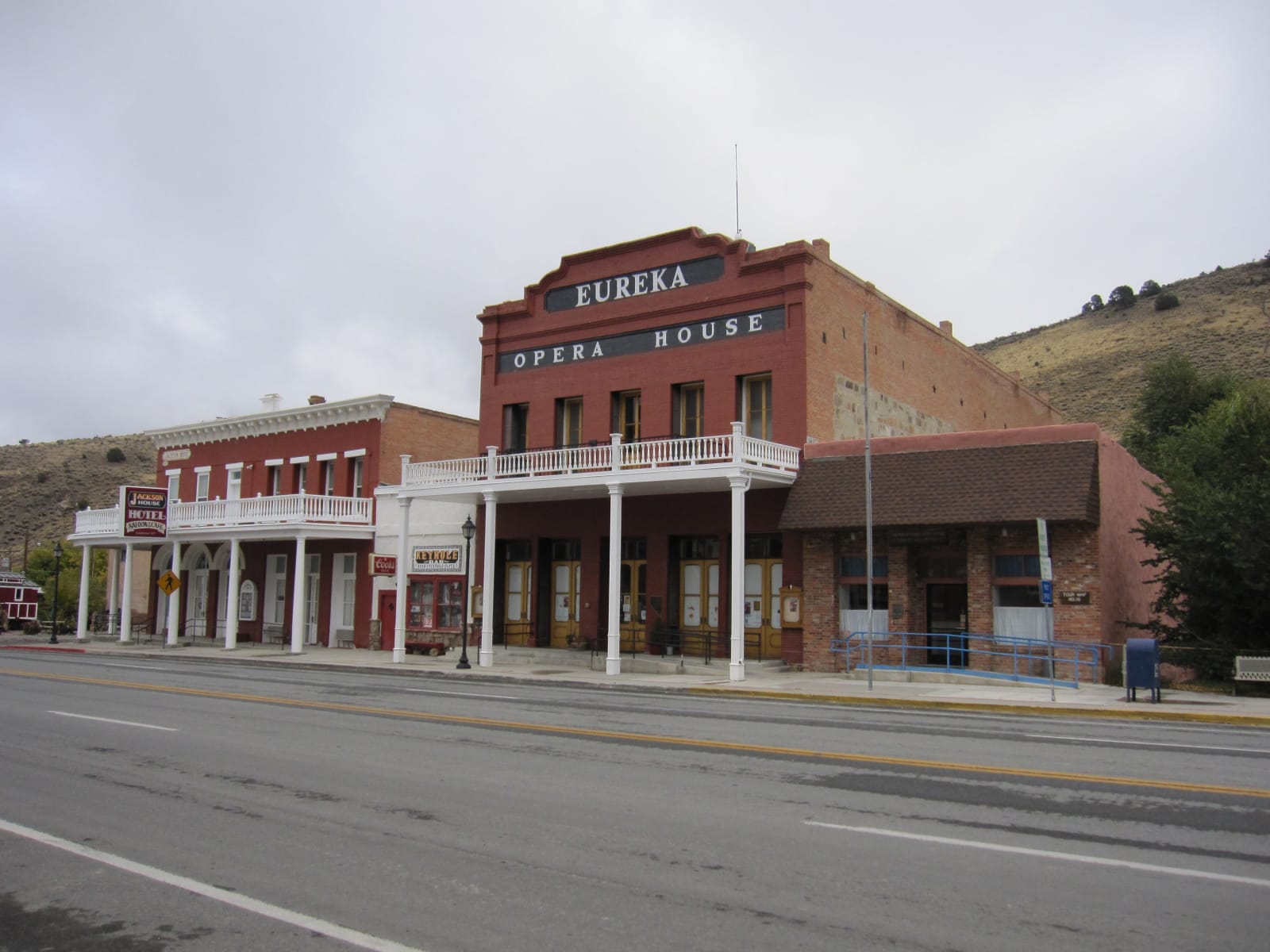
The crown of it is the Eureka Opera House, put up in 1880 on the ashes of a hall the fire had taken and opened with a costume ball as the year turned to 1881. Restored to its full Victorian glory in 1993, it still hosts events under its painted curtain and remains the heart of the town. A few doors away, the red-brick county courthouse from 1879 is one of only two nineteenth-century courthouses in Nevada still housing a working county government, its pressed-tin ceilings and wood trim intact. Behind it, the old Eureka Sentinel building — home to a newspaper that began in 1870 — is now a museum with its original press room frozen in place, and across from the opera house the Victorian Jackson House Hotel still keeps a bar.
The boom wound down the way they all did. Silver prices sagged, water flooded the deeper workings, the richest ore gave out around 1885, and the great smelters fell silent by 1891; the narrow-gauge Eureka and Palisade railroad that had tied the town to the world hung on until 1938. But Eureka had two things the pure ghost towns lacked — the county seat, which kept the courthouse lit, and a county floored with gold. Modern open-pit mines among the largest in the world work the ground nearby, and the town still breathes in time with them, swelling when they hire and settling when they slow.
For travelers it is the most rewarding stop on the road. Start at the information kiosk on Main Street, then walk the few blocks past the opera house, the courthouse, the Sentinel museum, and the iron-shuttered storefronts — an unusually complete Victorian downtown you can take in on foot in an afternoon. There are motels, gas, and places to eat, which matters on a road where the next town is seventy miles off in either direction. Eureka is the loneliest road at its most settled: a real Main Street, a working opera house, and a town that, against considerable odds, decided to stay.
Visitor Info
On the Map
A story featuring this place
Go deeper into the history and character of this stop
Nearby
The closest stops worth working into your route
Historical markers nearby
Roadside plaques and monuments within a short detour