 Clyde Charles Brown / CC BY-SA 4.0
The Story
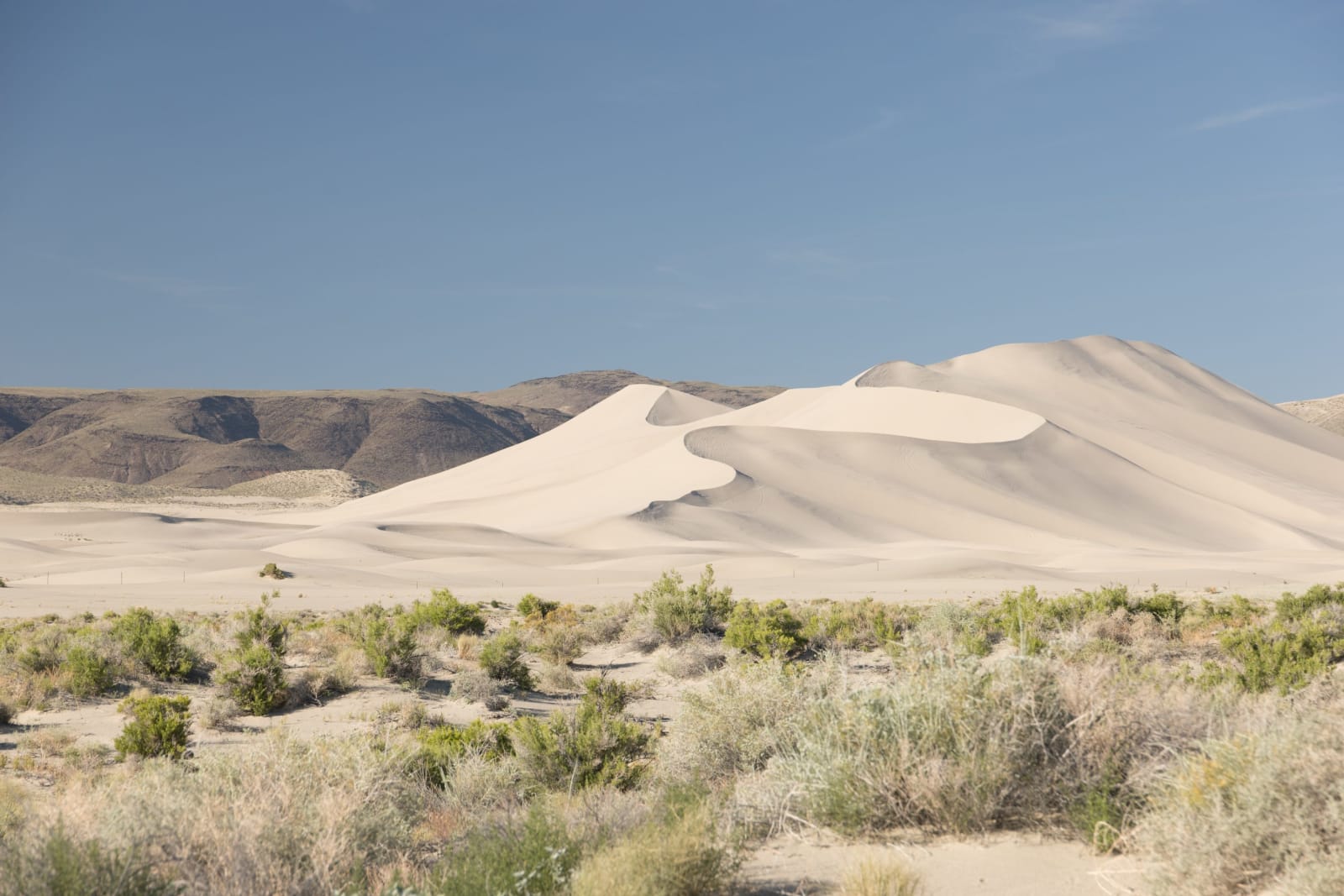
You see it long before you reach it: a pale mountain of sand standing alone in the Salt Wells basin, out of scale with everything around it, as if a piece of the Sahara had been set down in the middle of Nevada. This is Sand Mountain, six hundred feet high and two miles long, the largest single dune in the Great Basin. The Northern Paiute know it as Kwazi — the snake that lives in the dune, its backbone forming the long crest of the mountain — and the place is sacred to the Fallon Paiute-Shoshone, whose ancestors watched it grow. It rises about twenty-five miles east of Fallon, close enough to the highway that you can pull off, walk to its base, and feel how strange it is to stand at the foot of a moving mountain.
The sand is older than the dune. When ancient Lake Lahontan dried down some nine thousand years ago, it left a vast flat of fine pale sediment across this country, and the prevailing west wind has been at work on it ever since — lifting the old lakebed grain by grain and carrying it east until the rising wall of the Stillwater Range stops the wind and drops its load. Sand Mountain is what has piled up there over the millennia: an entire ancient beach, gathered into one slow-walking hill. It shifts and reshapes constantly, its crest and slip faces redrawn by every strong wind, never quite the same dune twice.
And on a quiet day it sings. Sand Mountain is one of only a handful of booming dunes in North America — dunes whose sand, under the right dryness and grain size, vibrates as it avalanches down the steep face and lets out a deep, droning boom you feel as much as hear. It can reach a hundred and five decibels and roll on for the better part of a minute, an eerie sound with no obvious source. The catch is silence: the boom carries only when nothing else does, which on most weekends is never, because Sand Mountain has a louder life.
For most of its visitors the dune is not a wonder but a playground. Sand Mountain is one of the busiest off-highway-vehicle sites in Nevada, drawing fifty to seventy thousand riders a year who climb it on dune buggies, quads, dirt bikes, and sand rails, orange whip flags snapping above them, the slopes crawling with machines that look from a distance like ants on a sugar pile. On a holiday weekend the engines run day and night and the booming dune never gets a word in. It is genuinely a lot of fun to watch, and a long way from quiet — worth knowing before you arrive expecting solitude.
For all the engine noise, the dune is also the entire world for one small creature. The Sand Mountain blue butterfly lives here and nowhere else on earth, a thumbnail-sized blue that depends completely on the Kearney buckwheat scattered across the dune's flanks. It is critically imperiled, and the buckwheat is fragile, so the Bureau of Land Management, which runs the area, has had to thread a hard needle — laying out twenty-three miles of designated trails in 2008 and closing the rest, refereeing among the riders, the butterfly, and the tribe that holds the dune sacred. Watch for the blues in early summer near the buckwheat; there is nowhere else on the planet to see them.
Less than a mile from the base lie the low stone walls of the Sand Springs Pony Express Station, and they carry more history than the whole rest of the basin. The overland road through here was surveyed in 1859, and in 1860 the Pony Express strung its relay stations along it, this one beside a brackish spring at the dune's foot. The English explorer Richard Burton stopped here that year and found it a vile hole — the water foul with salts, the station roofless and squalid, the keepers as rough as the country. The Pony Express lasted barely eighteen months; the station was abandoned, swallowed by the advancing dune, and forgotten until archaeologists dug it back out in 1976. It joined the National Register in 1980, and a short loop through the Sand Springs Desert Study Area now lets you walk the ruins the dune gave back.
You don't need a machine to make the stop worthwhile. A paved road runs off US-50 to the dune's base, and anyone can walk out onto the sand — best in the cool of evening, when the heat lets up and the light goes gold — or follow the half-mile Sand Springs loop through the ruins. Bring your own water; there is none on site, and the sand throws the heat back at you. If you catch the dune on a windless weekday with the engines stilled, climb partway up and listen. The loneliest road runs right past Sand Mountain, and here, in a single pull-off, it hands you both the deep past and a booming, improbable present.
Visitor Info
On the Map
Stories featuring this place
Go deeper into the history and character of this stop
Nearby
The closest stops worth working into your route
Historical markers nearby
Roadside plaques and monuments within a short detour