 MPSharwood / CC BY-SA 4.0
The Story
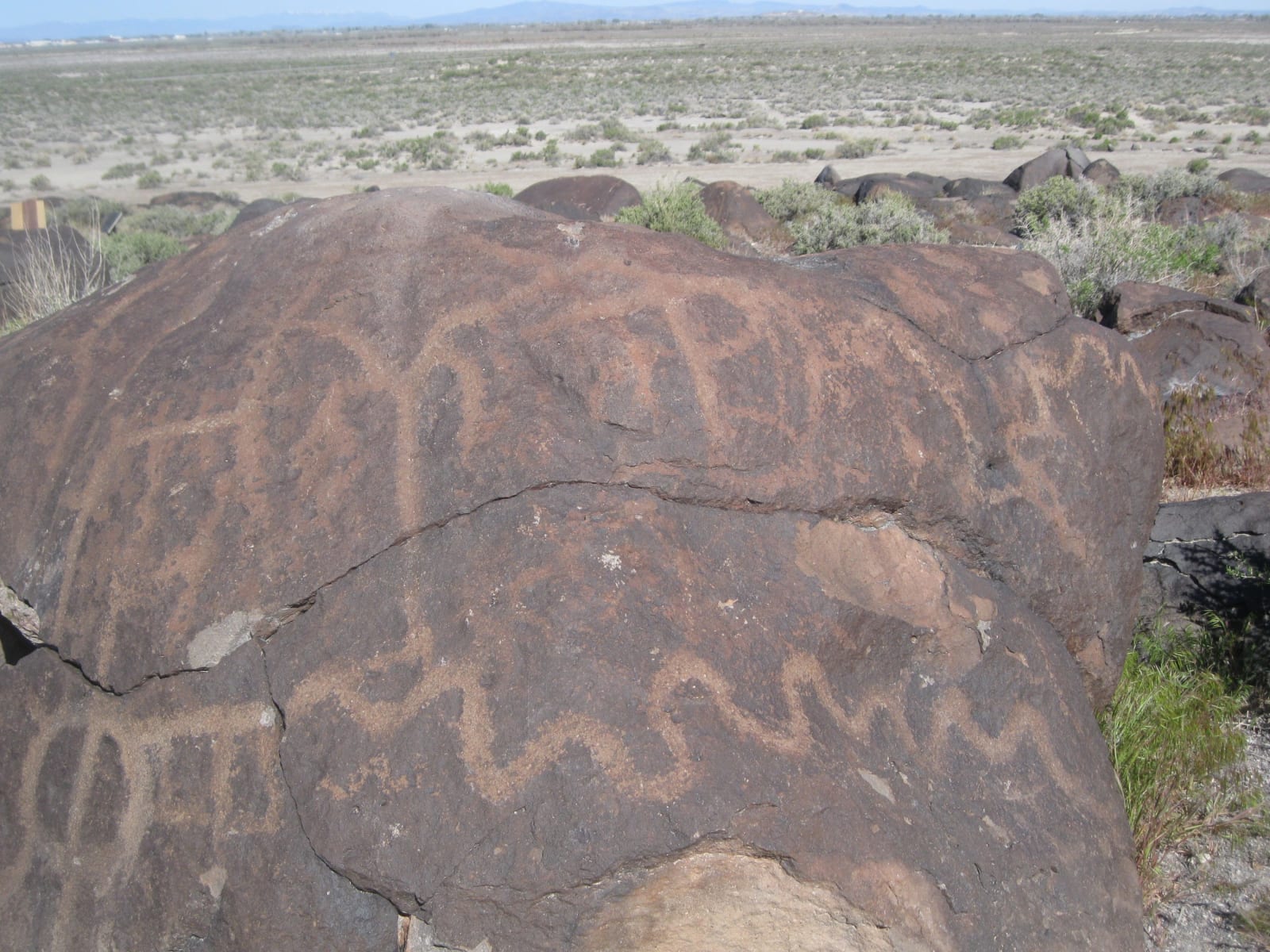
Ten miles east of Fallon, where US-50 leaves the last farms and starts across open desert, a low basalt ridge is scattered with hundreds of dark boulders, and almost every one of them is carved. This is Grimes Point, one of the largest and most accessible concentrations of rock art in the Great Basin — the work of people who have lived in this country for thousands of years, ancestors of the Fallon Paiute-Shoshone, the Numu band known as the Toidikadi, the Cattail-Eaters of the Carson Sink. They began marking these stones perhaps eight thousand years ago, and some of the carvings may be older still. You can walk among them on a loop trail barely a third of a mile long, which is a strange and humbling thing to do — to stand close enough to touch work that predates the pyramids, out in the open beside a federal highway.
To understand why the carvings are here, you have to drain the desert and refill it. Through the last ice age this whole basin lay under Lake Lahontan, an inland sea that at its height covered much of northwestern Nevada; Grimes Point sat on its shoreline, and the flat ground below the boulders was open water. As the climate dried over the last ten thousand years the lake shrank and swelled and finally pulled back for good, leaving marshland thick with tule and waterfowl and game coming down to drink — everything a people needed, gathered at one edge. The old shoreline is still legible as a faint bench cut into the hills, a high-water mark left by a lake that has been gone for millennia.
The boulders themselves are basalt, blackened over ages by desert varnish — a glossy patina of manganese and iron that arid country lays down grain by grain. The petroglyphs were made by pecking and scraping through that dark skin to the lighter rock beneath, and their age shows in the varnish itself: on the oldest, the dark coating has crept back over the carved lines, slowly re-darkening what was once bright. There are circles and grids, wandering lines, bighorn sheep and human figures and shapes that match nothing in the visible world, hundreds of them crowded along the short trail. On a flat midday they hide in plain sight; in the low light of morning or evening they leap off the stone.
What they mean is the honest mystery of the place. For a long time the favored explanation was hunting magic — the idea that the boulders were blinds where hunters waited for game at the water's edge, and the carvings ritual marks made to bring the hunt luck. It is a tidy story, and archaeologists today hold it more loosely than they once did; the truth is that the meaning of most Great Basin rock art is simply not known, and the people who could read it left no key. That uncertainty is worth sitting with rather than explaining away. These are not decorations. They are a language carved in stone, and we are looking at it without being able to read it.
A mile and a half up the road is the area's other secret, Hidden Cave — not a dwelling but a pantry. Around four thousand years ago the ancestral people used this hard-to-find chamber as a cache, digging pits in its floor to store baskets, tools, and stone points against leaner seasons, then leaving them sealed and forgotten. The cave was cut by Lake Lahontan's waves some twenty thousand years ago and rediscovered in the 1920s by four boys poking around the hills; three rounds of excavation, the last by the American Museum of Natural History around 1980, pulled out artifacts so well preserved precisely because they had been stored, not used and thrown away. Because the cave is fragile and kept locked, you can see inside only on a guided tour — run on the second and fourth Saturdays out of the Churchill County Museum in Fallon, and worth planning around.
It would be easy to file all of this under the distant past, and wrong to. The descendants of the people who carved these stones live a few miles away and still hold this ground sacred; the petroglyphs are protected by law and by their care — not relics so much as inheritance. So the rules at Grimes Point are simple, and they matter: stay on the trail, photograph all you like, and touch nothing — no chalking, no rubbings, no finger traced along a line that has lasted eight thousand years. The oils from a single hand can undo what the desert spent millennia preserving.
For all its depth, Grimes Point asks very little of a traveler — a paved pullout, restrooms, a kiosk, and a flat walk you can finish in half an hour, though the good carvings reward going slow. Come early or late for the light, bring water, and don't be surprised when fighter jets from the naval air station at Fallon tear across the sky overhead, a thirty-second collision of the very old and the very new. If you are driving the loneliest road from the west, this is the first place it quietly disproves its name: ten miles out of Fallon, and already eight thousand years deep.
Visitor Info
On the Map
Stories featuring this place
Go deeper into the history and character of this stop
Nearby
The closest stops worth working into your route
Historical markers nearby
Roadside plaques and monuments within a short detour