The signs at either end of it call U.S. 50 across Nevada the loneliest road in America, and for four hundred miles of sagebrush and silence the name feels earned. But ten miles east of Fallon, in a dry cave above the old shore of a vanished lake, a man was laid to rest more than ten thousand six hundred years ago — the oldest human being ever found in North America. He is the reason the loneliest road is better understood as the oldest, and the reason a small Nevada tribe spent the better part of a century trying to undo what was done to him.
The man in the cave
He was found in 1940 by Sydney and Georgia Wheeler, a husband-and-wife survey team working ahead of a guano-mining operation for the state. In a small chamber the desert air had kept bone-dry, they uncovered a man of about forty, wrapped in a rabbit-skin blanket and woven tule matting, moccasins still on his feet — laid in his grave with obvious care, and preserved by the cave so completely that skin and hair remained. The Wheelers judged him fifteen hundred years old, catalogued him, and moved him to a museum drawer in Carson City, where he lay for half a century. Then, in the 1990s, his was among the first skeletons ever dated by a new accelerator method, and the number came back staggering: not fifteen hundred years but more than ten thousand six hundred. He had been buried on this ground millennia before the first farmers anywhere, six thousand years before the earliest pyramid. Science called him the oldest natural mummy in North America. To the people whose country this is, he was never a mummy. He was a relative, and he was missing.
What the tribe always said
The Fallon Paiute-Shoshone — the Toidikadi, the Cattail-Eaters of the Carson Sink — had never wondered whose he was. In 1997, under the Native American Graves Protection and Repatriation Act — the 1990 law Congress passed after museums and agencies were found holding the remains of tens of thousands of Native people in drawers and crates — they asked for their ancestor back. The government refused. The remains, the Bureau of Land Management ruled, could not be shown to be "culturally affiliated" with any living tribe; ten thousand years was too wide a gap to prove a link. Some scientists pressed the point further, arguing from the shape of his skull that he belonged to a lost, non-Native people who had reached the continent before Native Americans — the same claim being made in those same years about Kennewick Man far to the north, and the same old idea in newer clothes: that the first Americans must have been somebody other than the people found living here. The tribe sued. In 2006 a federal judge found the government had brushed their evidence aside without explanation and sent the case back for another look. And there it stalled, year after year — the ancestor in his drawer, the question left open, a grandfather no one would let them bury.
The proof they should not have needed
The break came in 2015, and it came on the tribe's own terms. Their history with scientists had been, by their own account, mostly a bad one — their ancestor measured and stored over their objections for decades — yet they judged this one willing to listen. They agreed to let a geneticist from Copenhagen, Eske Willerslev, read the DNA still held in the ancestor's remains — but only under a written understanding: if the genome showed he was Native American, he would come home. It did. His DNA proved closer to living Native Americans, from Alaska to Patagonia, than to any other people on earth, and the "lost Paleoamerican" theory fell apart. The result, the tribe said, only confirmed "what we have always known from our oral tradition" — that the man taken from Spirit Cave was their ancestor. He was returned in 2016 and, two years later, reburied in a place the tribe keeps secret, so that no one can take him a second time. It should not have required a sequenced genome to believe them; they had been saying it for a hundred years. But the science, at last, said what they had always said, and he went back into the ground.
The oldest road
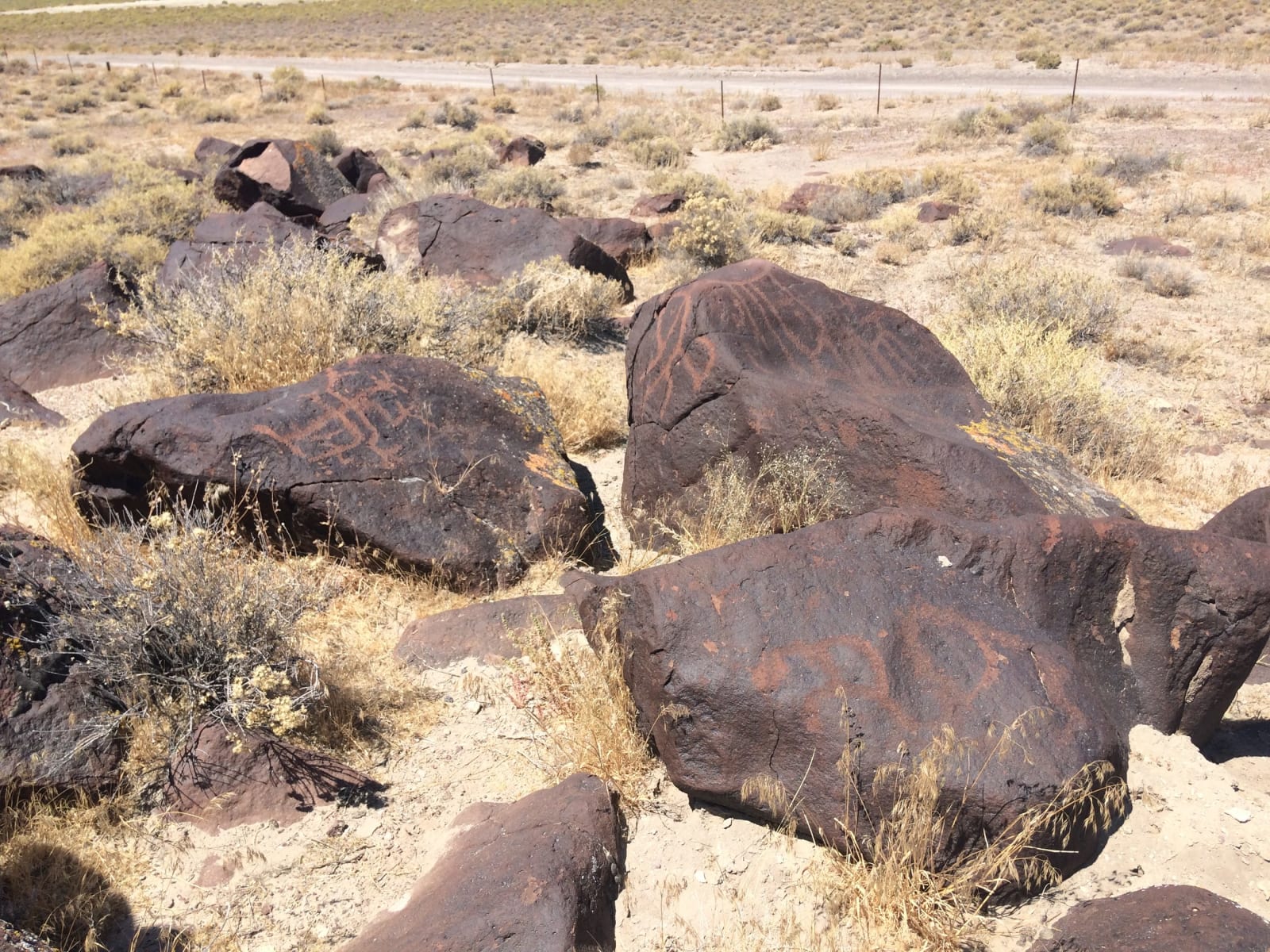
Stand at Grimes Point, ten miles east of Fallon, where hundreds of boulders wear carvings eight thousand years old, and the ancestor of Spirit Cave stops seeming like an exception. This basin was once the floor and shoreline of Lake Lahontan, an inland sea, and people have lived along it for more than ten thousand years — pecking the rock here and at Hickison up the grade, caching food in its hidden caves, laying their dead in its dry hollows. The Pony Express riders and stage drivers and Lincoln Highway motorists who gave U.S. 50 its history were the newest arrivals on a road already ancient when they came. You cannot visit Spirit Cave, and should not want to; the man who was laid there is back in the earth where he belongs. But the country that held him runs right along the highway, and it has never once been lonely. It has only, for ten thousand years, looked empty to the people driving through.