The Story
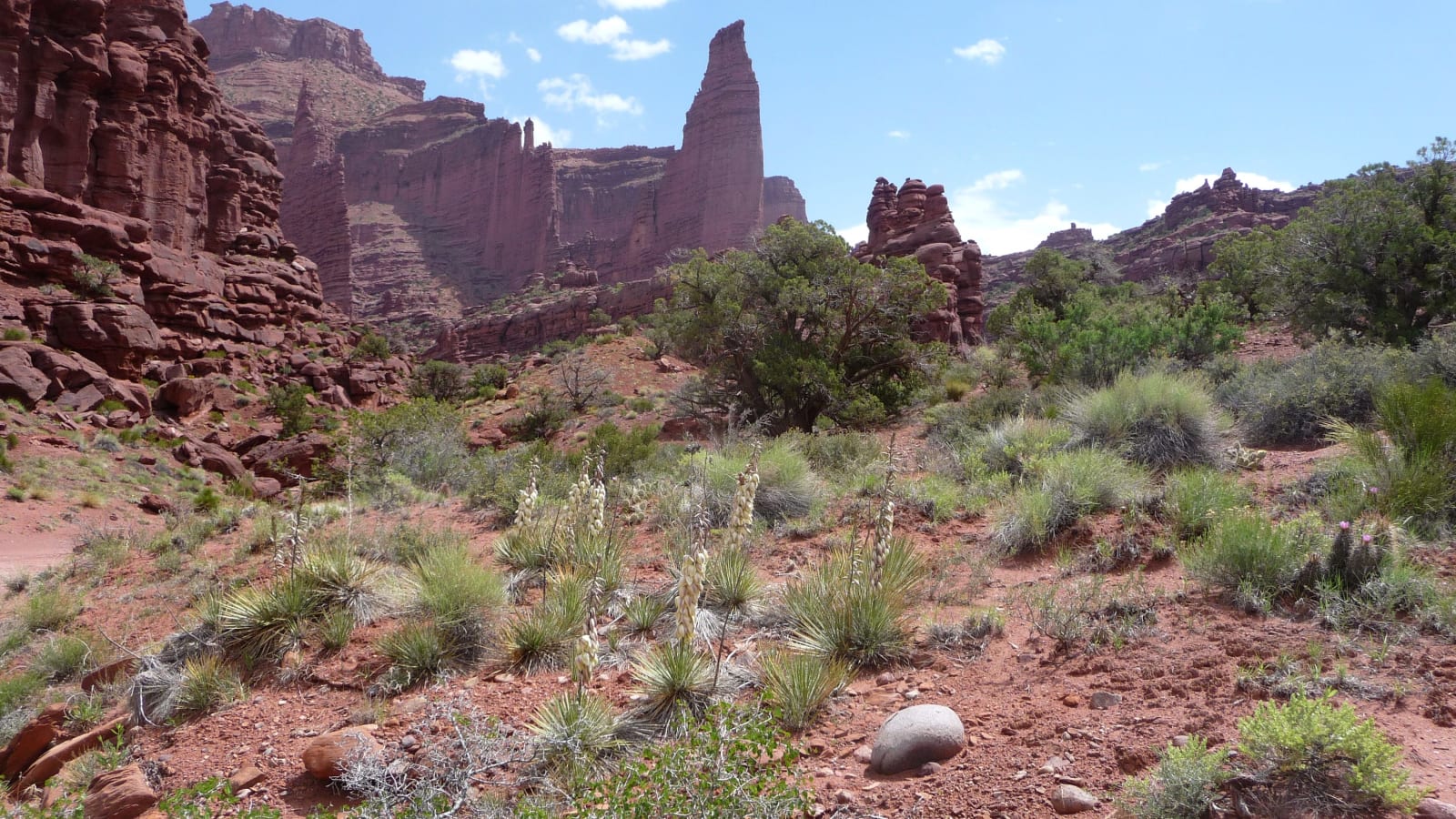
Fisher Towers look like they were built by a sculptor who ran out of time before smoothing the edges. Dark red pinnacles of Cutler sandstone rise 900 feet from the desert floor northeast of Moab, their surfaces cracked, fluted, and eroded into shapes that seem to be melting in slow motion. The tallest tower, Titan, stands 900 feet — taller than any building in Utah — and its dark red walls are capped with a layer of harder Moenkopi sandstone that gives it a distinctive flat-topped profile, like a mushroom designed by a geologist with a flair for the dramatic.
The towers are composed of Permian-age Cutler Formation sandstone and mudstone, deposited roughly 275 million years ago by rivers flowing off the Uncompahgre Uplift — an ancient mountain range that once stood where the Colorado-Utah border is today. The Cutler Formation is softer and more crumbly than the Entrada and Navajo sandstones that form most of Utah's famous arches and cliffs, which gives Fisher Towers their distinctive texture. The rock looks almost organic — pocked, ridged, and furrowed like the bark of an ancient tree — and pieces of it flake and crumble constantly. The towers are eroding in real time, and their current forms are temporary snapshots in a process that will eventually reduce them to rubble.
The Fisher Towers Trail is a 4.4-mile out-and-back hike that winds through the base of the formation, passing between and around the towers with constantly changing perspectives. The trail is not technically difficult — no scrambling or exposure — but it traverses uneven terrain of slickrock, loose sand, and narrow ledges that keep you engaged for the full distance. The payoff views come steadily throughout the hike, not just at the end, and each bend in the trail reveals a new angle on the towers that makes them look like completely different formations.
The trail ends at a viewpoint overlooking Onion Creek and the Fisher Valley, with the La Sal Mountains rising in the background. The contrast between the dark red towers in the foreground and the snow-capped peaks behind them is one of the most photographed compositions in the Moab area, and it captures something essential about this part of Utah — the collision of desert and mountain, red rock and white snow, ancient seafloor and young volcanic peaks.
Rock climbing on Fisher Towers is legendary and terrifying in equal measure. The soft, crumbly Cutler sandstone makes for notoriously unreliable protection — cracks that look solid can pull apart under a climber's weight, and the rock surface sheds flakes and chunks with alarming regularity. Despite this, or perhaps because of it, the towers have attracted elite climbers for decades. The first ascent of Titan was completed in 1962 by a team that spent multiple days on the wall, and modern climbers still consider it one of the most committing routes in the desert Southwest. The climbing here is not about gymnastic difficulty — it is about commitment, judgment, and comfort with uncertainty.
The towers gained wider fame in 1964 when a car commercial filmed a Pontiac being lowered by helicopter onto the summit of one of the shorter towers, creating an image so absurd and so perfectly American that it became an instant icon. The flat-topped Moenkopi cap that made the stunt possible is the same geological feature that protects the towers from eroding even faster — a hard hat of stone sheltering the softer layers beneath.
Fisher Towers is managed by the Bureau of Land Management and has a small, first-come-first-served campground at the trailhead with a handful of sites perched on the edge of a cliff overlooking the towers. Camping here at sunset, watching the towers turn from rust to crimson to black silhouette against a fading sky, is one of the finest free camping experiences in the Moab area. The campground fills up on spring and fall weekends, so arriving early is advisable.
The towers sit about 21 miles northeast of Moab along Highway 128, the Colorado River Road, which is itself one of the most scenic drives in the state. The combination of the river road drive and the Fisher Towers hike makes for a half-day excursion that rivals anything in the nearby national parks, without the entrance fees, timed reservations, or crowds. Fisher Towers is the kind of place that reminds you why public land matters — a world-class geological formation on an open desert hillside, free to visit, free to photograph, free to stand beneath and feel the weight of 900 feet of ancient stone towering above you.
Visitor Info
On the Map
A story featuring this place
Go deeper into the history and character of this stop
Nearby
The closest stops worth working into your route
Historical markers nearby
Roadside plaques and monuments within a short detour