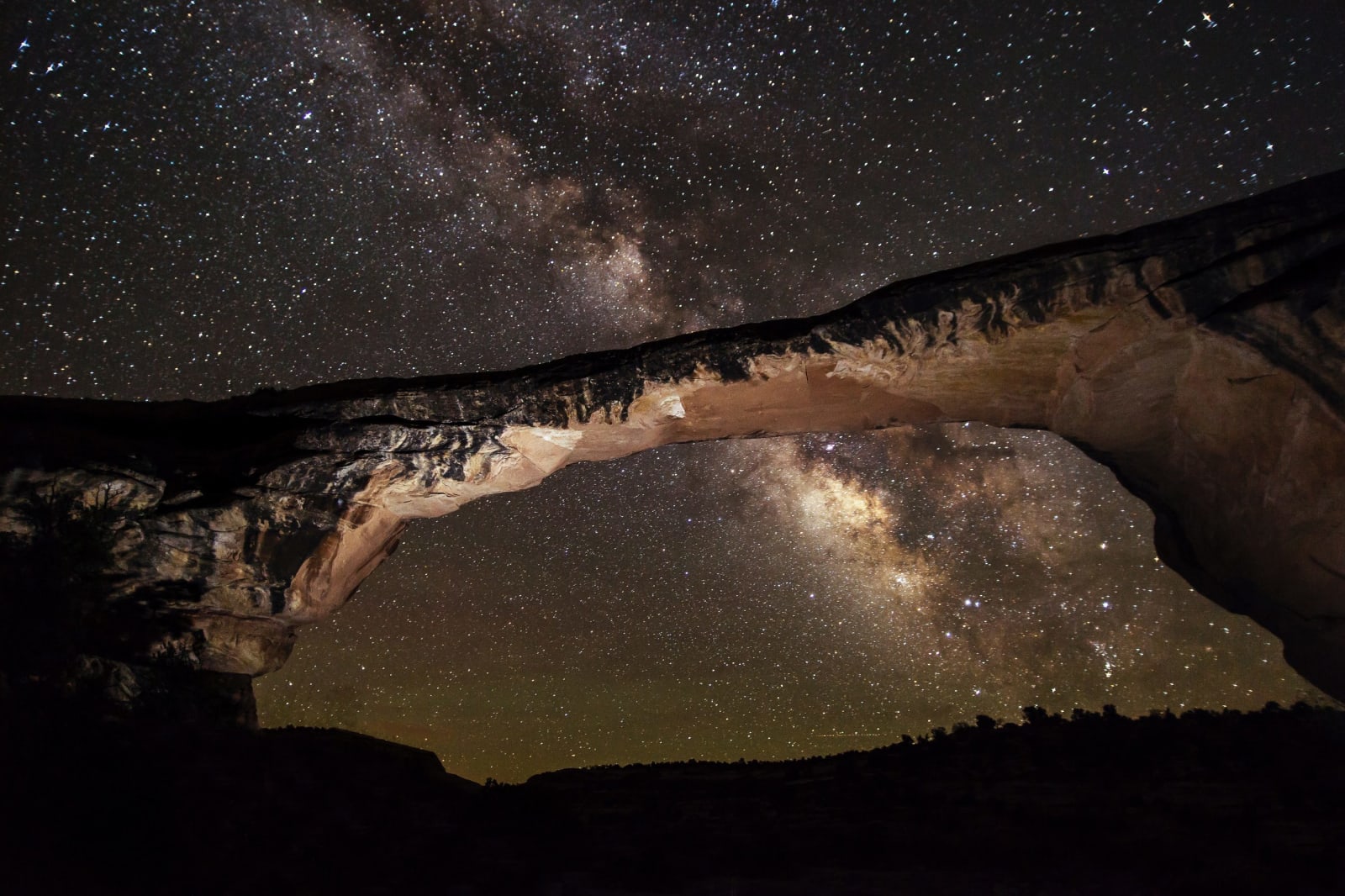
More than a third of humanity, and nearly eight in ten North Americans, can no longer see the Milky Way from where they sleep. The galaxy has not moved — the light beneath it has. But one corner of the country still holds the old sky whole: the high, dry, thinly settled quarter where the Colorado Plateau meets the Great Basin, one of the last great reservoirs of natural darkness in the lower forty-eight. Out here the Milky Way still throws a faint shadow, and the people who noticed set about keeping it that way.
The movement started with a town. Flagstaff passed the world's first outdoor-lighting ordinance in 1958 and became, in 2001, the first International Dark Sky City — its streetlights capped so the stars that let Lowell Observatory find Pluto still carry overhead. Six years later a remote monument in southern Utah was certified the world's first International Dark Sky Park, for a sky measured darker than any other in the national park system. Between those two poles sits one of the densest concentrations of protected night sky anywhere.
This was never empty ground. These are the homelands of the Newe, Nuwuvi, Numu, Diné, Hopi, and Havasupai, among others, who read these skies for navigation, ceremony, and story for thousands of years before the first ordinance — the largest span at Natural Bridges still carries the Hopi name Sipapu, the passage between worlds.
The trail runs the arc from the town that learned to dim its lights to the monument that measured the dark, through the parks that now hold star parties where they once held only silence. Come for the canyons. Stay for the night.
The stops
In order along the arc — not one road, but one story told thirteen ways.
Where the movement began. Flagstaff wrote the world's first outdoor-lighting law in 1958 to protect the sky that let Lowell Observatory find Pluto, and in 2001 became the first International Dark Sky City. The idea that darkness is worth saving started here.
Visit Flagstaff →A certified International Dark Sky Park since 2019, where the mile-deep view people come for by day is matched overhead at night. Each June the South Rim fills with the volunteer telescopes of the Grand Canyon Star Party, aimed out over the dark.
Visit Grand Canyon (South Rim) →The darkest reward at the end of the loneliest road. Great Basin built the first research observatory inside any national park and holds an astronomy festival each fall, under a sky so black the Milky Way throws a shadow off Wheeler Peak.
Visit Great Basin National Park →USA Today called it the best stargazing spot in America, and the old silver town leaned all the way in — a dedicated Stargazing Park on the hill, and a sky halfway between Reno and Las Vegas dark enough to plan a trip around.
Visit Tonopah →Ninety-eight empty miles along the edge of Area 51, under some of the blackest skies in the country. The same darkness that shields a secret base throws an unreal amount of starlight — out here the night is dark enough to believe almost anything.
Visit Extraterrestrial Highway →A gentle counterweight to the ghost-town glare. Far from any town, the pale clay spires hold the last light long after sunset, then stand under a genuinely black eastern-Nevada sky — a small park made for staying the night rather than rushing through.
Visit Cathedral Gorge State Park →The highest dark sky on the trail — a ten-thousand-foot amphitheater where the thin air strips the last haze from the stars. Astronomy festivals draw telescopes to the rim, and the Milky Way comes up not as a smudge but as structure.
Visit Cedar Breaks National Monument →The gateway sky. On a clear, moonless night Bryce shows roughly 7,500 stars to the naked eye — against fewer than 500 from a city — and its ranger astronomy programs are where countless travelers meet a true dark sky for the first time.
Visit Bryce Canyon National Park →The quiet one. A certified Dark Sky Park where the Milky Way is bright enough to read by and the silence runs as deep as the dark, in a park that feels far more remote than the map admits.
Visit Capitol Reef National Park →An alien landscape under an alien-bright sky. The mushroom rock of this Mars analog sits in one of the least light-polluted corners of the state, where the Milky Way arcs straight overhead and the campground silence is loud enough to hear.
Visit Goblin Valley State Park →Stars over a two-thousand-foot drop. A certified Dark Sky Park perched on a mesa above a gooseneck of the Colorado, holding the dark against Moab's growing glow — the canyon a black silhouette, the sky ablaze above it.
Visit Dead Horse Point State Park →The barest dark camp on the trail — a railing, a few flat sites, and a thousand-foot canyon of the San Juan below. No visitor center, no lights, nothing between you and the stars but the rim you pitch a tent on.
Visit Goosenecks State Park →The finale, and the first of them all. In 2007 Natural Bridges became the world's first International Dark Sky Park, its sky the darkest ever measured in the system — the Milky Way casting shadows through Sipapu, a stone span named in Hopi for the passage between worlds.
Visit Natural Bridges National Monument →