 Dietmar Rabich / CC BY-SA 4.0 via Wikimedia Commons
The Story
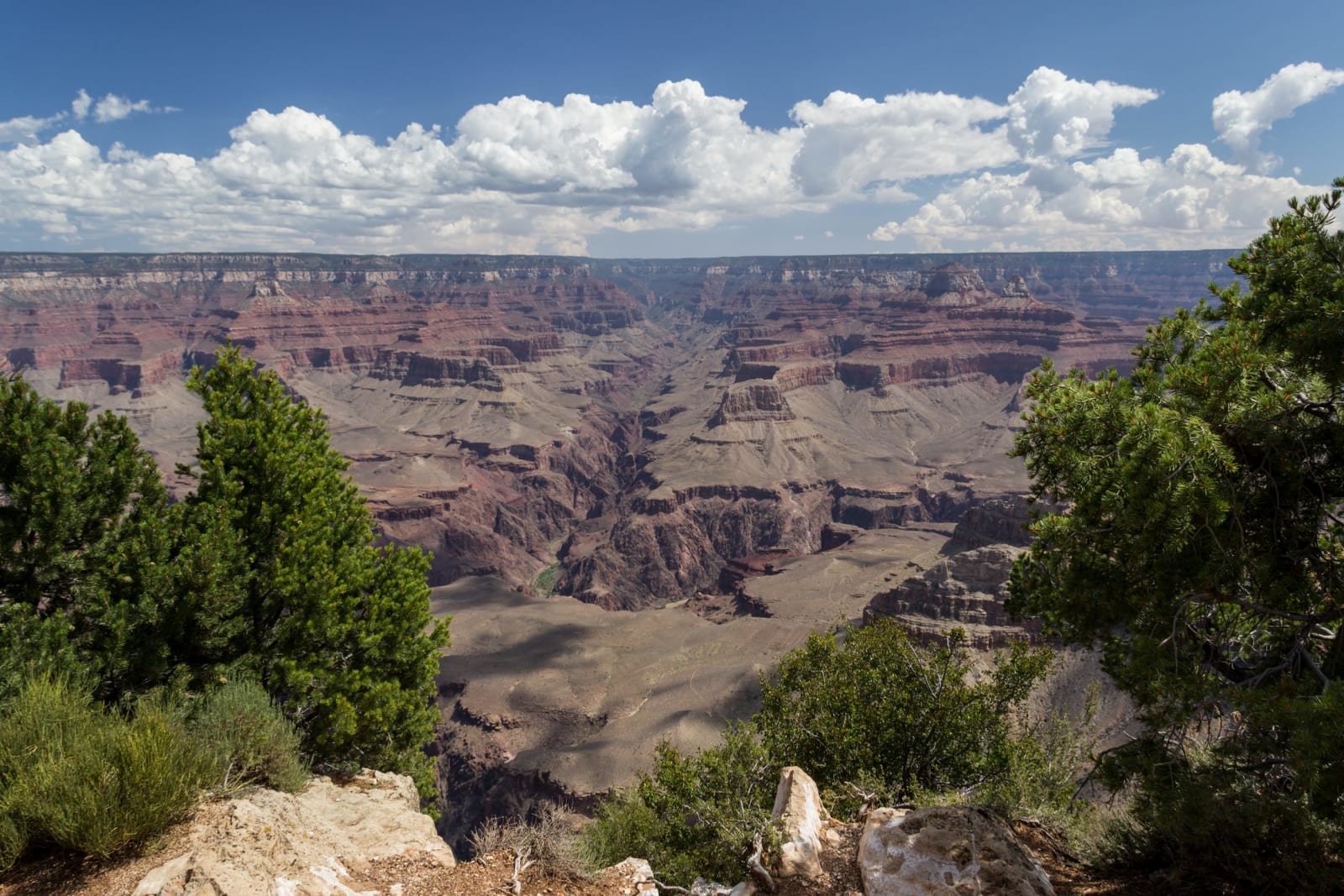
The Grand Canyon is the kind of place that defeats its own adjectives — a mile deep, up to eighteen miles across, two hundred and seventy-seven river miles long, with the Colorado still working at the bottom of it. What makes it more than a big hole is the rock: the walls expose most of the planet's history in order, from the roughly two-billion-year-old Vishnu Schist at the river to the 270-million-year-old Kaibab Limestone you stand on at the rim, with the Great Unconformity in between — a single surface where more than a billion years of missing time simply isn't there. The river carved almost all of this in the last five or six million years, which is to say yesterday.
It was never empty ground. Eleven tribes hold ancestral ties to the canyon, and it runs through their origins — the Hopi trace their emergence into this world to a place within it. The Havasupai, the "people of the blue-green water," still live down in a side canyon at Supai, the most remote community in the lower forty-eight; when the national park was drawn, most of their homeland was taken, and their long fight to reclaim it produced one of the landmark Native land returns in American law — roughly 185,000 acres restored by act of Congress in 1975.
Most visitors meet all of this from the South Rim, at around seven thousand feet, where the historic village, the old El Tovar hotel, and the trailheads down Bright Angel and South Kaibab cluster along the edge. The park was established in 1919, and it draws millions a year to a handful of overlooks, most of whom never step below the rim. The canyon rewards the ones who do — but even from the top at sunrise, watching the light pour down through two billion years of rock, it earns every word it defeats. Flagstaff is the nearest city, ninety minutes south; Williams, to the southwest, still runs the train to the rim.
Visitor Info
On the Map
Stories featuring this place
Go deeper into the history and character of this stop
Nearby
The closest stops worth working into your route
Historical markers nearby
Roadside plaques and monuments within a short detour