 Doc Searls / CC BY 2.0
The Story
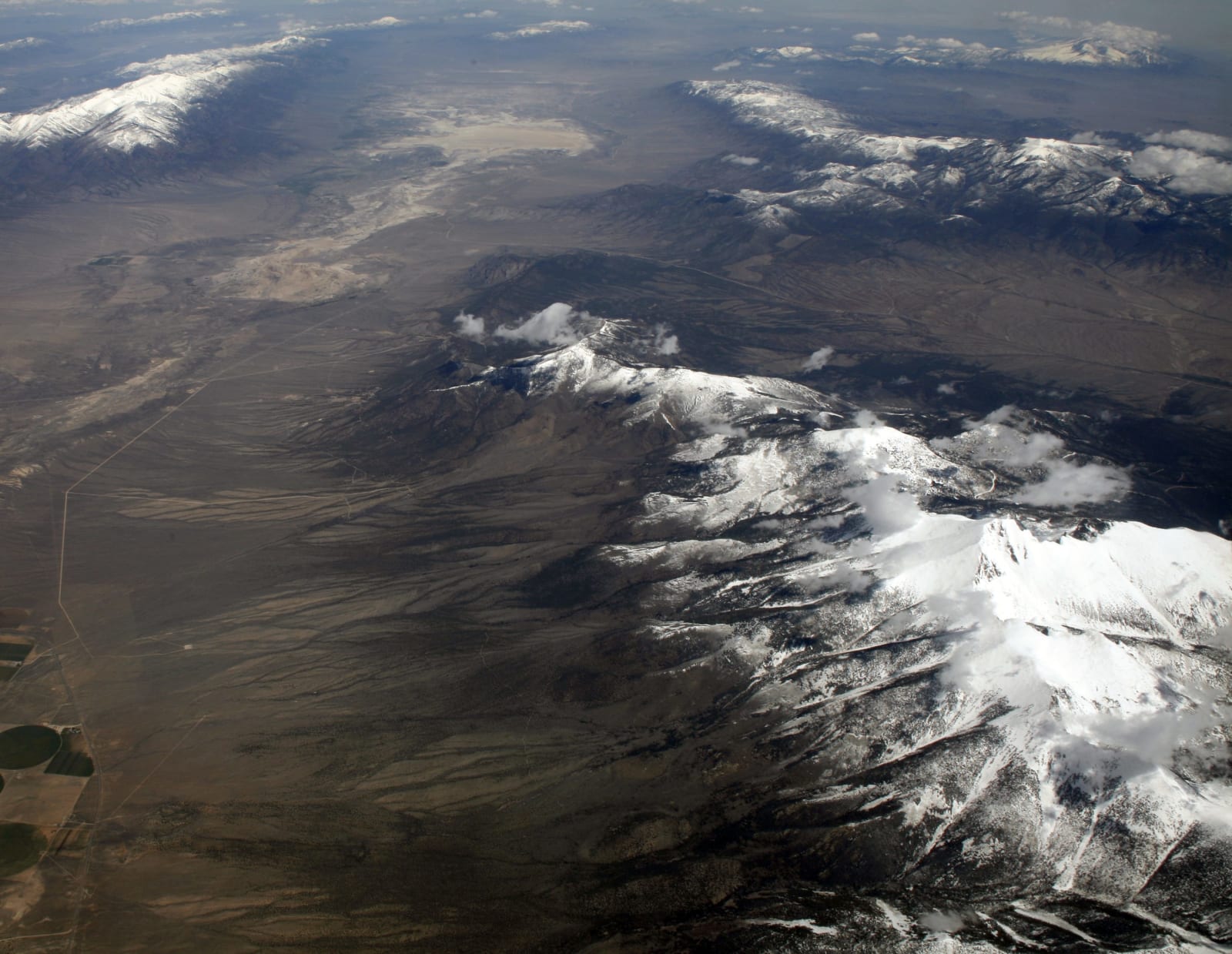
The reward for driving the loneliest road in America sits at its far end, five miles up a side road from the desert town of Baker and almost on the Utah line: Great Basin National Park, the only national park in Nevada and one of the least visited in the country, with around a hundred and forty thousand people a year — a rounding error next to Yellowstone. What they come for is improbable. Out of a sea of sagebrush rises the South Snake Range, an island of rock and alpine forest topped by 13,063-foot Wheeler Peak, and the park stacks its three headline wonders one above the other: a marble cavern in the foothills, a grove of the oldest trees on earth near the treeline, and overhead some of the darkest skies left in America.
The park is built on elevation. In a dozen miles the land climbs from high desert near six thousand feet to the bare alpine zone above ten thousand, passing through piñon and juniper, then aspen and fir, then twisted timberline pine — a stack of climate zones you would otherwise have to drive from Nevada to Canada to see. Wheeler Peak anchors it, at 13,063 feet the highest mountain that lies entirely within Nevada, and in a north-facing cirque just below the summit huddles a small rock glacier, the only thing resembling a glacier left in the state. The paved Wheeler Peak Scenic Drive does the climbing for you, gaining some four thousand feet in twelve miles to a trailhead near ten thousand, though it closes when the snow comes, usually from November into late spring.
Underneath all of it runs Lehman Caves — not a system of caverns, despite the plural, but a single richly decorated marble chamber about two miles long, the longest cave in Nevada. It holds the usual stalactites and stalagmites and something far rarer: more than three hundred shield formations, thin paired discs of calcite that grow out of the rock at odd angles, which almost no other cave on earth has in such number. Indigenous people knew the cave for generations; the settler history begins in 1885, when a rancher named Absalom Lehman started leading visitors in by lantern. It was protected as a national monument in 1922 and folded into the park in 1986. You can enter only on a ranger-led tour, in a steady fifty degrees year-round, and tours fill — reserve ahead.
Higher up grow the trees that make the park famous among people who care about such things. Great Basin bristlecone pines are the oldest individual living organisms known — not the biggest or the tallest, but the most patient, growing so slowly in the cold thin air that their wood turns dense as stone and resists rot for millennia. Many on these slopes are past four thousand years old. The most famous of them is gone: in 1964 a graduate student studying ice-age climate took a coring tool to a bristlecone here, then got permission to cut it down, and counted nearly five thousand rings — realizing too late that he had felled the oldest known living thing on the planet. The tree was nicknamed Prometheus, and its stump still stands near the treeline, a quiet monument to a spectacular mistake. The grove around it survives, reachable on a short walk that may be the most humbling two miles in Nevada.
When the sun goes down the park keeps going. Great Basin sits far from any city, high and dry, and its night skies are among the darkest in the lower forty-eight — dark enough that the Milky Way throws shadows and the rangers like to say half the park is after dark. It was named an International Dark Sky Park in 2016, the same year a small research observatory, the first inside any national park, was built here; an astronomy festival each autumn draws stargazers out to the valley with their telescopes. On a clear, moonless night the sky over Wheeler Peak is a genuine reason to time a visit.
People have read meaning into this country for a very long time. The Great Basin is the homeland of the Newe (Western Shoshone) and Numu (Northern Paiute), whose descendants still trace their roots to these mountains and the valleys around them. The settlers who came later wanted the range for its mineral and grazing wealth, and the fight over whether to protect it or mine it ran for decades; it took until October 27, 1986 — pushed through largely by Nevada's Harry Reid — for the old Lehman Caves monument and the wilderness above it to become a national park. That was the same year a magazine in New York was calling the road out front the loneliest in America. The park is the standing rebuttal.
Getting here takes commitment, which is the point. The park is about seventy miles east of Ely and nearly three hundred north of Las Vegas; from US-50 or US-6 you turn south on NV-487 to Baker, then west on NV-488 to the visitor center. Give it a full day at least — book a cave tour ahead, drive the scenic road, walk up to the bristlecones, and stay past dark for the stars. The high-country campgrounds are first-rate, and Wheeler Peak Campground, at nearly ten thousand feet, is the highest in the entire national park system. Spring through fall is the season, since snow shuts the upper road for half the year. Whatever else the loneliest road is, it ends in the opposite of empty — and most of the travelers warned away by that old insult never found out.
Visitor Info
On the Map
Stories featuring this place
Go deeper into the history and character of this stop
Nearby
The closest stops worth working into your route
Historical markers nearby
Roadside plaques and monuments within a short detour