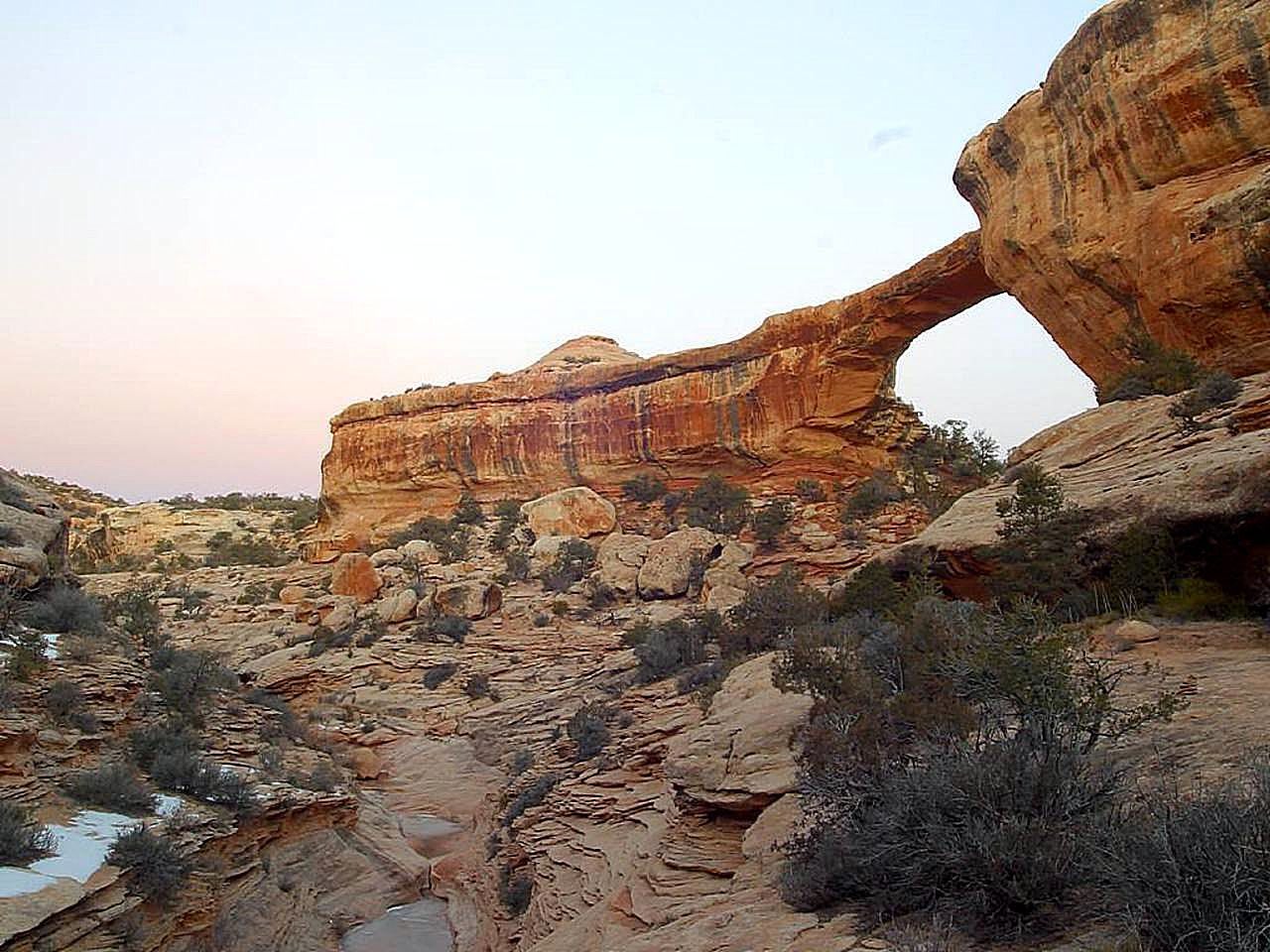
 Jon Sullivan / public domain via Wikimedia Commons
The Story
Natural Bridges National Monument is famous for two things: three massive stone bridges carved by ancient streams, and the darkest night sky of any designated site in the United States. The first will impress you during the day. The second will change how you think about the universe after the sun goes down.
The three bridges — Sipapu, Kachina, and Owachomo — span White Canyon and its tributaries in a remote corner of southeastern Utah. They are natural bridges, not arches, and the distinction matters. Arches are carved primarily by wind and frost working on rock fins. Bridges are carved by flowing water — streams that once ran through these canyons gradually wore through thin walls of rock, creating openings that widened over millennia into the soaring spans that exist today. The streams have long since shifted course, leaving the bridges standing high and dry above the canyon floor.
Sipapu is the largest and most dramatic, with a span of 268 feet and a height of 220 feet. It is the second-largest natural bridge in the world, after Rainbow Bridge near Lake Powell. The name comes from the Hopi word for the gateway through which souls enter the spirit world, and standing beneath it you understand why someone chose that name. The bridge is enormous, graceful, and framed by the narrow canyon walls in a way that makes it feel like a threshold between worlds.
Kachina Bridge is the youngest and thickest of the three, still in the early stages of its evolution. Its massive bulk — 210 feet wide and 93 feet thick at the top — shows how much rock the stream still needs to remove before it reaches the delicate proportions of its older siblings. Ancestral Puebloan pictographs are visible on the rock near the base, including figures that resemble Hopi kachina dolls, which inspired the name.
Owachomo is the oldest and most fragile, a thin ribbon of stone only nine feet thick at its narrowest point. It has reached the final stage of the bridge lifecycle — the stream that created it has long since abandoned the channel, and the bridge is now slowly weakening under its own weight and the constant work of frost and gravity. Someday it will collapse, as all natural bridges eventually do. For now, it is a study in geological impermanence — beautiful precisely because it will not last.
A nine-mile loop drive connects overlooks for all three bridges, and short trails descend into the canyons for close-up views. The hikes are moderately steep — plan on about an hour for each bridge if you descend to the canyon floor — and the trails pass through juniper and pinyon forest before dropping into the white sandstone canyons. A longer trail connects all three bridges along the canyon bottom, creating a roughly nine-mile loop that is one of the finest day hikes in southern Utah.
But it is the night sky that has put Natural Bridges on the map in recent years. In 2007, it became the first International Dark Sky Park in the world, a recognition that the skies here are essentially free of artificial light pollution. On a clear, moonless night, the Milky Way is not just visible — it is dominant. It stretches from horizon to horizon with enough brightness to cast shadows, and the sheer number of stars visible to the naked eye is staggering. Visitors who have never seen a truly dark sky often describe the experience as emotional, even overwhelming. You realize how much of the universe is hidden behind the glow of city lights.
The monument is small, quiet, and rarely crowded. It sits well off the main tourist routes, about 40 miles west of Blanding on Highway 95, and most visitors to southern Utah skip it entirely in favor of the national parks. That is a mistake. Natural Bridges offers something the parks cannot — the combination of world-class geological formations and world-class darkness in a setting so peaceful it feels like time has slowed down.
The Ancestral Puebloan presence is strong throughout the monument. Ruins, granaries, and rock art panels dot the canyons, evidence of people who lived and farmed here between roughly AD 1000 and 1300. In Blanding, about 40 miles east, the Edge of the Cedars State Park Museum preserves a partially excavated Ancestral Puebloan great house and the largest collection of their pottery in the Four Corners — a worthwhile primer on the people whose marks fill these canyons. They chose this place for the same reasons visitors come today — water, shelter, and a landscape that provides. The bridges they walked beneath are the same bridges you will see, barely changed in a thousand years. That continuity, quiet and unforced, is one of the most powerful things about this place.
Visitor Info
On the Map
Stories featuring this place
Go deeper into the history and character of this stop
Nearby
The closest stops worth working into your route
Historical markers nearby
Roadside plaques and monuments within a short detour