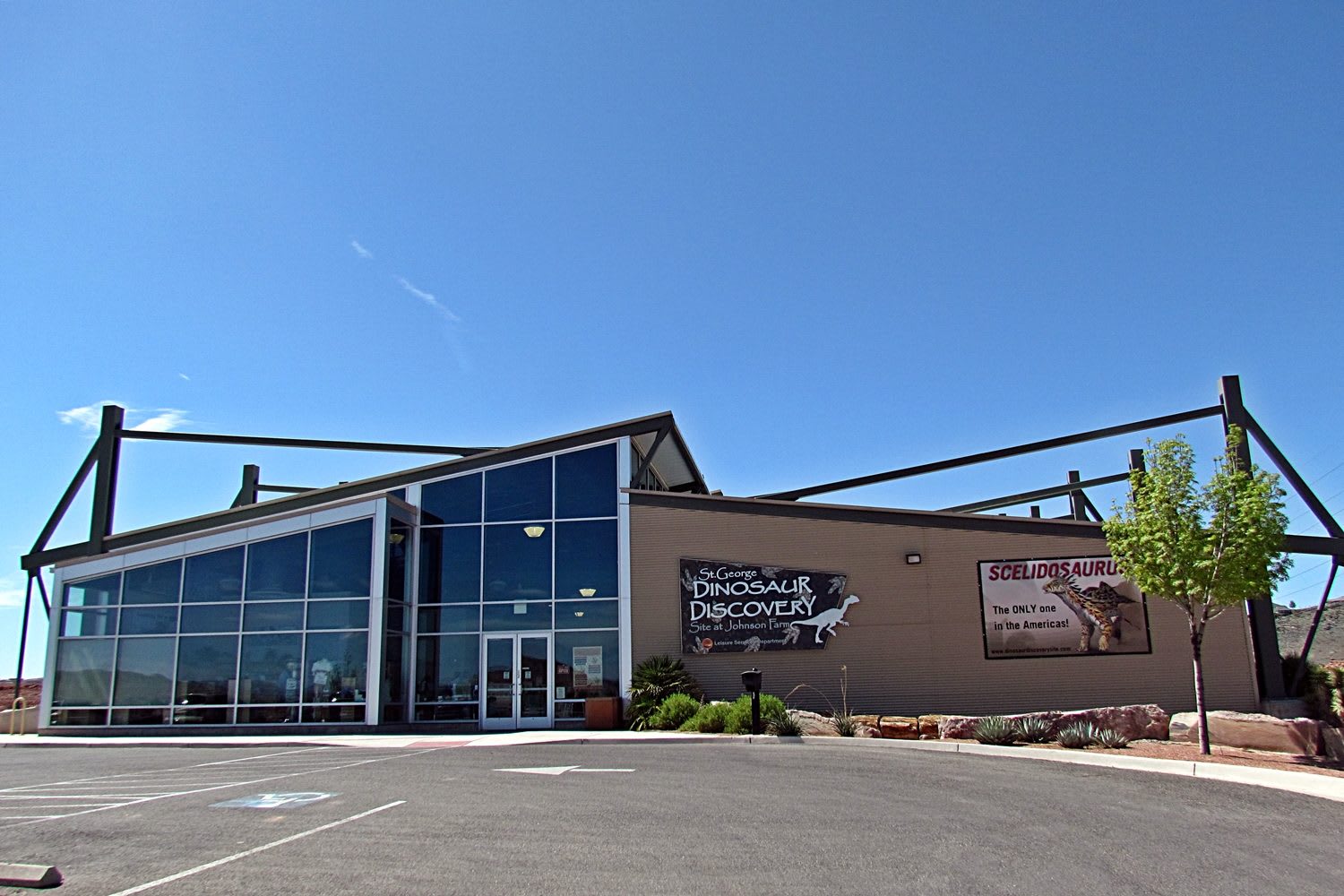
 5of7 / CC BY-SA 2.0
The Story
The St. George Dinosaur Discovery Site at Johnson Farm exists because a retired optometrist tried to flatten a hill. In February 2000, Dr. Sheldon Johnson was leveling a low rise on his property on the east side of St. George, meaning to develop the land, when he tore up the underlying sandstone in large blocks and found, on their undersides, what he first took for a complete fossil skeleton: the three-dimensional shapes of dinosaur feet, pressed into a bed of clay and then filled by the sand that hardened into the rock above. They were not impressions but natural casts — the sediment that had settled into each track, set, and now hung from the bottom of the slab in raised relief, claw marks, foot pads, and all.
Johnson had seen tracks in the region before and was briefly baffled, but he grasped quickly that the find mattered. He and his wife, LaVerna, set the land aside rather than build on it, brought in experts including Utah State Paleontologist James Kirkland, and eventually arranged for the City of St. George to take the site over; a museum building was raised directly over the main trackway in 2005, with the tracks left exactly where the animals had made them. Scientists have since ranked it among the finest dinosaur track sites in the world, and it now draws well over a hundred thousand visitors a year.
The rock is the Moenave Formation, laid down roughly 200 million years ago at the very start of the Jurassic, when this corner of southwestern Utah lay along the shifting edge of a broad, shallow body of water that geologists call Lake Dixie. The main track-bearing layer sits near the base of the formation's Whitmore Point Member, in a sandstone bed that was dropped quickly across an exposed mud flat and so captured the fine detail of the clay beneath it — which is why the casts preserve not only the outline of a foot but the pads, the claws, the small backward-pointing dewclaw, and, in a few remarkable cases, the pebbled texture of dinosaur skin. As many as twenty-five separate track-bearing horizons have been identified in the formation here, a stacked record of animals crossing the same lakeshore again and again across thousands of years.
Two kinds of track dominate. The large ones, thirteen to eighteen inches long and known to ichnologists as Eubrontes, were left by a big three-toed meat-eater of roughly the build of Dilophosaurus, the crested predator recorded in the slightly younger Kayenta Formation nearby. The smaller prints, four to eight inches and named Grallator, belonged to a slighter theropod along the lines of Megapnosaurus. Among them run the tracks of early crocodile relatives and the scuttling traces of horseshoe crabs — the signatures of a whole shoreline community rather than a single animal.
Two features in particular have made the site important to science. The first is the largest known collection of dinosaur swim tracks: scratch-like marks left by theropods that waded out until the water lifted them off the bottom, where a current running along the shore pushed them sideways as they clawed for purchase, evidence that some researchers read as dinosaurs fishing in the shallows. The second is a single trackway in which an animal stopped, crouched, and pressed the impressions of its tail and the underside of its body into the mud — one of only about six such "sitting" traces known anywhere in the world.
The lake left more than footprints. Higher layers hold fossil fish, stromatolites built by mats of algae, clam shrimp and other tiny crustaceans, conifer branches with the needles still attached, and a strange water-lily-like plant found in the fill of one Eubrontes track, mimicking the form of flowering plants that would not evolve for another hundred million years. Together they let paleontologists rebuild the Early Jurassic life of the lake margin in unusual detail.
All of it is indoors now, on Riverside Drive on the east side of St. George, the main trackway preserved in place beneath the museum floor and surrounded by hands-on exhibits aimed squarely at families. It pairs naturally with Snow Canyon State Park, a short drive across town — the same red-rock country, one stop reading the deep geological past and the other walking out across the petrified dunes that record it.
Visitor Info
On the Map
Nearby
The closest stops worth working into your route
Historical markers nearby
Roadside plaques and monuments within a short detour