The Story
Saltair is a building that refuses to stay dead. The current structure — a large, vaguely Moorish pavilion sitting on the southern shore of the Great Salt Lake west of Salt Lake City — is the third version of a resort that has burned down, been rebuilt, burned down again, been rebuilt again, and now stands as a concert venue surrounded by salt flats and brine flies, hosting rock shows in a building that looks like it belongs in a dream sequence. The history of Saltair is the history of Utah's complicated relationship with its strangest natural feature, told through a series of ambitious buildings that the lake and the elements kept destroying.
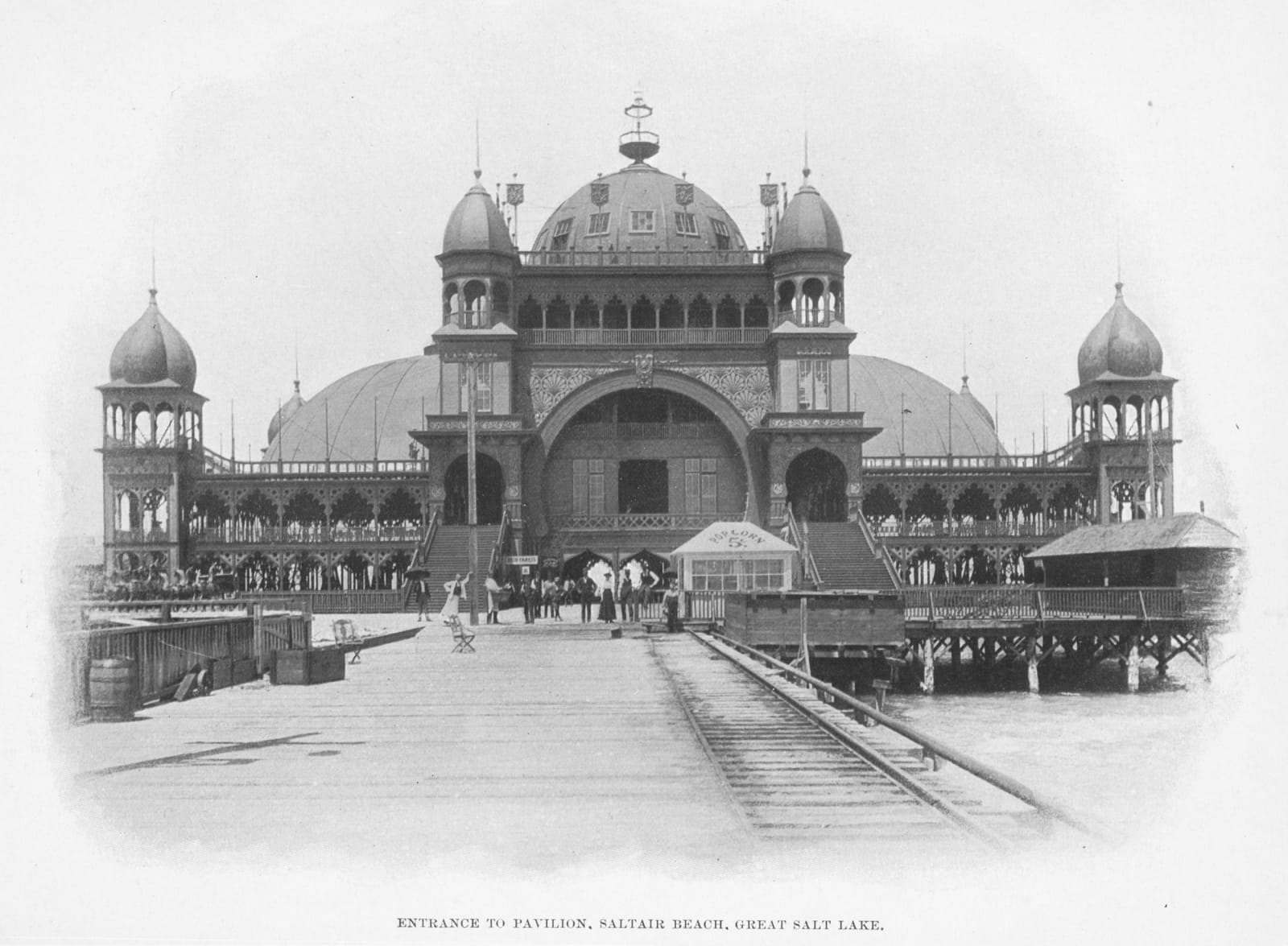
The original Saltair opened in 1893, and it was magnificent. Built on pilings over the shallow waters of the Great Salt Lake, it was designed in an extravagant Moorish Revival style — onion domes, minarets, arched windows, and a massive dance floor that could hold thousands. The resort was conceived as a destination that would draw visitors to experience the lake's unique buoyancy — floating in water so salty that sinking is impossible — and the combination of exotic architecture, warm brine bathing, and amusement park rides made it one of the most popular attractions in the American West. At its peak, special trains ran from Salt Lake City to the resort, depositing thousands of visitors at a waterfront pavilion that looked like it had been transported from Istanbul.
The lake had other ideas. The original Saltair burned in 1925, a fire that consumed the wooden structure in hours. It was rebuilt — smaller, less ornate, but still functional — and the second version operated through the mid-twentieth century before succumbing to a combination of fire damage, declining water levels, and changing tastes. By the 1960s, the lake had receded so far from the building that the shoreline was hundreds of yards away, and the romantic experience of bathing in salt water steps from the pavilion had been replaced by a long walk across mudflats. The second Saltair closed and eventually burned as well.
The current Saltair — the third incarnation — was built in 1981 using a salvaged airplane hangar as the structural core, clad in a facade that echoes the Moorish styling of the original. It sits on the exposed lakebed rather than over the water, and its relationship to the lake has been defined by the same fluctuations that doomed its predecessors. In the wet years of the 1980s, the lake rose dramatically and flooded the building, forcing a closure and costly repairs. In the dry years that followed, the lake retreated again, leaving the building stranded on a white salt flat with the waterline a distant shimmer on the horizon.
Today, Saltair functions primarily as a concert and event venue, hosting shows that range from metal and punk to electronic music and cultural festivals. The acoustics inside the cavernous hangar structure are imperfect but energetic, and the setting — a strange building on a salt flat, surrounded by nothing but white ground and big sky — gives every event a slightly surreal quality that indoor venues cannot replicate. Driving to a show at Saltair means driving west on I-80 past the airport, turning off at a nondescript exit, and following a road across the salt flats to a building that materializes out of the haze like a mirage.
The ghost of the original Saltair haunts the current structure in the best possible way. Old photographs in the lobby show the 1893 resort in its glory — thousands of bathers in the lake, the domes and minarets reflected in the water, trains arriving with fresh crowds. The contrast with the present — a converted hangar on a dry salt flat — is melancholy but also oddly inspiring. Three times this resort has been built. Three times the lake and the elements have tested it. And three times someone has decided that the idea of Saltair — a gathering place on the shore of an impossible lake — is worth trying again.
The surrounding landscape is not conventionally beautiful but it is compelling. The salt flats stretch in every direction, blindingly white in the sun. Brine flies congregate along the former shoreline in numbers that can be startling. The smell of the lake — mineral, sulfurous, organic — varies with temperature and wind direction, ranging from barely noticeable to aggressively pungent. On certain evenings, when the sun drops toward the lake and the sky turns pink and gold over the salt, the desolate setting transforms into something genuinely beautiful — a vast, empty canvas that the sunset paints with colors that have nowhere to go but everywhere.
Saltair is not a conventional tourist attraction. It is not polished or comfortable or easy to categorize. It is a concert venue in a recycled airplane hangar wearing a costume borrowed from a building that burned down over a century ago, sitting on a salt flat that used to be a lakebed that used to be a resort. It is the physical embodiment of Utah's stubborn refusal to give up on the Great Salt Lake as a place of recreation and wonder, even when the lake keeps making that proposition as difficult as possible. The building stands because someone keeps deciding it should, and that persistence — human and architectural — is its own kind of beauty.
Visitor Info
On the Map
A story featuring this place
Go deeper into the history and character of this stop
Nearby
The closest stops worth working into your route
Historical markers nearby
Roadside plaques and monuments within a short detour