The Story
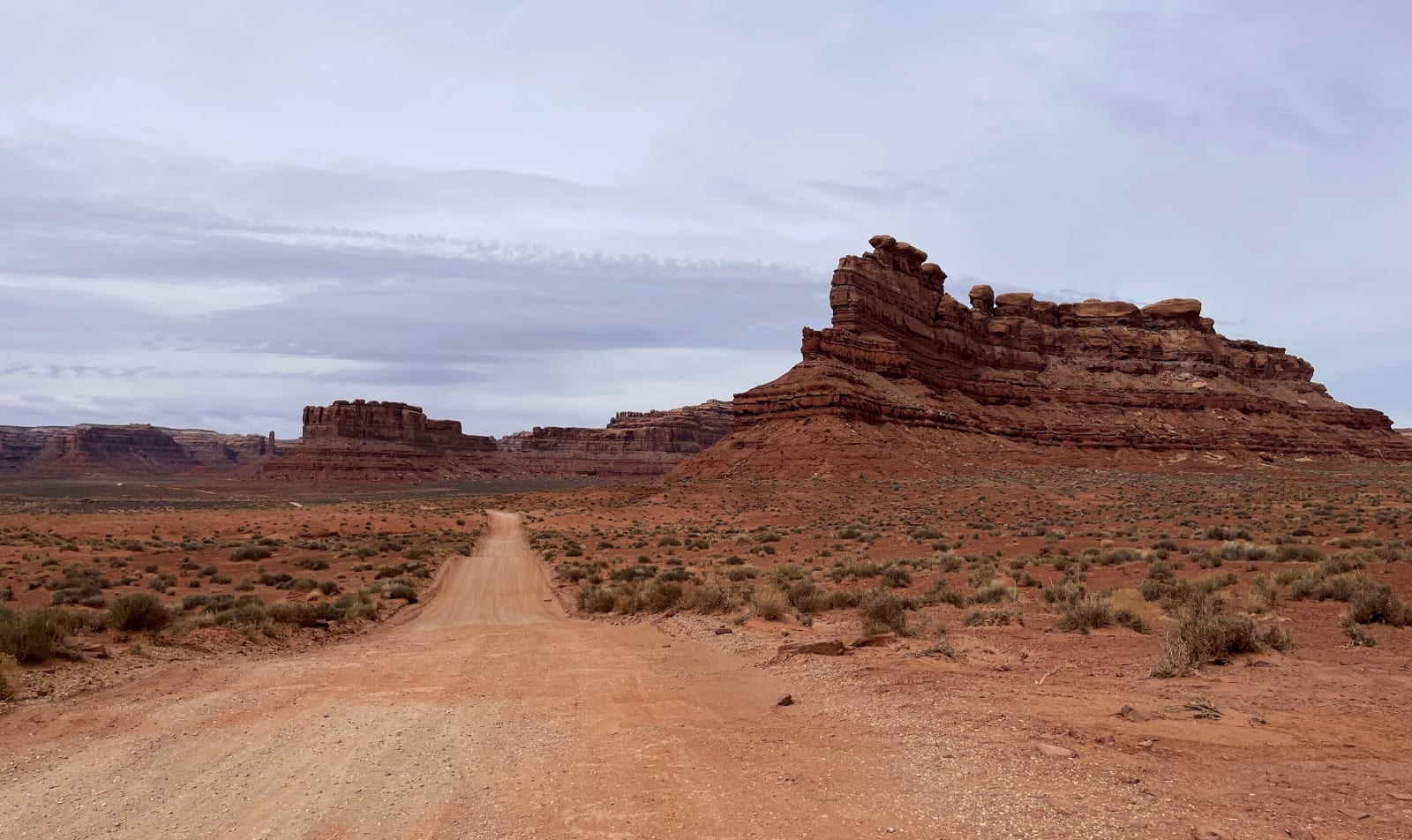
Valley of the Gods is the secret that Monument Valley visitors wish someone had told them about. The same towering buttes, the same red sandstone spires, the same wide desert floor stretching to the horizon — but with no entrance fee, no crowds, no tour buses, and no restrictions on where you can camp. You can drive in, park your vehicle beneath a 500-foot butte, set up a chair, and watch the sunset in complete solitude. On most evenings, you will be the only person there.
The valley sits on Bureau of Land Management land just north of Mexican Hat, connected by a 17-mile unpaved loop road that winds between the formations. The road is passable in a regular car when dry, though a high-clearance vehicle is more comfortable — the surface is packed dirt with occasional rocky patches and washboard sections that rattle your teeth. The drive takes about an hour if you do not stop, but you will stop. Every quarter mile presents another formation that demands a photograph, another angle on a butte that looks completely different from the one you saw three minutes ago.
The formations here are carved from the same Cedar Mesa Sandstone and Organ Rock Shale that built Monument Valley, and the geological story is identical — differential erosion over tens of millions of years, with harder rock caps protecting softer layers beneath. The buttes and pinnacles are remnants of a plateau that once covered this entire region, slowly whittled down to isolated towers by wind, water, and frost. Some formations have names — Setting Hen Butte, Rooster Butte, Castle Butte — and the names are surprisingly accurate. Others stand unnamed, which feels appropriate for a place that resists the urge to label everything.
The lack of development is the point. Monument Valley has a visitor center, a hotel, guided tours, and a paved road to the main overlook. Valley of the Gods has a dirt road and a silence so deep it rings in your ears. There are no facilities, no water, no cell service, and no rangers. The BLM allows free dispersed camping anywhere along the road, which means you can pitch a tent at the base of a formation and fall asleep watching the stars wheel overhead between sandstone towers. This is one of the last places in the lower 48 where you can have a landscape of this magnitude entirely to yourself.
The light here follows the same rules as Monument Valley — iron oxide in the sandstone responds to the angle of the sun with colors that shift from pale gold at midday to deep crimson at sunset. But without the crowds, you experience the transitions differently. There is no jostling for position at an overlook, no camera shutters clicking around you. Just you, the rock, and the light doing what it has done here for millions of years.
The drive pairs naturally with a visit to nearby Goosenecks State Park, where the San Juan River makes a series of impossibly tight meanders through a canyon 1,000 feet deep, and the Moki Dugway, a heart-stopping series of unpaved switchbacks that descend 1,200 feet from the top of Cedar Mesa to the valley floor. Together, these three stops — Valley of the Gods, Goosenecks, and Moki Dugway — form one of the most spectacular half-day drives in the American West, and most tourists blow right past all three on their way to Monument Valley.
The Navajo Nation boundary lies just to the south, and the cultural landscape here is layered. Ancestral Puebloan ruins dot the mesa tops and alcoves throughout the region, and the area has been home to indigenous peoples for thousands of years. The valley itself sits on public land, but the surrounding region is deeply connected to Navajo history and identity.
Valley of the Gods is not a substitute for Monument Valley — it is a complement. Monument Valley gives you the icons, the guided cultural context, the famous viewpoints. Valley of the Gods gives you the solitude, the freedom, and the rare privilege of standing alone in a landscape that rivals anything in the national park system without a single sign telling you where to stand or what to feel. Some places are better without infrastructure. This is one of them.
Visitor Info
On the Map
Nearby
The closest stops worth working into your route
Historical markers nearby
Roadside plaques and monuments within a short detour