The Story
There is a moment, usually in the first ten minutes, when every visitor to Arches National Park stops walking and just stands still. It might happen at the Windows, where two massive stone openings frame the La Sal Mountains like nature built a cathedral. It might happen at Landscape Arch, a 290-foot ribbon of stone so impossibly thin it looks like it should have collapsed centuries ago. Or it might happen at Delicate Arch, the icon of Utah itself, standing alone on the edge of a sandstone bowl like a gateway to somewhere ancient and unknowable.
Arches contains over 2,000 documented natural stone arches — the densest concentration on the planet. But the number alone does not capture what makes this place extraordinary. What makes Arches special is scale. These are not small holes in rocks. These are soaring, cathedral-sized openings carved by 300 million years of water, ice, frost, and wind working on a buried salt bed that buckled and cracked the sandstone above it.
The geology reads like a slow-motion drama. Deep beneath the park lies the Paradox Formation, a layer of salt deposited by an ancient sea roughly 300 million years ago. Over time, thousands of feet of sediment piled on top. The salt, under immense pressure, began to flow and shift, cracking the overlying Entrada Sandstone into long parallel fins. Water seeped into those cracks, froze, expanded, and gradually hollowed out the windows and arches that exist today. Every arch you see is a snapshot of a process still underway — some arches are growing, others are collapsing, and new ones are forming in fins that are just beginning to crack.
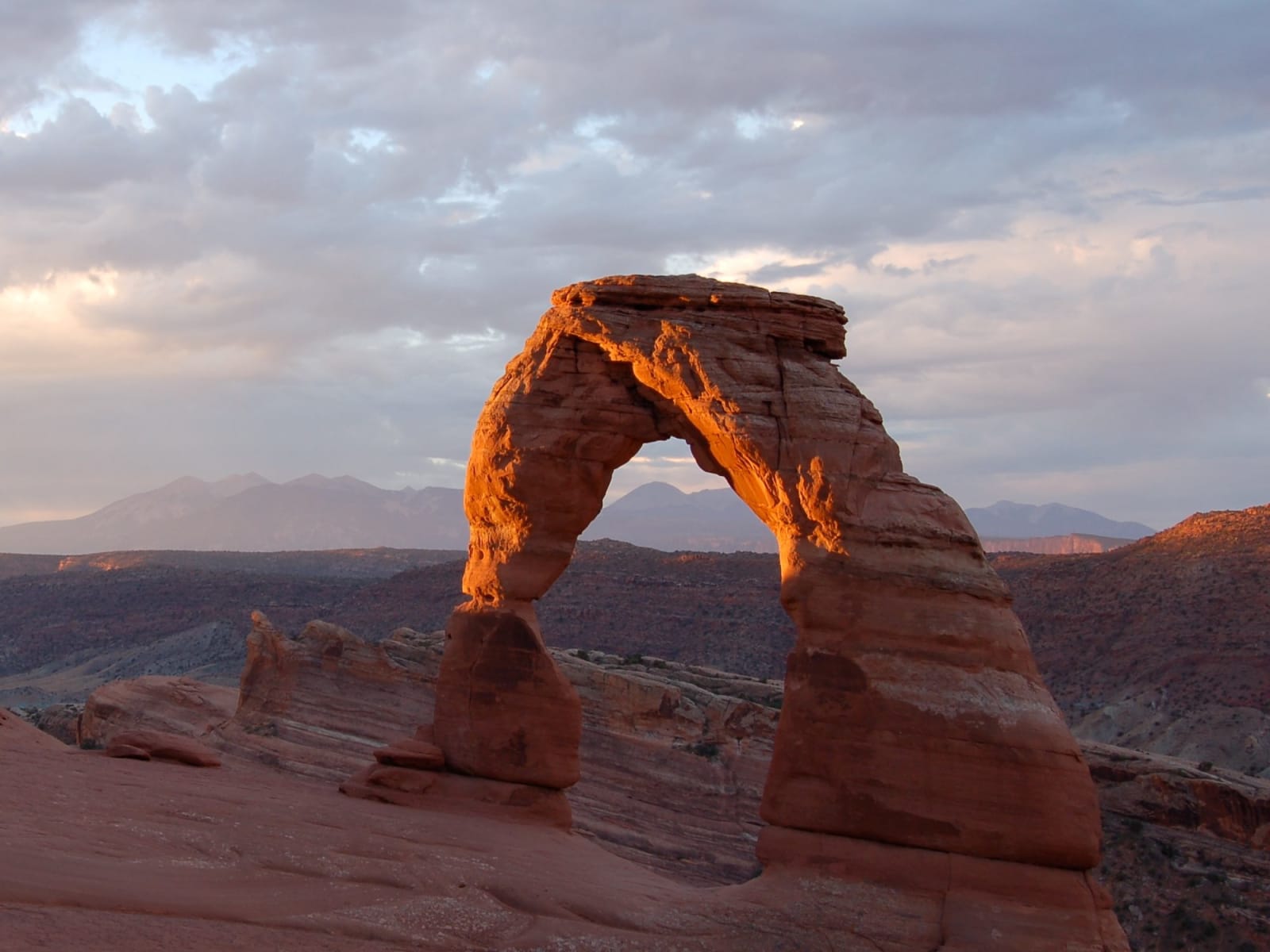
The most famous resident is Delicate Arch, a 52-foot freestanding crescent of Entrada Sandstone perched at the edge of a natural amphitheater. It appears on the Utah license plate, on stamps, and in the dreams of every landscape photographer who has ever aimed a camera at red rock. The hike to reach it is 1.5 miles and climbs 480 feet across open slickrock — there is no shade, no shortcuts, and no way to prepare yourself for the moment you round the final curve and see it standing there, impossibly balanced, glowing orange against a blue sky.
But Delicate Arch is only one character in a very large cast. Landscape Arch, in the Devils Garden area, stretches 290 feet — longer than a football field — and is the longest natural arch in North America. A 73-foot slab fell from its underside in 1991, and the Park Service closed the trail beneath it, so visitors now view it from a distance, watching geology happen in real time. Double Arch is a pair of arches sharing the same rock wall, one of the few places on Earth where two arches formed side by side. Fiery Furnace is a labyrinth of narrow sandstone corridors so confusing that the Park Service requires a permit or guided tour to enter.
Timing matters here. The sandstone changes color with the sun. In early morning the rock is pale and ghostly. By late afternoon it deepens to burnt orange and finally, at sunset, turns a red so saturated it barely looks real. Photographers and painters have been chasing this light for generations, and it never gets old.
The park sits at an elevation of roughly 4,000 to 5,600 feet, which means summer days regularly exceed 100 degrees Fahrenheit. Spring and fall are the prime seasons — warm days, cool nights, and manageable crowds. Winter brings occasional snow, which settles into the crevices of red rock and creates some of the most striking contrasts in the American landscape.
A timed entry reservation system is in effect during peak season, so planning ahead is essential. But even on the busiest days, if you are willing to walk a little farther — past the parking lots, past the viewpoints, past the crowds — you will find yourself standing alone in a landscape that has been sculpting itself for longer than humans have existed. That stillness, that slow geological patience, is what stays with you long after you leave.
Visitor Info
On the Map
Stories featuring this place
Go deeper into the history and character of this stop
Nearby
The closest stops worth working into your route
Historical markers nearby
Roadside plaques and monuments within a short detour