 Sokoloff et al. / CC BY 4.0
The Story
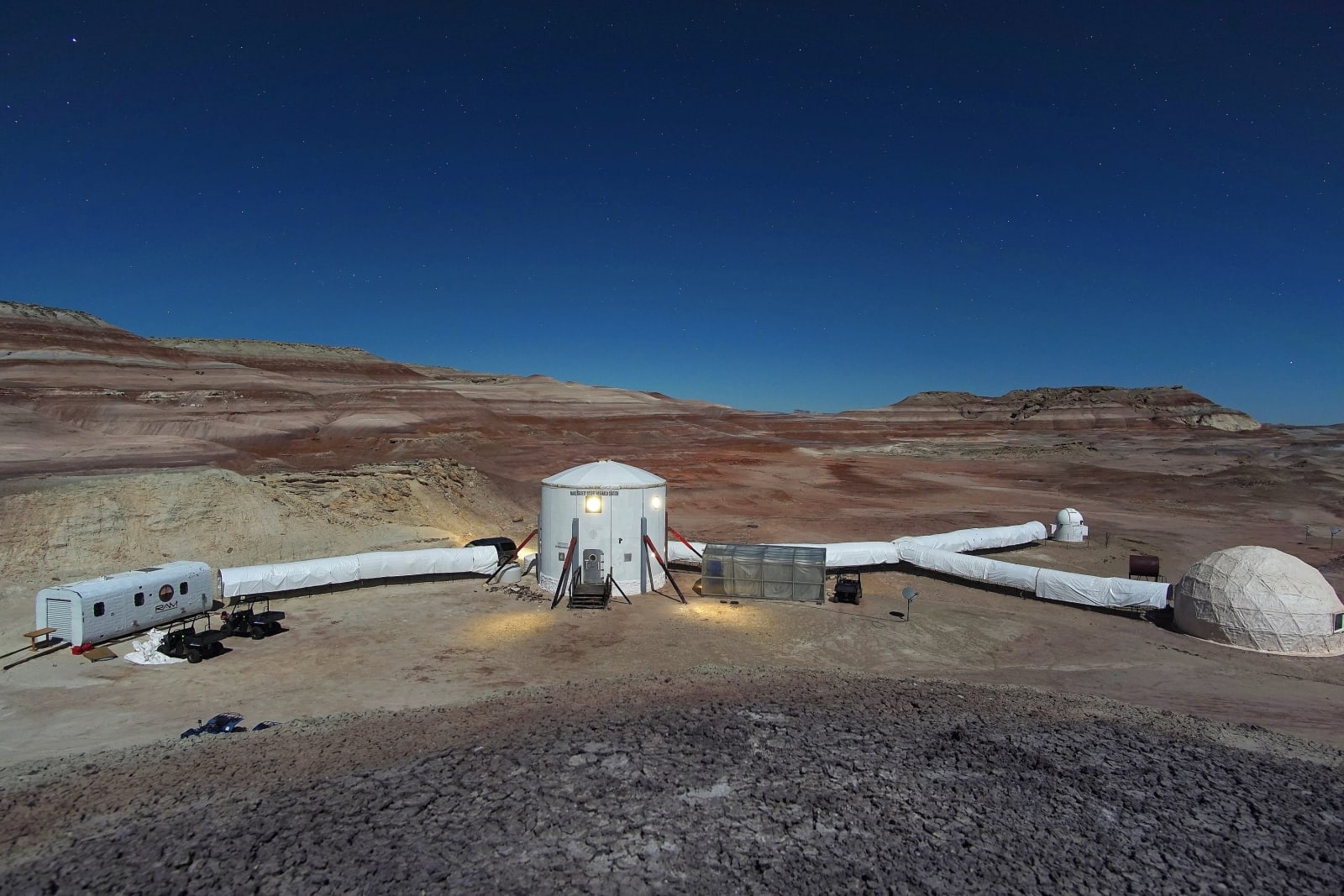
Seven miles northwest of Hanksville, on a dirt track called Cow Dung Road, there is a sign that marks where Earth ends and Mars begins. Behind it stands a two-story white cylinder ringed by smaller domes and an observatory — the Mars Desert Research Station, the longest-running Mars analog habitat on the planet. The Mars Society built it here in 2001 because the terrain around Hanksville is one of the closest things on Earth to the surface of Mars. Bentonite hills banded in gray and rust. Sandstone formations weathered into shapes that look engineered rather than eroded. A reddish, dust-covered ground with so little vegetation that the horizon reads as alien from any angle. Crews of six spend two weeks at a time inside the habitat each winter, wearing simulated spacesuits whenever they step outside, conducting research that may one day apply to a real Martian mission.
Hollywood noticed the resemblance before the Mars Society did. The badlands surrounding Hanksville have stood in for other planets in Galaxy Quest, the 2009 Star Trek reboot, John Carter, and The Space Between Us — a small filmography that confirms what every visitor notices on arrival: this landscape does not look like anywhere else in the United States. The Morrison Formation outcrops north of town, with their striped claystone mounds in pink and gray and pale green, look less like geology than like prop fabrication. Factory Butte, ten miles west, rises out of the desert like a freestanding monument with sheer walls and a flat top. The country is genuinely strange, and the strangeness is the point.
What is interesting is how thoroughly the Mars angle fits the rest of Hanksville's biography. The town has always been an outpost. Mormon settlers founded it in 1882, at the junction of the Fremont River and Muddy Creek, calling it Graves Valley after a member of the Powell expedition who had surveyed the area. They renamed it in 1885 after Ebenezer Hanks, one of the original pioneers. For most of the next century, Hanksville was simply too remote to thrive — electricity didn't arrive until 1960, and the town wasn't formally incorporated until 1999. Butch Cassidy and the Wild Bunch used it as a resupply point while hiding out in the labyrinth of Robbers Roost canyons to the south. After World War II, it became a staging town for uranium prospectors combing the Colorado Plateau, and abandoned mines from that era still pock the surrounding desert.
Today, Hanksville sits at the crossroads of Highway 24 and Highway 95, which makes it the practical anchor of an enormous and otherwise empty quarter of the state. Highway 24 carries travelers west to Capitol Reef and east to Green River, sixty miles away across pure desert. Highway 95 drops south through Glen Canyon country to Lake Powell and the Bullfrog ferry. From Hanksville, the Henry Mountains rise to the southwest — the last range in the contiguous United States to be officially mapped, in 1872, and home to one of only a handful of genetically pure, free-roaming bison herds in North America. The Bureau of Land Management's Henry Mountains field station operates from town. For anyone traveling this corner of Utah, Hanksville is the gas, the food, the bed, and the conversation with someone who actually lives out here.
The town's population hovers under two hundred. There is a general store, a couple of small motels, a few restaurants serving the seasonal traveler, and the famous Hollow Mountain gas station — built into the sandstone cliff at the south edge of town, where the building is the rock and the rock is the building. The school goes through sixth grade; older students ride the bus fifty-five miles each way to Bicknell. The pace is slow because the geography insists on it.
North of Hanksville, the Hanksville-Burpee Quarry has yielded one of the most significant Jurassic dinosaur fossil concentrations in North America, with bones from at least a dozen distinct dinosaurs excavated since 2007. The site sits in the same Morrison Formation that surrounds the Mars station, which is fitting: the rocks that look most like Mars are also the rocks that record the deepest evidence of life on Earth. The contrast is one of the small jokes of the place.
Most travelers pass through Hanksville on the way to somewhere — Capitol Reef, Goblin Valley, Lake Powell, the Henrys, Moab. Few stop longer than they need to refuel. But the town is worth a closer look. The crossroads identity is real, the Mars connection is genuine, the history is older and stranger than the population would suggest, and the surrounding desert is some of the most genuinely otherworldly country in the lower forty-eight. Hanksville does not announce itself. It simply sits at the end of one stretch of highway and the beginning of three more, and waits to see who comes through next.
Visitor Info
On the Map
Nearby
The closest stops worth working into your route
Historical markers nearby
Roadside plaques and monuments within a short detour