The Story
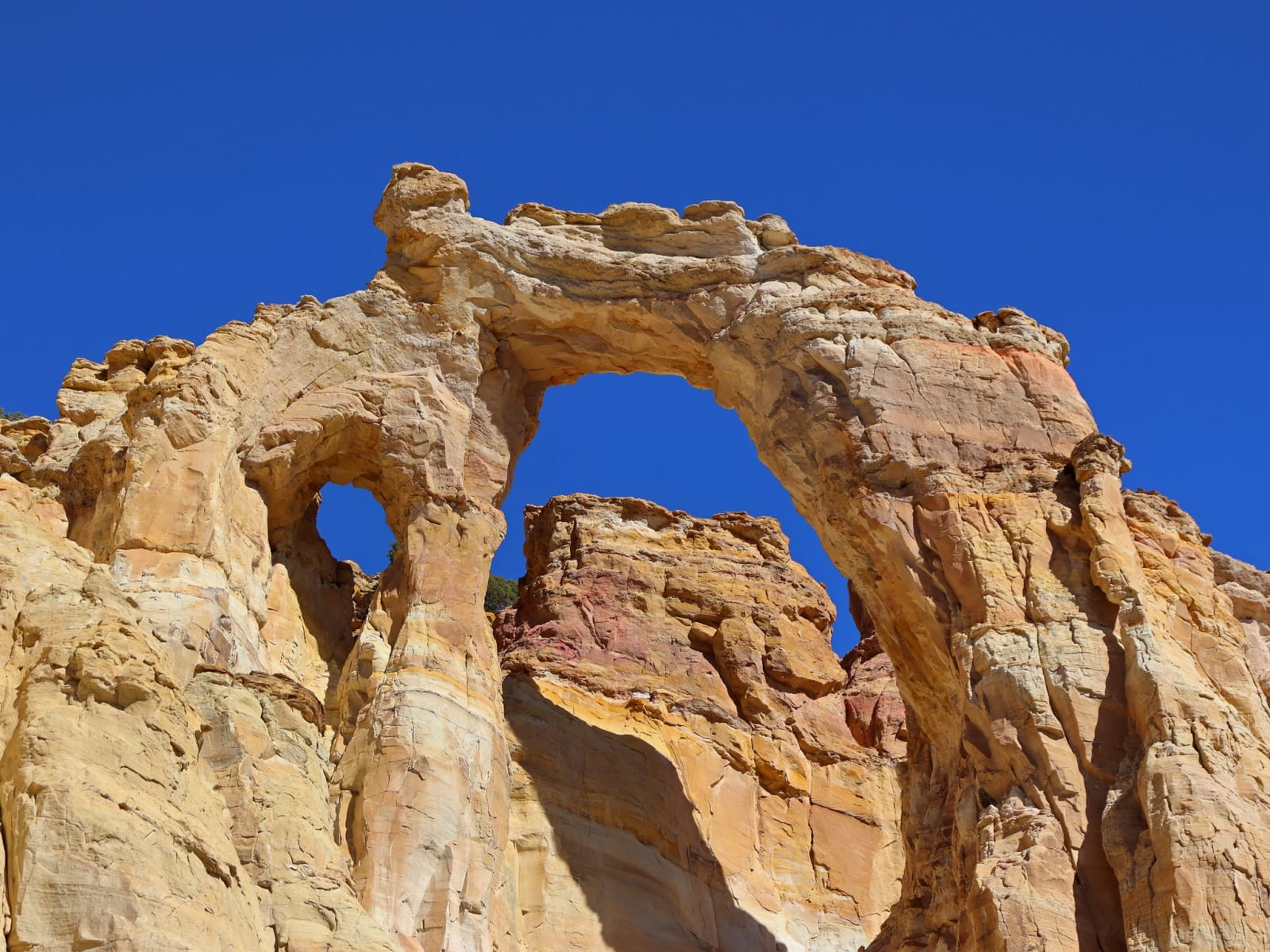
Grosvenor Arch is the kind of geological formation that makes you suspect the landscape is showing off. A massive double arch — two openings side by side in a single wall of pale Henrieville Sandstone — rises 152 feet above the desert floor in the backcountry of Grand Staircase-Escalante National Monument, looking like the entrance to a cathedral that nature started building and then decided was complete without the cathedral. The scale is enormous, the proportions are elegant, and the fact that it sits at the end of a dirt road in one of the least-visited corners of southern Utah means you might have it entirely to yourself.
The arch was named after Gilbert Hovey Grosvenor, the first full-time editor of National Geographic magazine, by a 1949 National Geographic expedition that was also responsible for naming nearby Kodachrome Basin. Grosvenor served as editor for over 50 years and transformed National Geographic from a dry academic journal into one of the most widely read publications on Earth. Naming a spectacular double arch after him was the expedition's way of honoring that legacy, and the gesture was apt — Grosvenor Arch is exactly the kind of formation that would stop a National Geographic photographer mid-stride and keep them shooting until the light changed.
The double opening is what makes Grosvenor Arch unusual. Most natural arches have a single opening — one hole in one wall of rock. Grosvenor has two, side by side, sharing a central pillar that supports both spans. The larger opening is roughly 100 feet wide and dominates the formation. The smaller opening sits to the right, lower and narrower, creating an asymmetry that gives the arch a dynamic, almost architectural quality. The effect is of a structure with a grand entrance and a side door, each framed in the same pale sandstone but scaled differently enough to create visual tension.
The rock is Henrieville Sandstone, a formation deposited roughly 75 to 80 million years ago during the late Cretaceous period, when this region was a coastal environment at the edge of a vast inland sea. The sandstone is pale cream to yellow, considerably lighter than the red Entrada and Navajo Sandstones that form most of southern Utah's famous arches. The lighter color gives Grosvenor Arch a different mood than its red rock counterparts — less fiery, more luminous, with a soft glow in the afternoon light that makes the formation look almost translucent against a blue sky.
The arch formed through the same processes that create most natural arches — water seeping into fractures in the rock, freezing, expanding, and gradually hollowing out alcoves that deepened and eventually broke through. The double opening suggests that two separate fracture zones were being eroded simultaneously, with the central pillar representing a section of rock that was slightly more resistant than its neighbors. The pillar is the structural key to the formation — if it fails, both arches collapse — and its current thickness suggests that Grosvenor Arch is in the middle of its geological lifespan, stable enough to persist for millennia but ultimately doomed by the same erosive forces that created it.
The drive to Grosvenor Arch follows Cottonwood Canyon Road south from Kodachrome Basin State Park, a well-graded dirt road that is passable in most passenger vehicles when dry. The arch is about 10 miles south of Kodachrome Basin, and the turnoff is marked with a small BLM sign. A short spur road leads to a parking area, and the walk to the base of the arch takes about two minutes. The entire detour — drive, walk, photograph, return — can be completed in 30 minutes, though spending more time with the formation as the light shifts is well worth the investment.
The surrounding landscape is classic Grand Staircase-Escalante backcountry — rolling hills of gray and cream badlands, distant red cliffs, and the vast, empty silence that defines this part of Utah. Cottonwood Canyon Road continues south from the arch toward Highway 89 near the Arizona border, passing through increasingly remote and beautiful terrain. The road can be impassable when wet — the clay soils become lethally slick in rain — so checking conditions before committing to the drive is essential.
Grosvenor Arch receives a fraction of the visitation that the arches in Arches National Park attract, despite being comparable in scale and arguably more unusual in form. The double opening, the pale sandstone, the backcountry setting, and the absence of crowds create an experience that the national park — with its timed entry reservations and parking lot traffic — increasingly cannot offer. You stand at the base of a 152-foot double arch in complete silence, with no one else in sight, and you understand why a National Geographic expedition looked at this formation and decided it deserved their founder's name. Some things are simply that good.
Visitor Info
On the Map
Nearby
The closest stops worth working into your route
Historical markers nearby
Roadside plaques and monuments within a short detour