The Story
The first thing that strikes you is the light. The Bonneville Salt Flats are so white, so flat, and so vast that the reflected glare erases every shadow and flattens every sense of depth. The horizon dissolves into a shimmering haze where sky and ground become indistinguishable, and mirages ripple in the distance like pools of water that do not exist. It is one of the most disorienting landscapes in America, and one of the most beautiful.
The salt flats cover roughly 30,000 acres of ancient lakebed west of the Great Salt Lake, near the Nevada border. This was once the floor of Lake Bonneville, a prehistoric freshwater lake that covered much of western Utah during the last ice age. At its peak roughly 17,000 years ago, the lake was over 1,000 feet deep and larger than Lake Michigan. As the climate warmed and the lake evaporated, it left behind a crust of salt, potash, and other minerals that in places is five feet thick. The surface is so flat that a deviation of less than one inch per mile has been measured across large sections — making it one of the flattest natural surfaces on Earth.
That flatness is what brought the speed chasers. In 1914, a daredevil named Teddy Tetzlaff drove a Blitzen Benz across the salt at 141 miles per hour, and the legend was born. Since then, the Bonneville Salt Flats have hosted land speed racing almost continuously, producing some of the most extraordinary speed records in automotive history. In 1970, Gary Gabelich drove the Blue Flame rocket car to 622 miles per hour. In 1997, Andy Green broke the sound barrier on land at Black Rock Desert in Nevada, but Bonneville remains the spiritual home of land speed racing — a place where the combination of perfectly flat terrain, firm surface, and vast open distance creates ideal conditions for going as fast as a machine can possibly go.
Speed Week, held every August by the Southern California Timing Association, draws hundreds of racers in everything from streamlined rocket cars to modified motorcycles and vintage hot rods. The atmosphere is part motorsport, part family reunion, part desert hallucination. Teams camp on the salt, work on their vehicles under canopies, and take turns blasting across the measured mile. The speeds are staggering — 300, 400, even 500 miles per hour — but the culture is remarkably welcoming. Spectators can walk through the pits, talk to drivers, and watch runs from surprisingly close range.
Beyond the racing, the salt flats have an almost spiritual quality. The landscape is so minimal — white ground, blue sky, nothing else — that it functions as a kind of natural sensory deprivation chamber. Photographers love it for the way it reduces the world to pure geometry. Artists have used it as a canvas. Tourists drive out, stand in the middle of the whiteness, and take portraits that look like they were shot on another planet.
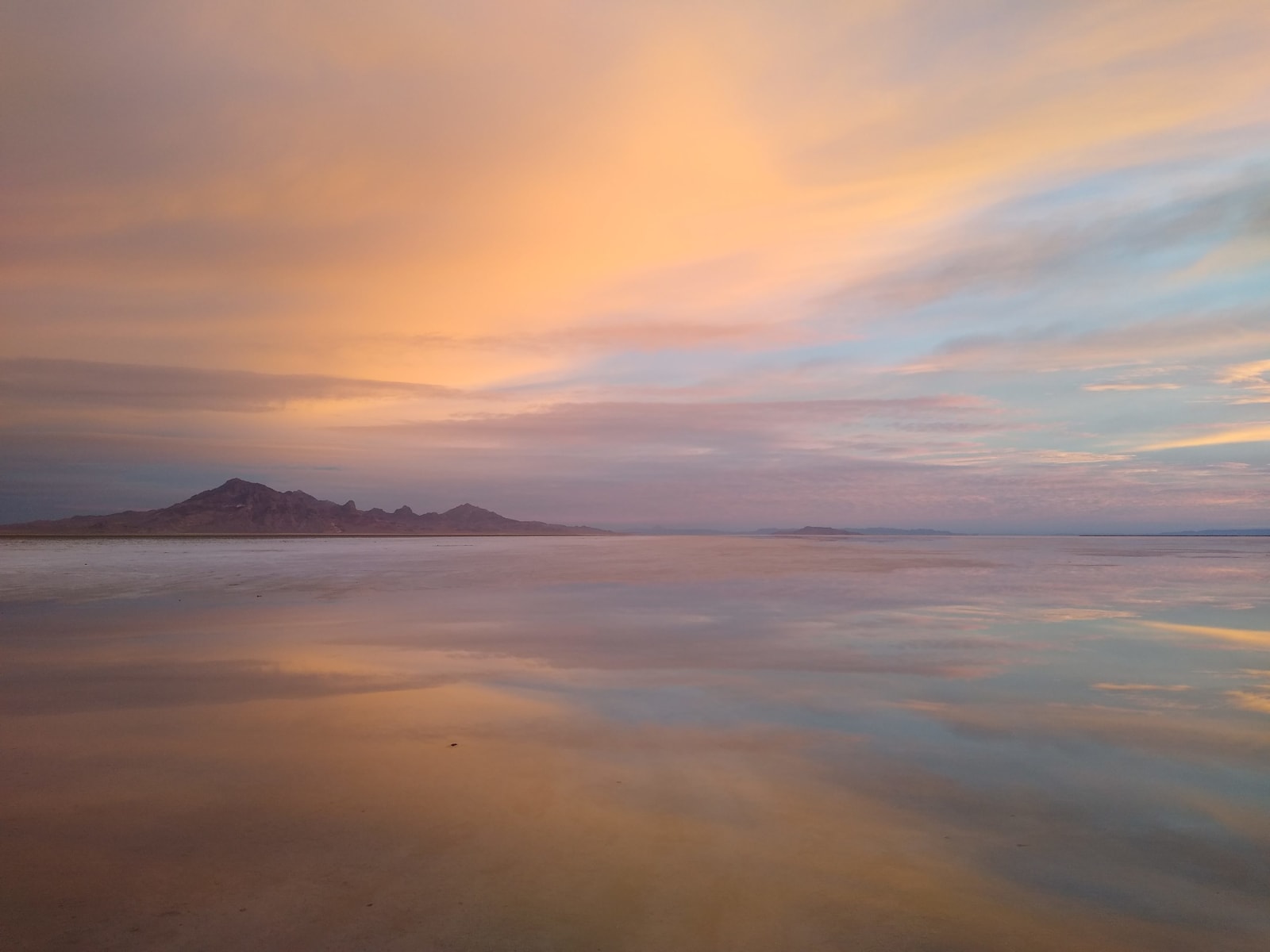
The best time to visit for the classic mirror effect is late winter or early spring, when a thin layer of rainwater covers the salt and transforms the surface into a perfect reflecting pool. The sky appears beneath your feet. Mountains float upside down. The reflection is so precise that it rivals the famous Salar de Uyuni in Bolivia, and it is free, accessible, and twenty minutes off Interstate 80.
There is a fragility to the salt flats that most visitors do not see. The salt crust has been thinning for decades, partly from mineral extraction by nearby potash operations and partly from changing drainage patterns. Areas that once supported racing are now too thin and rough. Conservation efforts are underway — the Bureau of Land Management has been pumping salt brine back onto the flats to rebuild the crust — but the long-term future of this landscape is uncertain.
That tension between permanence and fragility is part of what makes Bonneville so compelling. The flats look eternal — a white void that stretches to the horizon in every direction — but they are actually a delicate mineral skin stretched over ancient mud. They are a remnant of a lake that no longer exists, shaped by a climate that no longer prevails, preserved by a balance of evaporation and mineral deposition that humans are only beginning to understand. Standing on the salt, squinting into the white glare, you are standing on borrowed time made solid. It will not last forever, but right now, in this light, it feels like it could.
Visitor Info
On the Map
Nearby
The closest stops worth working into your route
Historical markers nearby
Roadside plaques and monuments within a short detour