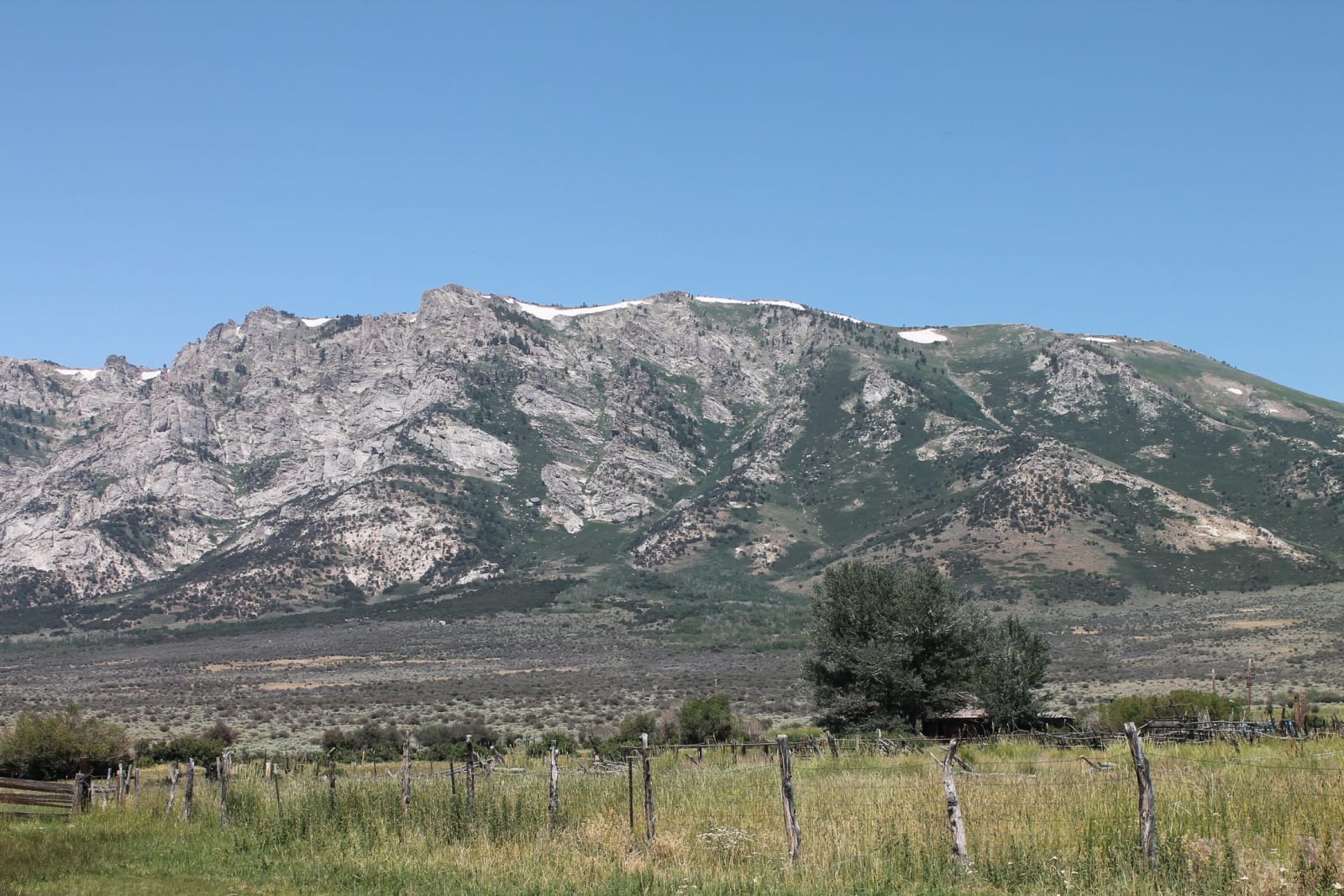
 Jrmichae / CC BY-SA 4.0
The Story
To the Newe — the Western Shoshone — this valley on the east side of the Ruby Mountains is part of Newe Sogobia, the people's mother earth: a homeland that ran from southern Idaho across the heart of Nevada to Death Valley, held not as property but as relationship. For thousands of years the Newe lived it in small family bands, wintering by the pine-nut groves and moving with the seasons and the water, in a high desert where the springs themselves were understood to be alive. They did not build towns or fence ground, which later made it easy for newcomers to call the country empty. It was not empty. It was, and to the Newe still is, theirs.
The document that should have protected that was signed right here. By the early 1860s, emigrants, miners, and soldiers had stripped the game, fouled the springs, and brought the Newe close to starvation; the army built Fort Ruby in 1862 to guard the overland route, and bands pushed to the wall struck back at travelers along the Humboldt. To quiet the corridor ahead of the railroad, federal officials and a dozen Western Shoshone leaders met in Ruby Valley and signed the Treaty of Ruby Valley on October 1, 1863. It was a treaty of peace and friendship. The Newe agreed to end the raids and let Americans cross, mine, string telegraph lines, and build a railroad; in return they were promised yearly payments for the loss of their land's bounty. What the treaty did not do, in plain and unambiguous language, was cede a single acre. The Newe never sold Newe Sogobia. They agreed only to share the road.
The government took it anyway. Within decades federal agencies were calling Newe Sogobia public land and running it as their own, until today the United States claims the great majority of it — though the Newe never signed it over and the treaty, never repealed, is still on the books. The hardest irony in the West is folded into that paperwork: the gold of the Carlin Trend, the largest gold production in the country, comes out of this never-ceded ground, and the most-bombed landscape on earth — close to a thousand nuclear detonations at the Nevada Test Site — lies inside the same treaty boundary. Extraction and annihilation, on land the law still says was never surrendered, and not a dollar of royalty to its people.
The Newe have refused to let it rest. When the government tried to settle the question by paying for the land — a 1979 award that valued the whole of Newe Sogobia at about fifteen cents an acre — the Western Shoshone declined the money, reasoning that to take it would be to sell what was never for sale; the funds still sit in a federal account, unclaimed and gathering interest. Two sisters made the stand concrete. Mary and Carrie Dann, ranchers near Crescent Valley, grazed their cattle on the open range from 1973 onward and refused to buy federal permits, insisting the land was Shoshone under the treaty. Their fight reached the Supreme Court as United States v. Dann; they lost on a technicality and went on ranching anyway, and in 1993 the world honored them with the Right Livelihood Award. Carrie Dann ran cattle on contested ground nearly until her death in 2021.
What's here now is not a tidy monument. Ruby Valley is remote and largely unmarked — gravel roads, scattered ranches, the old Fort Ruby site down by the marshes at the valley's south end — and the treaty ground carries little more than a roadside plaque. The living place to meet this history is in Elko, at the Noowuh Knowledge Center, the Te-Moak tribe's library and archive, where Western Shoshone people keep and teach the story in their own words. The Newe are still here — in Elko, at South Fork, across the bands of the Te-Moak — and the treaty is not a closed chapter of the past but an open one of the present.
It is the part of Cowboy Country that the cattle drives and the cowboy poetry leave out, and the part that gives the rest its weight. Every boom this region has known — the silver, the cattle, the invisible gold still coming up by the ton — has happened on ground that, by the United States' own treaty, was never ceded. Drive Ruby Valley quietly, and remember whose it is.
Visitor Info
On the Map
Stories featuring this place
Go deeper into the history and character of this stop
Nearby
The closest stops worth working into your route
Historical markers nearby
Roadside plaques and monuments within a short detour