 Jeremy Michael / CC BY 2.0
The Story
Drop off Interstate 80 at Elko, point the car southeast, and in under an hour the sagebrush gives way to something Nevada is not supposed to have: a wall of granite peaks holding snow into August, ten of them above eleven thousand feet, with alpine lakes strung beneath them like beads. The Ruby Mountains run about eighty miles down the eastern edge of the county, the largest alpine zone in the state and the great exception to its basin-and-range monotony — fairly, if a little wistfully, called Nevada's Alps. They are also the most beautiful country in Nevada that almost no one outside Elko has heard of.
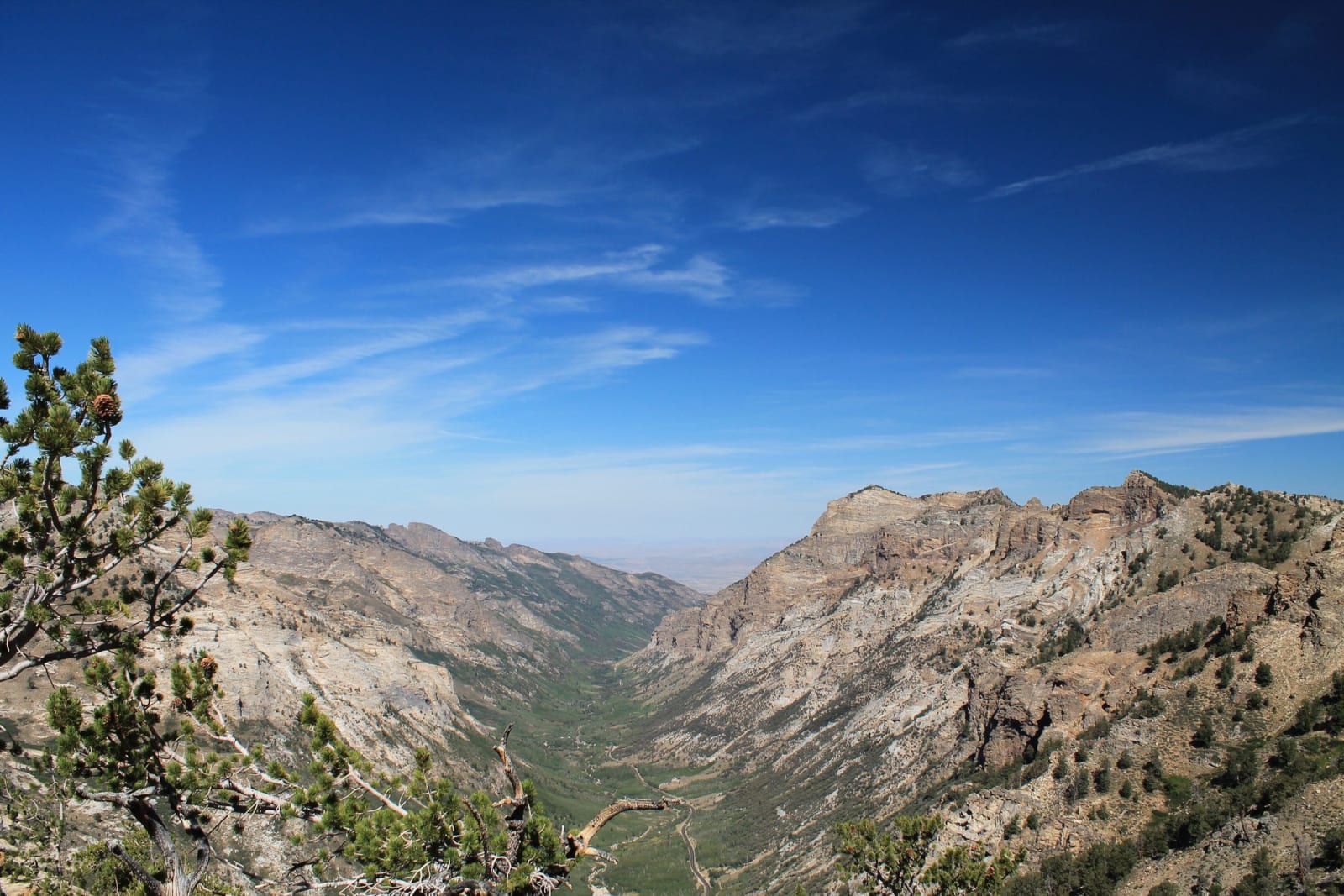
The way in is Lamoille Canyon, the largest valley in the range and a textbook of the last ice age. Glaciers gouged it into a broad U a thousand feet deep, hung side valleys above the floor, and filled the basins with cold tarns as they melted back — Lamoille Lake, the Dollar Lakes, Liberty and Favre and Castle, climbing the staircase toward the crest. Ruby Dome, the high point, stands a few miles south at eleven thousand three hundred eighty-seven feet, glaciated and snow-streaked the year around. Geologists call the Rubies a metamorphic core complex: a slab of the deep crust shoved up and laid bare. What you walk on is rock that was once miles underground, polished by ice and set out in the desert sun.
Most of it is reachable on a single paved road. The Lamoille Canyon Scenic Byway runs twelve miles up the canyon from the town of Lamoille to Road's End at eight thousand eight hundred feet, climbing past waterfalls, avalanche chutes, and meadows that go off like fireworks with wildflowers in early summer, with pullouts that read the glacial story straight off the walls. It is one of the great drives in the West, and it asks nothing of you but the gas to get up it — though it closes with the first heavy snow and does not reliably reopen until Memorial Day. In winter the same canyon becomes the base for Nevada's only heli-skiing, lifting skiers onto powder no lift could reach.
Road's End is also where the walking starts. Short legs reach real alpine country fast: Island Lake sits two miles up in a hanging cirque, Lamoille Lake a little farther, both glacial tarns near the timberline. From the same lot the Ruby Crest National Recreation Trail runs the spine of the range roughly forty miles south to Harrison Pass — a three-to-four-day backpack through lake basins and over ten-thousand-foot passes, among the finest in the Great Basin. The wildlife is its own draw: bighorn sheep and mountain goats on the high rock, elk in the meadows, and, improbably, the Himalayan snowcock — a gray game bird turned loose here in the 1960s that found the Ruby crest enough like home to stay, now the only wild population in North America. Birders charter helicopters just to glimpse it.
What's here now is wilderness with a paved approach, a rare and forgiving pairing. You can drive to a glacial overlook in street shoes, or shoulder a pack and not see another soul for days. The high country is a summer-and-early-fall proposition — the snow that feeds the heli-skiing buries the trails into June, and weather turns fast at altitude. Cell service quits at the canyon mouth. Bring water, layers, and a full tank, and tell someone where you're going.
It is the answer to anyone who thinks they have read Nevada off the windshield of I-80. An hour off the interstate, the state that spent three hundred miles as brown sage stands up into glaciers and granite. The Rubies are why the people who know this corner are quietly possessive of it — and the single best reason to turn off the Humboldt and climb.
Visitor Info
On the Map
Stories featuring this place
Go deeper into the history and character of this stop
Nearby
The closest stops worth working into your route
Historical markers nearby
Roadside plaques and monuments within a short detour