 Xrzt / CC BY-SA 4.0
The Story
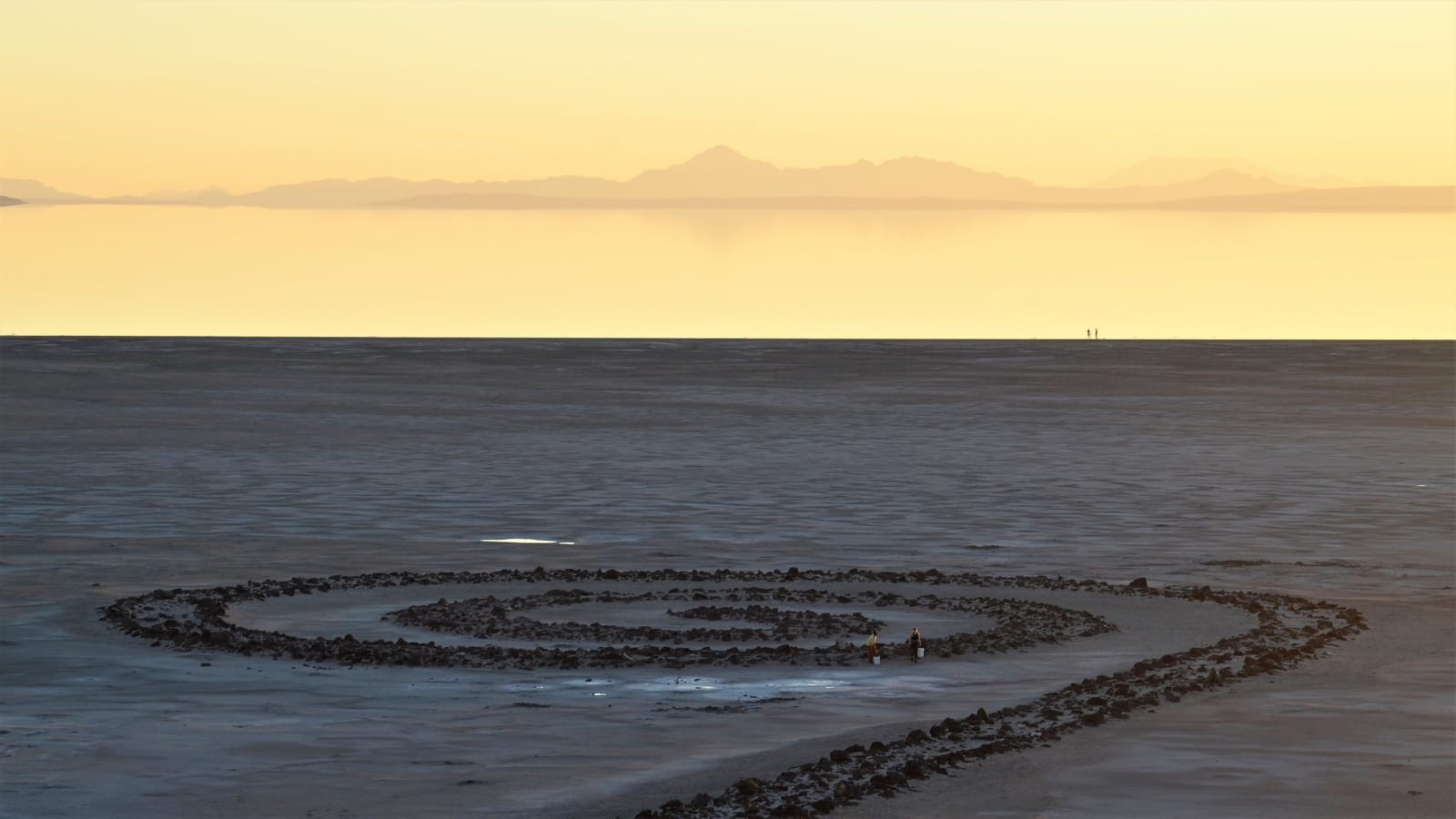
Spiral Jetty is not easy to get to, and that is part of the point. You drive north along the edge of the Great Salt Lake, past the Golden Spike National Historical Park, down a series of increasingly rough dirt roads, through cattle gates you have to open and close yourself, until the road ends at the shore of a lake that does not look like any lake you have ever seen. The water is pink. The ground is white with salt. And extending from the shore into the shallow brine is a 1,500-foot-long coil of black basalt rock, curling counterclockwise like a galaxy seen from above.
Robert Smithson built Spiral Jetty in April 1970 using 6,650 tons of black basalt boulders, earth, and salt crystals, arranged in a spiral formation that extends into the northeastern arm of the Great Salt Lake. It is one of the most important works of art created in the twentieth century — a landmark of the Land Art movement that sought to take art out of galleries and embed it in the landscape itself. Smithson chose this site specifically for its remoteness, its otherworldly coloring, and its connection to entropy — the slow, inevitable decay of all organized systems. The jetty was designed to change over time, to be submerged and revealed by the fluctuating lake levels, to accumulate salt crystals and algae, to become part of the landscape rather than merely sitting on top of it.
For most of its first three decades, the jetty was underwater. The lake level rose after its construction and submerged the spiral completely, and many people assumed it was gone. Then, in 2002, a prolonged drought dropped the lake level enough to expose the jetty again, and it reemerged covered in a thick crust of white salt crystals that transformed its appearance entirely. The original black basalt was now ghostly white, and the contrast against the pink and red water — colored by halophilic bacteria that thrive in extreme salinity — created a visual spectacle that Smithson could not have predicted but almost certainly would have loved.
The jetty's visibility depends entirely on the lake level, which fluctuates with precipitation, snowmelt, and water diversions. In wet years it disappears. In dry years it stands fully exposed, its coils visible from the hillside above like an ancient petroglyph carved into the lakeshore. Checking current conditions before making the drive is essential — the Dia Art Foundation, which now manages the work, maintains updates on visibility. But even when the jetty is partially submerged, the site is worth visiting. The landscape itself — the pink water, the white salt flats, the distant mountains shimmering in heat haze — is so surreal that it justifies the journey on its own terms.
Walking the jetty when it is exposed is a meditative experience. The basalt rocks are rough and uneven underfoot, crusted with salt that crunches with each step. The spiral draws you inward, turn by turn, until you are standing at the center point surrounded by water on all sides. The silence is enormous. The only sounds are wind, the occasional cry of a gull, and the faint lapping of brine against rock. The scale shifts as you walk — from the hillside the jetty looks modest, but standing at its center the coil stretches away in every direction, and the lake and sky merge into a single plane of pink and blue.
Smithson died in a plane crash in 1973 while surveying a site for a new work in Texas. He was 35. Spiral Jetty was completed only three years before his death, and it remains his masterpiece — a work that has outlived its creator by more than half a century and continues to evolve in ways he set in motion but could never fully control. The salt accumulation, the bacterial coloring, the rising and falling water — these are not threats to the artwork. They are the artwork. Smithson understood that nature does not preserve. It transforms. And Spiral Jetty is a collaboration between human intention and natural process that will continue for as long as the lake exists.
The drive out to the jetty takes about two hours from Salt Lake City, and the last 15 miles are on unpaved roads that can be muddy or rutted depending on conditions. There are no facilities, no water, no shade, and no cell service. Bring everything you need and take everything with you when you leave. The remoteness is deliberate. Smithson wanted visitors to earn the experience, to feel the distance between the gallery world and the lake shore, to arrive at the spiral having already been changed by the journey. He was right. By the time you reach the jetty, you are ready to see it.
Visitor Info
On the Map
A story featuring this place
Go deeper into the history and character of this stop
Nearby
The closest stops worth working into your route
Historical markers nearby
Roadside plaques and monuments within a short detour