The Story
Antelope Island is a place of contradictions that somehow resolve into something beautiful. It is a rugged, mountainous island sitting in the middle of a vast salt lake. It is home to a herd of free-roaming bison that were brought here as an experiment over a century ago and never left. It smells, on certain days, like a chemistry lab — brine shrimp and salt flats baking in the sun — and yet the sunsets from its western shore are among the most extraordinary in the American West. It is strange, wild, and utterly unlike anything else in Utah.
The island is the largest in the Great Salt Lake, roughly 15 miles long and 5 miles wide, connected to the mainland by a seven-mile causeway that crosses the shallow southern arm of the lake. The causeway leaves I-15 a few exits north of Lagoon, Utah's historic Farmington amusement park, running since 1886. Driving across the causeway is an experience in itself — water stretches to the horizon on both sides, flocks of shorebirds wheel overhead, and the island rises ahead like a desert fortress, its ridgeline climbing to nearly 7,000 feet above sea level.
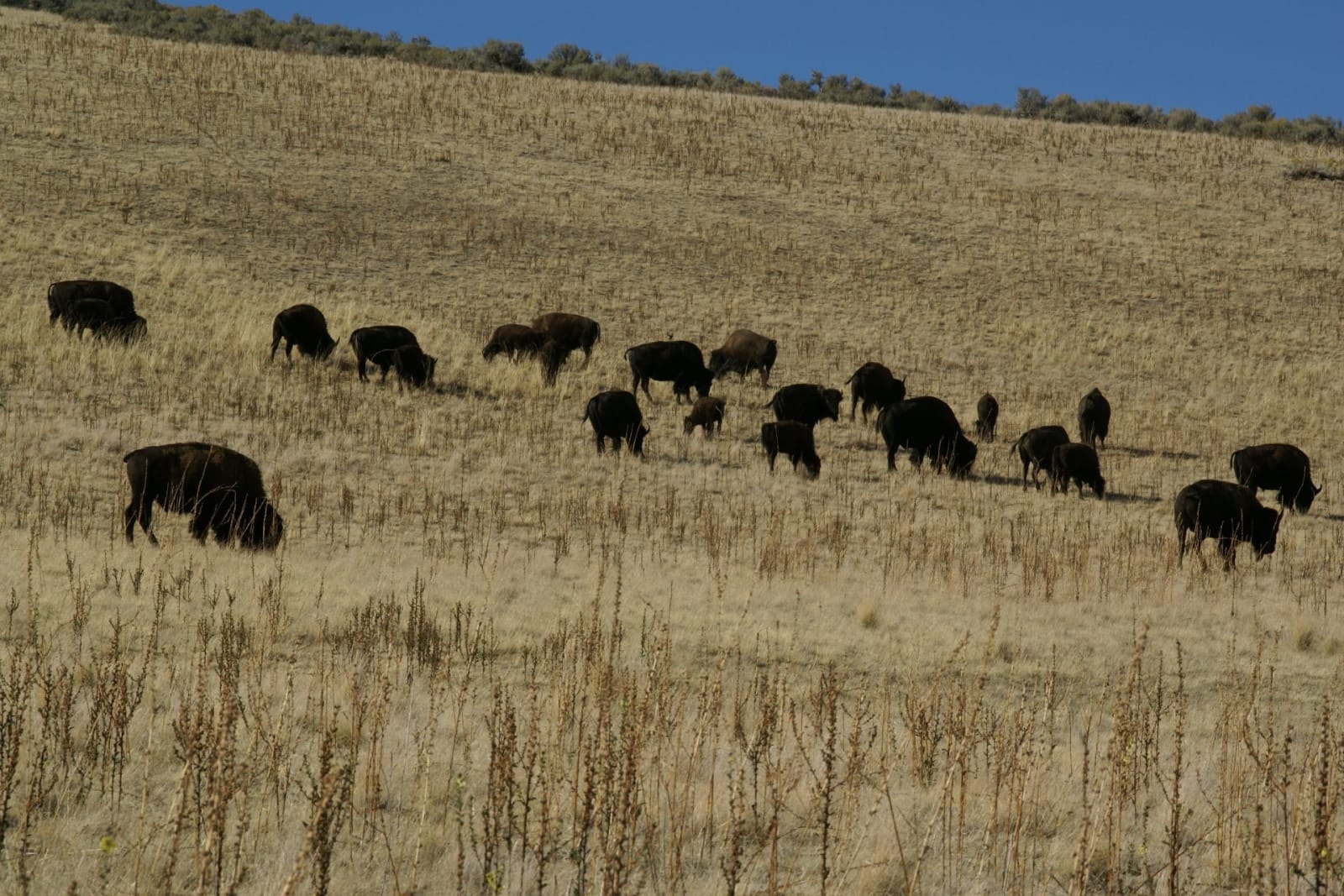
The bison are the main attraction for many visitors, and they do not disappoint. The herd of 500 to 700 animals descends from just 12 bison brought to the island in 1893 by John Dooly and William Glasmann, who wanted to preserve the species at a time when bison were being hunted to near extinction across the West. The island proved ideal — surrounded by water too salty for the bison to swim across, with enough grass, springs, and space to sustain a healthy population. Today the herd is one of the oldest and most genetically significant publicly owned bison herds in the country.
Every fall, usually in late October, the park conducts its annual bison roundup — a massive operation involving horseback riders, ATVs, and helicopters driving the entire herd into corrals for health checks, vaccinations, and population management. The roundup is open to spectators, and watching 600 bison thunder across the sagebrush flats with riders galloping alongside is one of the most thrilling wildlife spectacles in North America.
Beyond the bison, the island supports a surprising diversity of wildlife. Pronghorn antelope — the animal that gave the island its name when explorers John C. Fremont and Kit Carson visited in 1845 — still roam the grasslands. Mule deer browse the mountain slopes. Coyotes hunt the flats at dawn and dusk. And the shorebirds are extraordinary — the lake's brine shrimp and brine flies support millions of migratory birds, including Wilson's phalaropes, American avocets, and eared grebes in numbers that make Antelope Island one of the most important shorebird staging areas in the Western Hemisphere.
The hiking is surprisingly rugged for an island in a lake. Frary Peak, the island's high point at 6,596 feet, is reachable by a steep trail that gains over 2,000 feet and offers panoramic views of the lake, the Wasatch Front, and on clear days, the distant Uinta Mountains. Buffalo Point, a shorter and easier walk, provides sweeping views of the northern lake and the causeway. The Lakeside Trail follows the eastern shore past white sand beaches — yes, actual beaches on a salt lake — where you can wade into water so salty that floating is effortless and involuntary.
The lake itself is a remnant of ancient Lake Bonneville, the same prehistoric body of water that created the Bonneville Salt Flats. As the climate dried over thousands of years, the lake shrank to a fraction of its former size, and its salt concentration increased dramatically. Today the Great Salt Lake is three to eight times saltier than the ocean, depending on water levels and location. No fish survive in the open water — only brine shrimp and brine flies, which form the foundation of the ecosystem that supports the millions of birds.
The smell is real, and it is worth addressing honestly. On warm days, particularly on the causeway and near the shoreline, the combination of brine shrimp, algae, and salt flat chemistry produces a sulfurous odor that ranges from mildly pungent to genuinely aggressive. It fades as you move inland and uphill, and most visitors acclimate within half an hour. Do not let it deter you. The landscape on the other side of that smell is worth every breath.
Sunset from the western shore of Antelope Island is a private showing of one of nature's best performances. The sun drops toward the lake, the water turns gold and pink and violet, and the salt-haze horizon blurs the line between water and sky into a wash of color that looks like it was painted by someone who had never heard of subtlety. There are no crowds. No admission lines. Just you, the bison grazing in the middle distance, and a sky that refuses to quit.
Visitor Info
On the Map
A story featuring this place
Go deeper into the history and character of this stop
Nearby
The closest stops worth working into your route
Historical markers nearby
Roadside plaques and monuments within a short detour