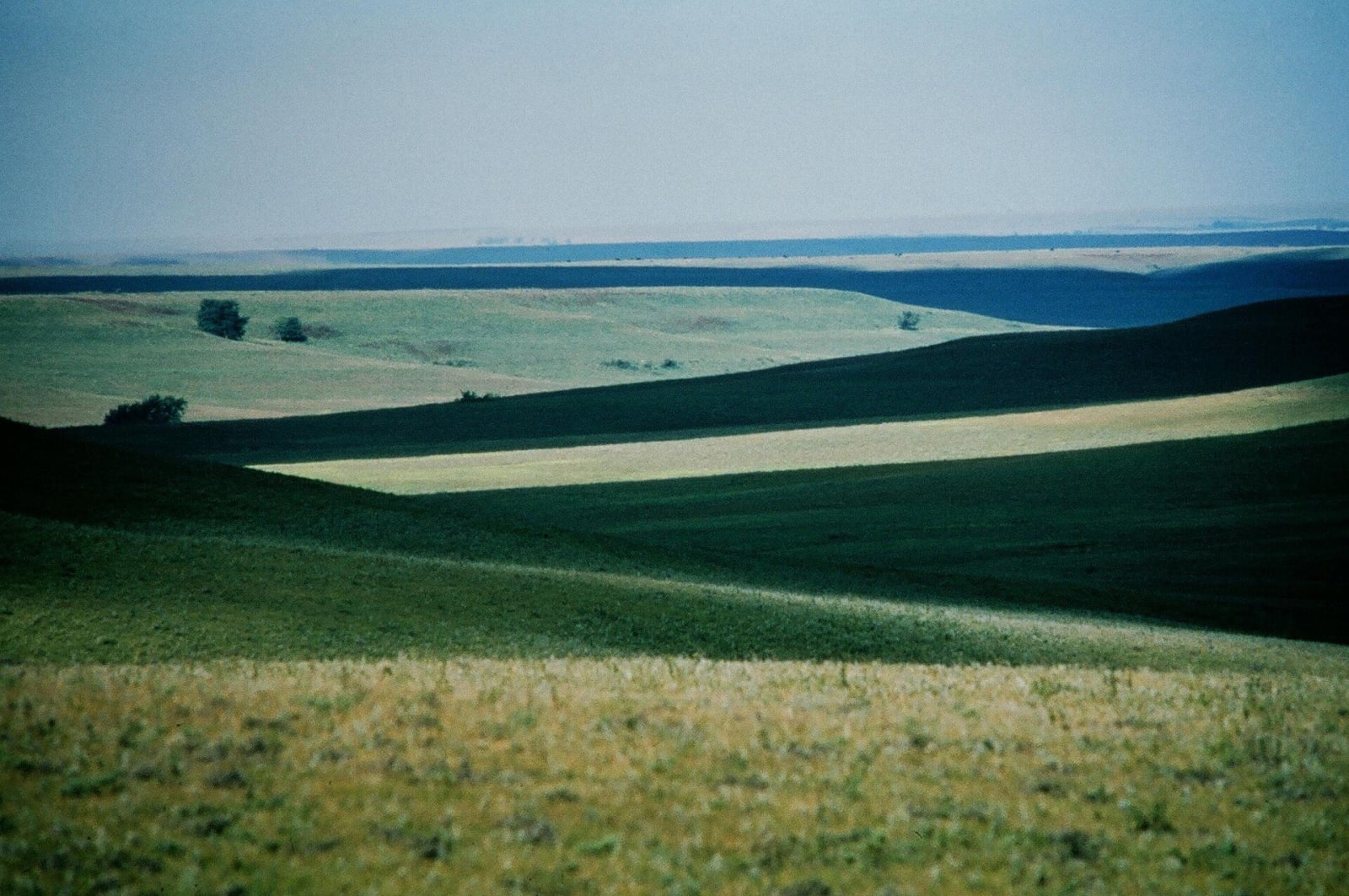
Mike Blair, Kansas Department of Wildlife and Parks (NARA) / public domain via Wikimedia Commons
A 5-Day Itinerary
The Flint Hills, the Santa Fe Trail and the Chalk in 5 Days
From Kansas City across the state and back: Quindaro, Haskell and Monroe School, the Konza and Tallgrass prairies on K-177, the Santa Fe Trail to Fort Larned and the Dodge City ruts, Lake Scott, Little Jerusalem and Monument Rocks, the Sternberg, the Garden of Eden and Abilene.
5 days · 893 miles · best in spring & summer & fall
Kansas City, KS → Abilene, KS
Most people cross Kansas on I-70 in a day. This trip takes five and makes a loop of it: west from Kansas City through Lawrence and Topeka to Manhattan, south on K-177 through the Flint Hills, west on US-56 along the line of the Santa Fe Trail to Dodge City, north on US-83 into the chalk of Scott, Logan and Gove counties, and back east on I-70 through Hays and Lucas to Abilene, about two and a half hours' drive from where it began.
The land it crosses belonged to nations who are still here or were forced out. Konza Prairie carries the name of the Kanza, the Kaw Nation, removed to Indian Territory under an act of May 27, 1872, over Chief Allegawaho's protests; the Nation owns a piece of its last Kansas reservation near Council Grove again. The Wichita towns Coronado found in 1541 stood near the great bend of the Arkansas. Fort Larned was an agency for the Cheyenne, Arapaho, Kiowa, Comanche and Plains Apache, and in April 1867 Hancock had a Cheyenne and Lakota village up the Pawnee Fork burned. At Lawrence, Haskell's own museum tells what its boarding school did to the children sent there. Those stories are told at the places where they happened.
1
Day 1
Kansas City to Manhattan
127 mi · about 2.6 hrs driving · overnight in Manhattan
Start on the bluff above the Missouri in Kansas City, Kansas, at Quindaro, the free-state landing a company of Wyandot leaders and Emigrant Aid men laid out in 1856 on Nancy Quindaro Brown Guthrie's allotment. An overlook on North 27th Street looks down on the ruins, and the marble John Brown statue from the Western University years stands at 27th and Sewell Avenue. Take I-70 west to Lawrence. The Haskell Cultural Center, open weekdays from 10, tells the boarding school that opened here in 1884 in its own words: children as young as three or four, hair cut short on arrival, languages and prayer forbidden, a campus jail used until 1933. Downtown, the Watkins Museum of History fills J. B. Watkins's 1888 mortgage-company bank, with the town's antislavery founding and Quantrill's raid of 1863 on the second floor. In Topeka, Monroe School, where Linda Brown went, tells how Lucinda Todd and 13 families brought the case decided on May 17, 1954. From Topeka it is about an hour west on I-70 and K-177 to Manhattan.
2
Day 2
K-177 Through the Flint Hills
105 mi · about 2.8 hrs driving · overnight in Council Grove
Walk early at Konza Prairie, south of town off McDowell Creek Road, where the nature trails open at dawn. The short loop, about two and a half miles, crosses Kings Creek, passes the Hokanson Homestead and climbs limestone ledges to a view over the Kansas River valley. The station is named for the Kanza, forced out between 1846 and 1872. Back in town, the Flint Hills Discovery Center opens at 10 with the overview, from the rock to the ranchers who still burn and graze the pastures. Then take K-177 south through Council Grove to the Tallgrass Prairie National Preserve, Stephen F. Jones's ranch, whose 1881 house of Cottonwood limestone is full of fusulinid fossils the size of wheat grains; the Scenic Overlook Trail climbs 3.2 miles into the bison pasture. In Cottonwood Falls, the Chase County Courthouse of 1872-73, built of the same stone, is open until 5. Drive back north to Council Grove and southeast of town to Allegawaho Memorial Heritage Park, the Kaw Nation's own land, where a two-mile trail passes the ruins of three of the 1862 stone houses.
3
Day 3
The Santa Fe Trail to Dodge City
251 mi · about 5.3 hrs driving · overnight in Dodge City
This is the long day, so leave Council Grove early, west on US-56, the line of the Santa Fe Trail, past Herington and McPherson to Lyons. The Coronado Quivira Museum, open from 10, starts with the Wichita and Affiliated Tribes, whose towns stood in Rice County from about 1425 to 1700 and whom Coronado found in 1541 instead of gold; a full-size grass lodge stands inside. Go on to Great Bend and northeast on K-156 to Cheyenne Bottoms, a 64-square-mile sink where an estimated 45 percent of North America's migratory shorebirds stage. The Kansas Wetlands Education Center is free. US-56 runs past Pawnee Rock to Larned. Two miles west of town, the Santa Fe Trail Center spreads over ten buildings, from a sod house to the Frizell depot. Four miles on is Fort Larned, its sandstone barracks of 1866-68 around the parade ground, open until 4:30; if time is short, go to the fort first. In April 1867 Hancock met Cheyenne chiefs here, then burned the empty Cheyenne and Lakota village up the Pawnee Fork. Drive south through Kinsley and west on US-50 to Dodge City.
4
Day 4
Boot Hill, the Ruts and the Chalk
173 mi · about 4.9 hrs driving · overnight in Oakley
Be at the Boot Hill Museum when it opens, at 9 outside summer. Its collection, begun by Chalkley Beeson in the 1870s, runs past 60,000 objects, and the museum is plain that Gunsmoke was shot on a Hollywood set. Nine miles west on US-50, the Santa Fe Trail ruts braid across 140 acres of shortgrass for about two miles, as much as 400 feet wide. Follow the Arkansas west to Garden City, then US-83 north past Scott City until K-95 drops into the canyon at Historic Lake Scott. Its springs watered the fields of El Cuartelejo, the stone pueblo that Pueblo families fleeing Spanish rule built among the Plains Apache in the later 1600s; the rebuilt foundation is on the west side of the lake. Back on US-83, Gold Road leads west to Little Jerusalem, chalk walls more than a hundred feet above the Smoky Hill, seen from two rim trails. Across the highway, Dakota Road and about nine miles of county gravel reach Monument Rocks, pillars of the same seabed on private ranch land, where the Keyhole Arch widens every year. Skip the gravel after rain. Then go north on US-83 to Oakley.
5
Day 5
Hays, Lucas and Abilene
237 mi · about 4.5 hrs driving · overnight in Abilene
Take I-70 east to Hays and the Sternberg Museum of Natural History, open from 9 in the dome by the interstate. It carries the name of the family who dug for Cope and Marsh, and it holds the Xiphactinus with a Gillicus inside it that George F. Sternberg collected in 1952, beside a diorama of the Cretaceous sea. Go on east and north on US-281 and K-18 to Lucas and S. P. Dinsmoor's Garden of Eden, 113 tons of cement poured between 1907 and 1928 around his post rock cabin: Adam and Eve on the west side, Labor crucified by a doctor, a lawyer, a preacher and a capitalist on the north, and his own glass-lidded coffin. K-18 runs east to US-81 and I-70 for Abilene. At the Eisenhower Presidential Library, the last museum entry is at 3:30, and tours of the boyhood home on Southeast Fourth Street are paused until late November 2026. The grounds and the Place of Meditation, where Ike, Mamie and their son Doud lie, are free and open until sunset; if the day runs long, the museum opens at 9 the next morning.
The drives this trip follows
Each one is traced end to end on its own page, with every stop worth making along the way.