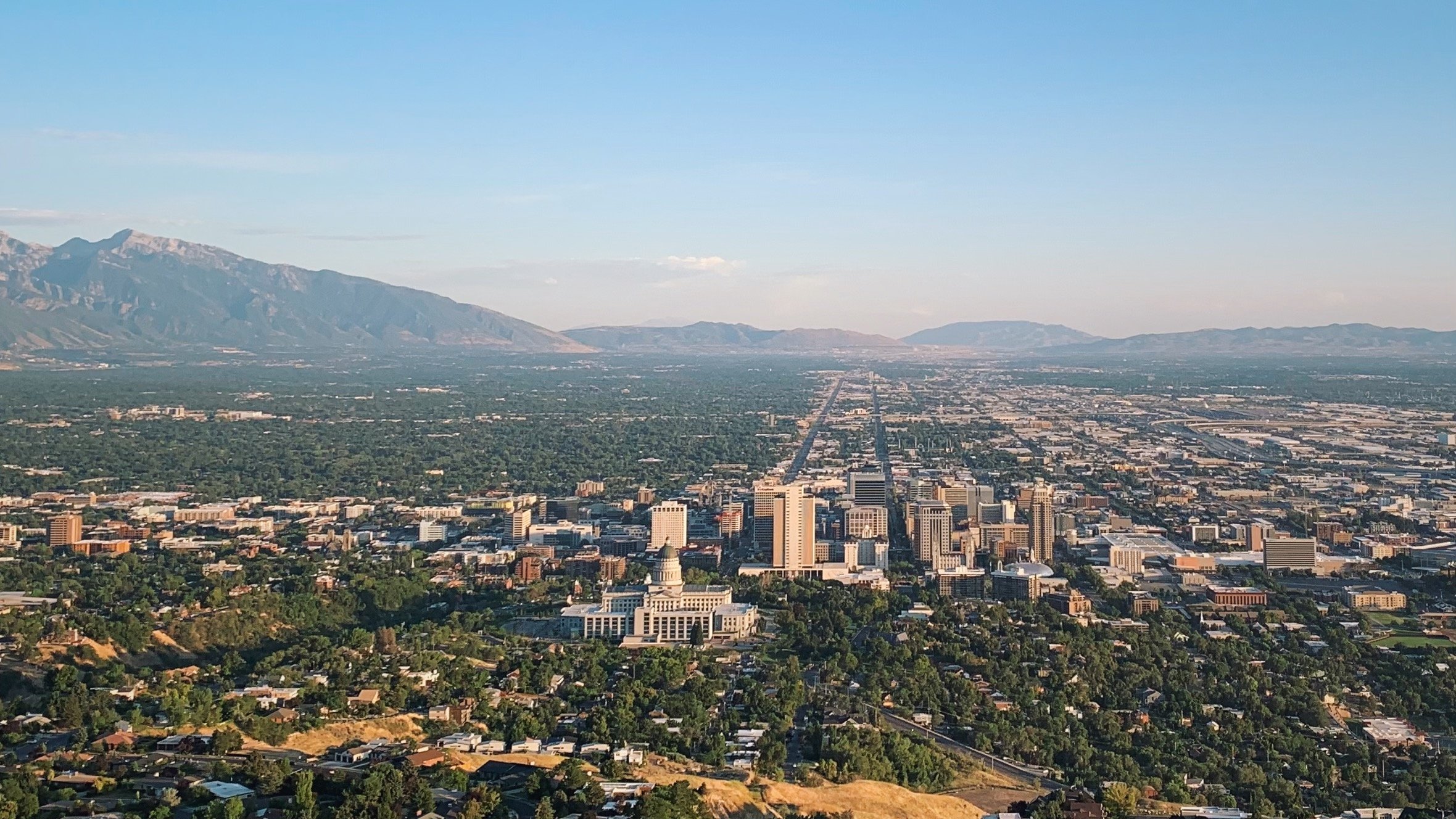
Beneath the Salt Lake Temple, over the past few years, crews dug seventeen feet under a foundation that pioneers laid in 1853 and set the entire granite building on ninety-eight isolation bearings, each one rated to carry eight million pounds. The point of the bearings is to let the temple move. When the ground under downtown finally lurches sideways, the temple is meant to ride above it, sliding as much as five feet in any direction while the earth does what it will, so that a cathedral built by hand over forty years is not shaken to rubble. The work cost an estimated two billion dollars and is wrapping up in 2026. It is the most expensive insurance policy in the state, and it is aimed at a single feature in the ground: the Wasatch Fault.
What the fault is
The Wasatch Fault is the seam where the West comes apart. It runs roughly two hundred and forty miles, from near Malad City in southern Idaho down to Fayette in central Utah, and it marks the eastern edge of the Basin and Range — the stretched, broken country that reaches all the way to Nevada and California, pulling apart a few millimeters a year. It is a normal fault, which means the two sides are separating rather than grinding past each other: the mountains on the east ride up, the valleys on the west drop down, and the range tips slowly eastward like a trapdoor hinged along its far edge. It is the longest continuous active fault of its kind in the United States, it has been moving for something like seventeen million years, and roughly eight out of ten Utahns have built their lives within sight of it.
You can learn to read it in an afternoon. The Natural History Museum of Utah sits on the foothills above the city, its copper walls tilted to match the angle of the rock strata behind it, and the building itself stands on a shelf the fault helped make. Inside, the Land gallery lays out the three ideas you need — the Colorado Plateau, the Basin and Range, and the fault between them — and once you have them, the drive home rearranges itself into cause and effect.
The lift
Start with the wall. The Wasatch Range exists because the fault keeps dropping the land in front of it, and nothing shows the bare mechanics better than the Wellsville Mountains at the northern end — the steepest mountains in North America for their height, five thousand vertical feet thrown up in four horizontal miles, a slab of range stood nearly on edge. The fault runs along their western foot, the valley floor sinking along it while the peaks climb, and the mountains are still rising, measurably, today. The same engine works the whole length of the range. Two hundred miles to the south, at Devil's Kitchen on the flank of Mount Nebo, the fault lifted a body of seventy-million-year-old river rock high enough for weather to carve it into red hoodoos — the range's far southern end, riding up on the same machine that built its north.
The drop
Every mountain the fault raises is matched by a basin it drops, and the Great Salt Lake lies in the lowest of them — a shallow, briny sheet with no outlet, sitting in a hole the fault has been deepening for millions of years. It is the leftover of something far larger. During the last ice age this basin held Lake Bonneville, a freshwater inland sea nearly the size of Lake Michigan and a thousand feet deep, lapping against the mountains where the suburbs now end. When the climate dried, the lake shrank to the salt puddle that remains — but on its way down it left its high-water marks cut into the range.
The bathtub ring
Those marks are the benches, and they are the most important flat ground in Utah. As Lake Bonneville stood at one level for centuries, its waves cut a terrace into the mountainside; when it dropped and held again, it cut another, lower one. The cities are built on those steps. The University of Utah and the museum sit on the highest, the Bonneville shoreline, about five thousand feet up; Brigham Young, Utah State, and Weber State all sit on the lower Provo bench. Drive almost any street on the east side of the valley and you are climbing a beach that has been dry for fifteen thousand years. The easiest place to stand on one is the mouth of Emigration Canyon, where the hundred-mile Bonneville Shoreline Trail traces the old waterline as a level path across the slope. And here is the proof the fault never stopped: in places the bench itself has been cut and offset, the same shoreline left standing higher on one side of the fault than the other — a line the lake laid down dead level, and the fault has been bending ever since.
The plumbing
The fault does quieter work too. Where it shatters the rock it opens deep cracks, and water sinks down them, warms against the heat of the earth, and rises again — which is why a string of hot springs follows the base of the range. The strangest surfaces inside a hollow limestone dome at Homestead Crater near Midway, where mineral water that has been underground a long time comes up at a steady ninety-six degrees and has spent ten thousand years building its own beehive of stone, one wet layer at a time. The fault is the plumbing; the dome is what the plumbing built.
The seafloor in the sky
And the lift reaches deeper than the rock you can see. High on the wall of American Fork Canyon, thousands of feet up in the Wasatch, the chambers of Timpanogos Cave are dissolved into limestone that formed on the floor of a warm sea three hundred and forty million years ago. The fault hoisted that seafloor into the alpine cold and held it there long enough for groundwater to hollow it out — an ocean bottom you now have to climb a thousand vertical feet to reach.
The bill
All of this is the same motion, and it is not finished. The mountains, the snow they catch, the rivers that water the cities, the benches the houses stand on, the warm springs, the view out every east-facing window — the Front got all of it from the fault, and the fault will eventually collect. Its five central segments, from Brigham City through Salt Lake and Provo to Nephi, each let go in a magnitude-seven earthquake every couple of thousand years, and somewhere along that central stretch a big one arrives, on average, about every three hundred years. The Salt Lake segment has not had a large one in roughly twelve hundred years, which puts it late in its cycle. The current best estimate gives the Wasatch Front a forty-three percent chance of a magnitude 6.75 or larger earthquake, and a fifty-seven percent chance of a magnitude six, in the next fifty years. The small Magna earthquake of March 2020 — magnitude five and seven-tenths, enough to crack plaster and knock the trumpet from the angel atop the temple — was the fault clearing its throat, not speaking.
Which is what the bearings under the temple are really about. A community that arrived with nothing and built a granite landmark by hand is now spending two billion dollars to let that landmark slide, because the same fault that gave the valley its mountains, its water, and the very ground the city is terraced onto will, on a schedule no one controls, ask for some of it back. The Wasatch Front is the most beautiful place in Utah to live on top of a fault. Everyone there does, whether they look up at the benches or not.