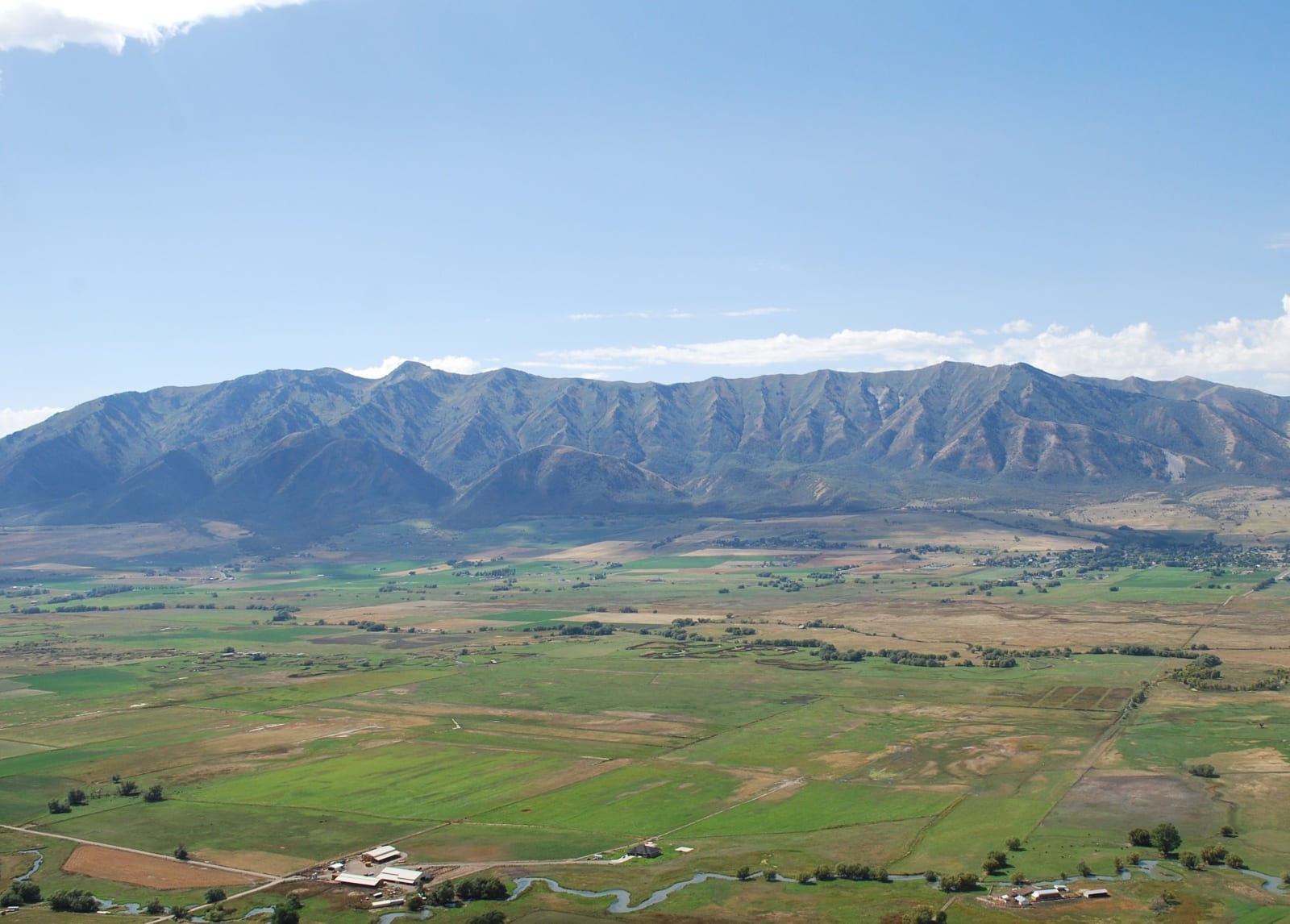
 Steve Sellers / CC BY-SA 2.0
The Story
The Wellsville Mountains hold a record that sounds like a mistake until you see them in person: they are the steepest mountains in North America for their height. The range rises over 5,000 vertical feet in just four horizontal miles from the floor of Cache Valley, creating a wall of rock so abrupt that it looks like the Earth tilted a slab of mountain on its edge and forgot to lay it back down. The peaks top out at nearly 10,000 feet, and the western face plunges to the valley floor at roughly 4,400 feet, making the angle of ascent brutally direct. There is no gradual approach. The mountains simply start, and they go straight up.
The range is also remarkably narrow — barely five miles wide at its broadest point — which contributes to the steepness record. Most mountain ranges spread their elevation gain across broad foothills and intermediate ridges. The Wellsvilles skip that entirely. The valley floor ends and the mountainside begins, and the transition is so sharp that houses in the town of Wellsville sit within a mile or two of slopes that would challenge an experienced mountaineer. The town is also home to the American West Heritage Center, a living-history farm and pioneer village spread across the bench at the foot of the range. The effect from the valley is dramatic — a dark, forested wall rising behind the town like a theatrical backdrop, snow-capped well into June, casting afternoon shadows that reach across the fields.
The main hiking route is the Wellsville Ridge Trail, and it is not for casual walkers. The trail climbs roughly 3,000 feet in about four miles from the Deep Canyon trailhead to the ridgeline, gaining elevation at a relentless grade through scrub oak, maple, and eventually subalpine fir and spruce. The lower sections are hot and exposed in summer, and the upper sections can be windy enough to knock you off balance. But the ridgeline, once you reach it, is extraordinary — a narrow spine with views extending west across the Great Salt Lake and east across Cache Valley to the Bear River Range, with the distant Uinta Mountains visible on clear days.
The Wellsville Mountains are also one of the premier raptor migration corridors in the western United States. Every autumn, thousands of hawks, eagles, and falcons funnel along the narrow ridge on their southward migration, riding the thermals and updrafts generated by the steep western face. The HawkWatch International monitoring station on the ridge has documented over 20 species of raptors passing through, and peak migration days can see hundreds of birds in a single morning — red-tailed hawks, sharp-shinned hawks, Cooper's hawks, golden eagles, and the occasional peregrine falcon slicing through the flock at speed. Birders and raptor enthusiasts hike to the monitoring station in September and October to witness the spectacle, and the combination of mountain scenery and aerial wildlife is unlike anything else in the region.
The range is designated as the Wellsville Mountain Wilderness, which means no motorized access, no mountain bikes, and no development beyond the trails themselves. The wilderness designation preserves the steep, rugged character of the mountains and ensures that the experience of climbing them remains physical and unmediated. There are no chairlifts, no maintained viewpoints with railings, and no shortcuts. You climb the Wellsvilles on your own legs, and you earn every foot of elevation.
The geology is a mix of Precambrian and Paleozoic sedimentary and metamorphic rocks — quartzite, limestone, and dolomite — pushed upward along the Wasatch Fault and tilted steeply by the same tectonic forces that created the Wasatch Range to the south. The Wasatch Fault runs along the western base of the range, and the mountains are still rising — imperceptibly, but measurably — as the valley floor drops along the fault line. The Wellsvilles are a young mountain range in geological terms, still being shaped by the forces that created them.
Wildlife beyond the raptors includes mule deer, elk, moose, mountain lions, and black bears, all of which inhabit the forested slopes and ridgeline meadows. The dense vegetation on the lower slopes provides excellent habitat, and the steepness of the terrain discourages the kind of heavy human traffic that pushes wildlife deeper into the backcountry in more accessible ranges.
The Wellsville Mountains are visible from nearly everywhere in Cache Valley, and locals tend to take them for granted the way people living near any landmark eventually do. But for visitors encountering them for the first time — driving north on Highway 89, watching the wall of rock grow taller and steeper with every mile — the Wellsvilles are a genuine surprise. Utah is famous for its red rock canyons and sandstone arches, not for mountains that rise like cliffs from the valley floor. The Wellsvilles are a reminder that this state's geological portfolio is deeper and stranger than the national parks alone suggest, and that some of the most impressive landscapes in Utah are the ones that never made it onto a postcard.
Visitor Info
On the Map
A story featuring this place
Go deeper into the history and character of this stop
Nearby
The closest stops worth working into your route
Historical markers nearby
Roadside plaques and monuments within a short detour