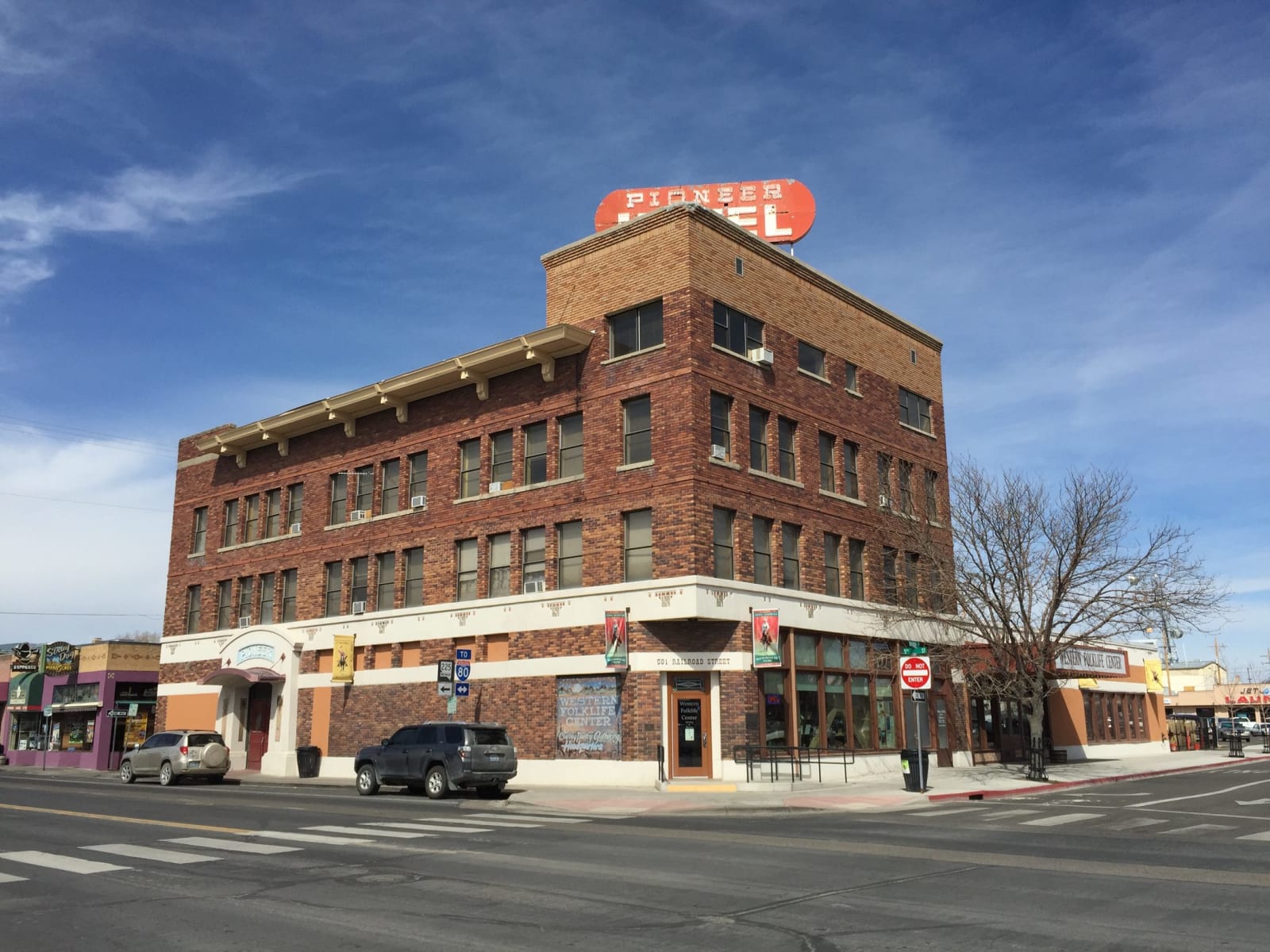
 Famartin / CC BY-SA 4.0
The Story
Elko is the rare Nevada town that never had to choose between its pasts, because it kept all of them running at once. The Central Pacific laid out the townsite in 1868 as a railhead and freight terminus, and the construction superintendent Charles Crocker — said to have had a weakness for animal names — christened it by adding an "o" to elk. The rails moved on; Elko stayed, made county seat in 1869 when the new Elko County was carved from Lander, and within two years it had a courthouse, two banks, forty-odd saloons, a newspaper, and the first University of Nevada, which opened here in 1874 and decamped for Reno a decade later when the local population slipped below a thousand. A railroad town, a county seat, a college town, a freight depot for a ring of mining camps — Elko was all of them before it was twenty years old.
What made it last was cattle. The grass valleys of the upper Humboldt grew some of the largest ranching outfits in the West, and Elko became their capital — the place where the buckaroo bought his gear, banked his pay, and wintered. The trade is still here, most visibly at J.M. Capriola Co. on Commercial Street, a working saddle and silver shop that has outfitted the Great Basin cowboy since 1929 and still turns out hand-tooled saddles and bits to order; upstairs, the Cowboy Arts and Gear Museum keeps the older G.S. Garcia saddlemaking tradition that fed it. This is gear made to be used, in a town where the people buying it have cattle to move come spring.
The cattle brought the Basques, and the Basques stayed. Sheep outfits run by men like Pedro Altube — a towering Basque rancher remembered as the father of his people in the American West, whose Spanish Ranch sprawled across the county — drew herders from the Pyrenees by the hundreds, and the boardinghouses that fed and housed them slowly opened their long tables to everyone. The Star Hotel has served Basque suppers since 1910, family-style and bottomless, the picon punch poured heavy; every July the town throws a Basque festival of weight-lifting, wood-chopping, and dancing that fills the city park. For a high-desert cow town, Elko sets a startlingly good table.
And then, in the way of Nevada, the ground gave up a second fortune. The Carlin gold that surfaced in the hills west of town in the 1960s turned Elko into a boomtown for the third or fourth time, and unlike the silver camps it has refused to bust — mining now drives most of the local economy, three of the largest gold operations on earth work within an hour's drive, and the town's population rises and falls with the price of the metal. In one twelve-month stretch in the 1980s it grew by a fifth. Elko does not feel like a place living off its history. It feels like a frontier town still very much open for business.
What's here now is a downtown that wears all of it at once. Idaho Street runs wide and busy past brick storefronts, Basque restaurants, the saddle shop, casinos with the lights still on, and the Western Folklife Center in the 1913 Pioneer building. The Northeastern Nevada Museum on the east side holds the regional history along with a wing of mounted wildlife and a glass case or two of pure local oddity. Great Basin College anchors the town the university left behind. The railroad that built the place was shoved out of the center in the early 1980s, its old downtown right-of-way paved into parking and the tracks rerouted to the river's edge — so the one thing Elko was founded on is now the thing you have to look for.
It makes a natural base. The Ruby Mountains rise some twenty miles southeast, the California Trail ran right past where the freeway now does, and the open sage country of the Newe — the Western Shoshone, whose people still live in and around town — runs out in every direction. Elko is where you fuel up, eat well, and sleep before the rest of Cowboy Country, and it is worth a day in its own right: the one Nevada town where the frontier never quite got around to closing.
Visitor Info
On the Map
Stories featuring this place
Go deeper into the history and character of this stop
Nearby
The closest stops worth working into your route
Historical markers nearby
Roadside plaques and monuments within a short detour