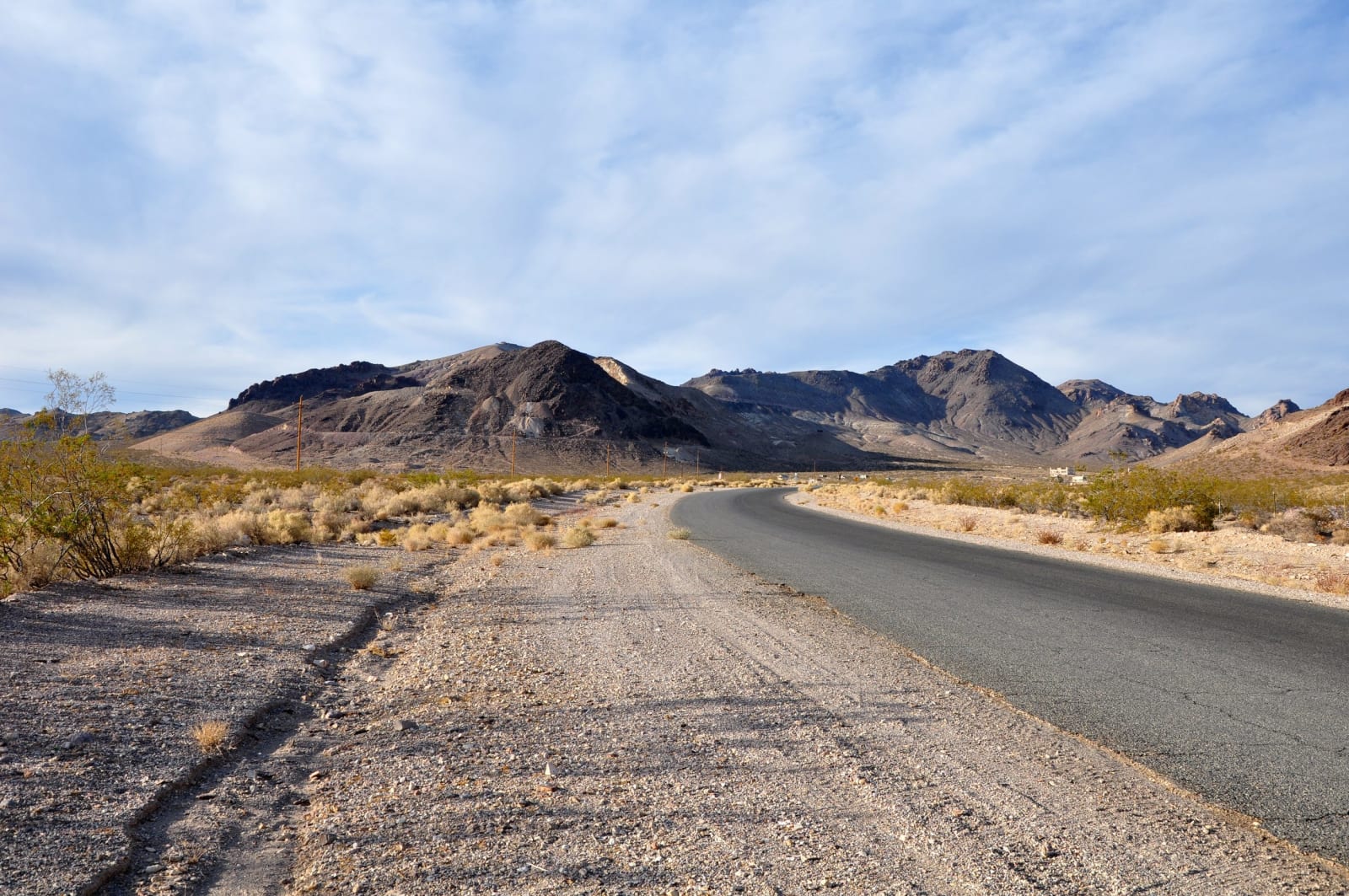
The Silver Trails are told as a human story — a prospector, a stray burro, a lucky rock, a city thrown up out of nothing, and then, a decade later, the sagebrush again. It is a good story, and it is the thin top layer of a much older and hotter one. Every camp on this drive sits on the same buried fact: the metal is here because the volcanoes were here first. The silver and gold that built Tonopah, Goldfield, and Rhyolite are the cooled residue of an extinct chain of volcanoes — and the desert still spells it out, right down to the name of the deadest town on the map.
An arc that isn't there anymore
Roughly twenty million years ago, in the Miocene, central Nevada sat over a subduction zone: the floor of the Pacific, the old Farallon plate, was grinding down and under the western edge of the continent, and the melt it squeezed out rose into a belt of volcanoes. It was the southern reach of the ancestral Cascades — an older, extinct cousin of the Shasta-and-Lassen chain that still smokes in California today, only this stretch of it ran straight through what is now the emptiest part of Nevada. For millions of years this country erupted: andesite and trachyte, sheets of welded ash, and the pale, silica-rich lava called rhyolite, piled thousands of feet deep. The volcanoes themselves are long gone — worn down, faulted apart, buried under their own debris. What is left of them is the ore.
How you cook a silver vein
A volcano is a heat engine, and it keeps working long after it stops erupting. Magma cooling a mile or two down warms the groundwater above it into a slow, circulating brine — superheated, chemically hungry water that dissolves the faint traces of gold and silver scattered through the surrounding rock and carries them up through cracks toward the surface. Where that fluid nears the top and begins to cool and boil, it can no longer hold its dissolved metal, so it drops it, lining the fractures with quartz and, threaded through the quartz, gold and silver. Run that process along one fault for tens of thousands of years and you have a vein — a lode. The camps here are two accents of the same language: Tonopah's silver came from cooler, quieter veins laced with quartz and adularia, while Goldfield's gold precipitated from hotter, acid fluids closer to the volcanic source, which bleached the rock and left the mineral alunite behind. Jim Butler's heavy rock and Shorty Harris's green ore were both just the exposed top of a fossil hot spring.
The town named for the rock
Of all the evidence, the plainest is a name. When a handful of claim owners platted a townsite in the Bullfrog Hills early in 1905, they called it Rhyolite — after the rock the whole district is built of. Rhyolite is a pale, buff-to-pink volcanic stone, the fast-cooled and fine-grained cousin of granite, thrown out of vents as sticky lava and ash; the Bullfrog Hills are the western edge of the great southwestern Nevada volcanic field, thousands of feet of rhyolite flows stacked over far older sea-bottom rock and then broken by faulting into tilted blocks, and the gold rode fractures through that pile. The claim that started the rush, "Bullfrog," had been named for a lump of green, gold-flecked rock a prospector thought looked like the back of a frog. The district named its ore for an animal and its town for a lava, and both were reading the volcano without quite knowing they were doing it.
Even the scenery
The fire turns up where you would least expect it. Drive to the quiet eastern end of the Silver Trails and the badlands of Cathedral Gorge — those soft clay spires you can walk into through cracks in the rock — are built largely of volcanic ash, blown from later eruptions into a Pliocene lake and settled into beds hundreds of feet deep. That was a different chapter, millions of years after the ore, from different volcanoes; but it is the same restless ingredient. In this corner of Nevada the volcano is never far beneath the surface. It made the metal that raised the towns and, a long age later and a hundred miles east, the ash that the rain is still carving into spires.
The system is only resting
The Silver Trails look like a story about luck, and greed, and time running out. Underneath, they are a story about fire — a vanished arc of volcanoes whose cooled veins the miners chased for a generation without ever seeing the mountains that made them. The boomtowns lived and died in a decade or two. The system that filled them took millions of years to build and, in geological terms, has merely gone quiet. You can read the ghost towns as monuments to human folly if you like. A geologist reads them as the opened plumbing of dead volcanoes — and notes that the deadest town on the drive is the one that got its name exactly right.