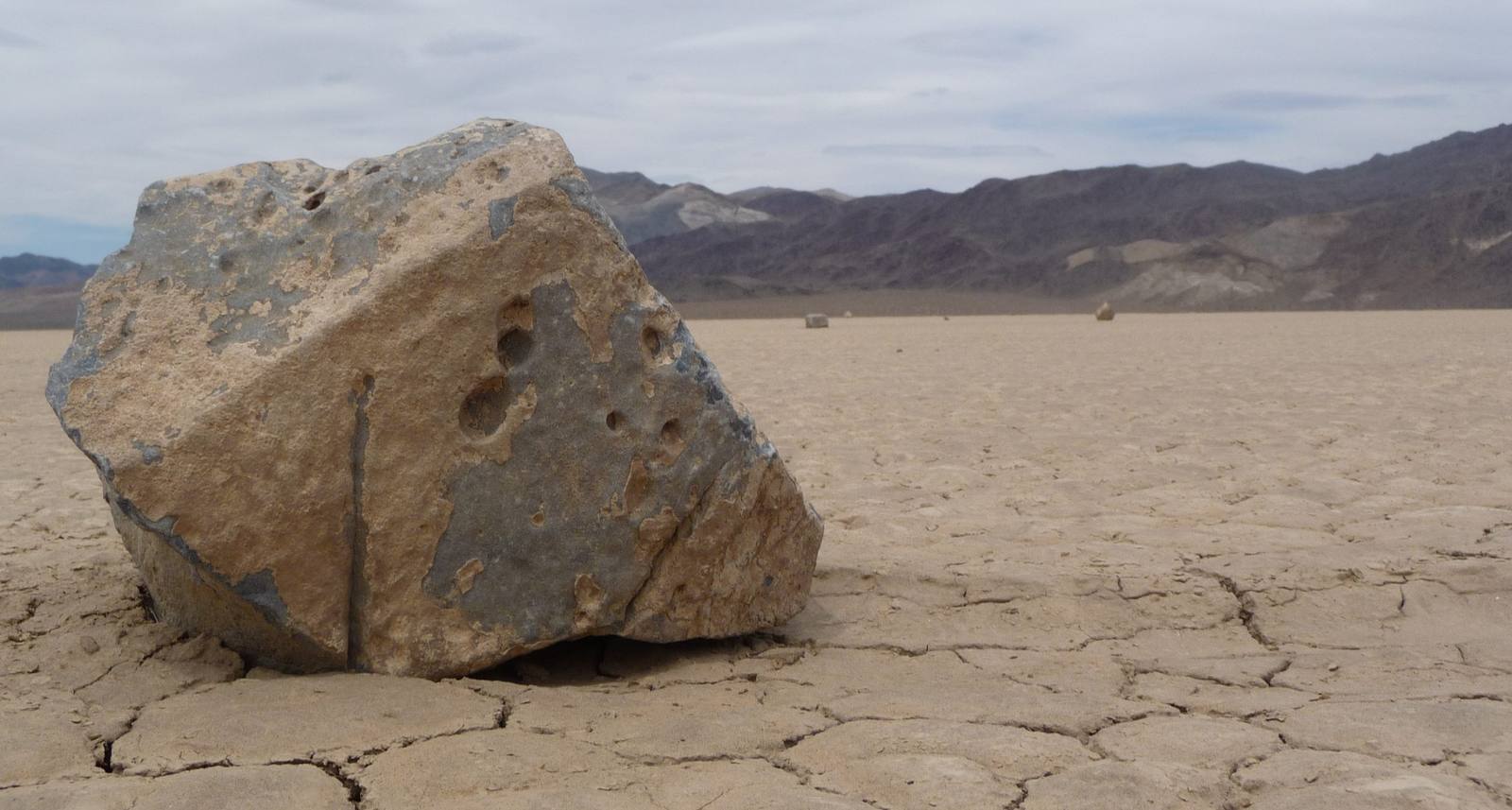
 Daniel Mayer / CC BY-SA 3.0 via Wikimedia Commons
The Story
For most of a century the rocks on this playa were a genuine mystery. They sit on a lakebed almost perfectly level across nearly three miles, some of them heavy enough to need two people to lift, and behind many of them run tracks scored into the dried mud, some straight, some curving, a few doubling back. Nobody had ever seen one move.
The answer arrived in the winter of 2013 and 2014, when a team led by Richard Norris and James Norris put GPS units inside fifteen rocks, set up a weather station, and waited. On a December day they watched it happen. Rain had left a shallow pond that froze overnight into ice only a few millimetres thick; as the sun loosened it, the sheets broke into floating panels, and a light wind pushed those panels against the rocks hard enough to shove them across the slick mud at a walking pace. More than sixty rocks moved at once. The mechanism turned out to be gentle, not violent, and exceptionally rare.
Getting here is the hard part. Racetrack Valley Road runs twenty-seven miles of sharp rock and washboard south from Ubehebe Crater, takes two to three hours each way, and shreds tires routinely; high clearance is required, four-wheel drive strongly advised, and a full-size spare is not optional. There are no services. Never walk on the playa when it is wet, and never move a stone.
Visitor Info
On the Map
Nearby
The closest stops worth working into your route
Historical markers nearby
Roadside plaques and monuments within a short detour