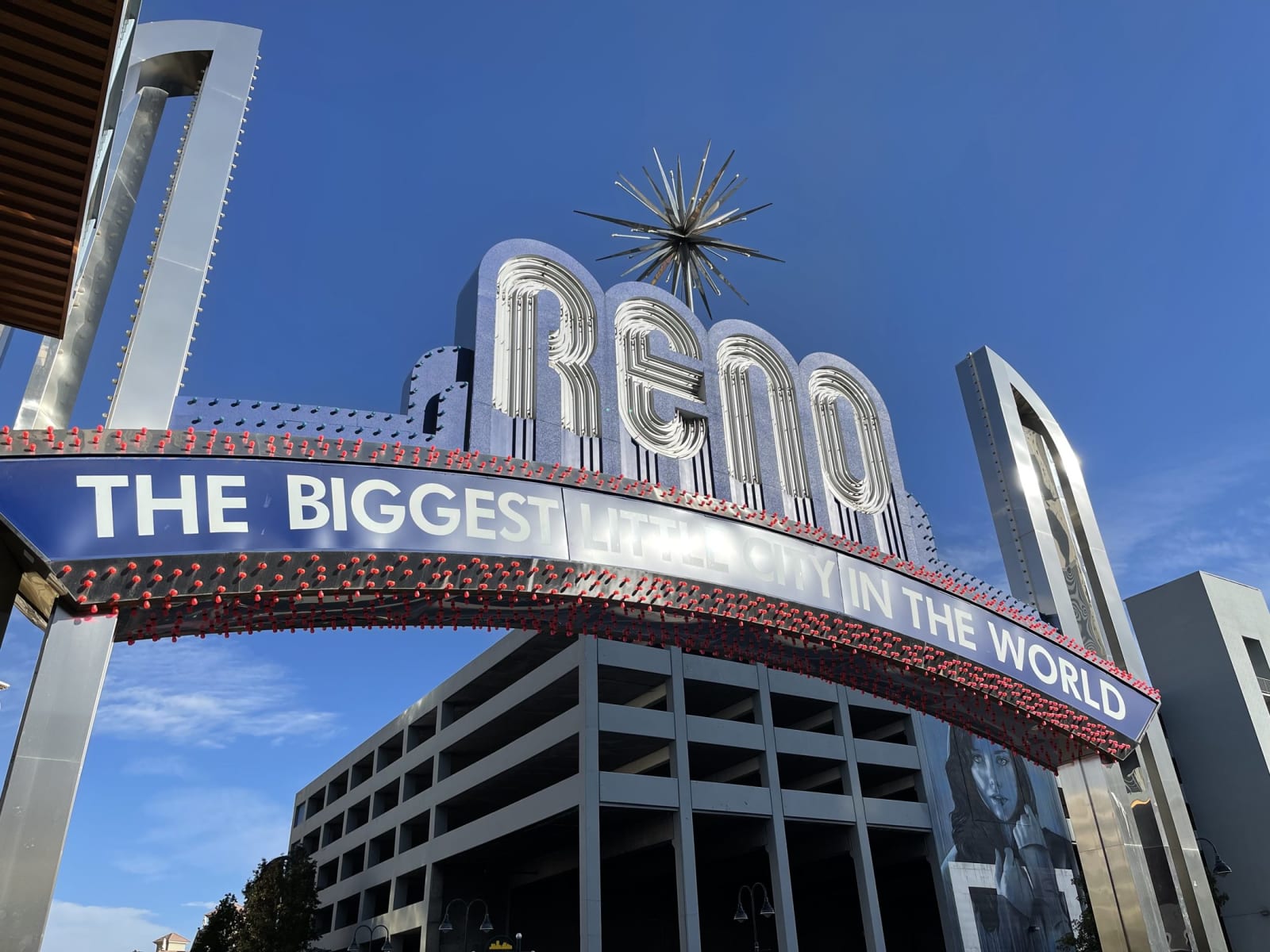
 Sarah Stierch / CC BY 4.0
The Story
Reno is the city the Comstock needed before it was a city at all. The Truckee Meadows—Washoe and Northern Paiute land, watered by the river running down from Lake Tahoe toward Pyramid Lake—had long been a place where California-bound emigrants rested and watered their stock before the hard climb over the Sierra. In 1859, as silver fever pulled traffic toward Virginia City, a man named Charles Fuller threw a log toll bridge across the Truckee to catch it; a few years later Myron Lake bought the bridge, added an inn, a mill, and a livery, and made "Lake's Crossing" the essential link between the California Trail and the mines. The town that became Reno started as a tollgate on the way to the silver.
What turned a river crossing into a city was the railroad, not the mines. In 1868 the Central Pacific, racing east to meet the Union Pacific and complete the transcontinental line, reached the Truckee Meadows; Lake deeded land for a depot, the railroad auctioned town lots, and homes went up almost overnight. The superintendent named the new town for Jesse Lee Reno, a Union general killed at South Mountain. Reno became the Washoe County seat in 1871, the Virginia & Truckee Railroad linked it to the Comstock in 1872, and the University of Nevada moved here in 1886. While Virginia City held the silver and the political clout, Reno became the principal town on the transcontinental line between Sacramento and Salt Lake—the place where the trains stopped, the goods were distributed, and the region did its business, which is the thing that lasts longer than any boom.
That instinct for outliving the boom became Reno's whole character. When the Comstock faded and Nevada cast about for an economy, Reno reinvented itself—twice over in a single stroke. In 1931, in the depths of the Depression, the state legalized casino gambling and cut the residency requirement for divorce to six weeks, and Reno seized both. It became the "Divorce Capital of the World," where Hollywood stars and New York socialites waited out their six weeks on dude ranches. And it became a gambling town a generation before Las Vegas, its downtown a canyon of neon—Harolds Club, Harrah's, the Riverside—beneath an arch that had crowned Virginia Street since 1926, blazing the slogan a public contest had chosen: "The Biggest Little City in the World."
What's here now is a city still reinventing—lately from gaming town toward a tech-and-university hub—with its layered past close to the surface. The Reno Arch still spans Virginia Street, rebuilt more than once and lit today in the silver and blue of the university. Bill Harrah's National Automobile Museum holds more than two hundred cars, one of the great collections in the country; the Nevada Museum of Art, the state's only nationally accredited art museum, anchors a growing arts scene nearby. The Truckee River, once just the thing to bridge, now runs through a downtown Riverwalk of restaurants and galleries, with Idlewild Park's rose gardens and the divorce-era Victorians of the "City of Trembling Leaves" upstream. South of downtown, the MidTown District has filled with boutiques and the Basque restaurants that nod to the herders who shaped northern Nevada for generations. The city's calendar still runs on big, improbable events—Hot August Nights and its classic cars, the dawn liftoff of the Great Reno Balloon Race, and a Reno Rodeo that has run for a full century.
Reno sits at the northwest hinge of the region, where Interstate 80 crosses U.S. 395, about forty minutes down from Virginia City, half an hour north of Carson City, and twenty-odd miles up from Lake Tahoe. The same Truckee that built the town is the water the Northern Paiute have always followed north from Tahoe to Pyramid Lake—a thread the region's story picks up beyond the city. Reno is the biggest place in this corner of Nevada and the one least content to stay any one thing: the river crossing that became a railroad town that became a gambling town that is becoming something else again. The silver built it a reason to exist; Reno has spent a century and a half inventing new ones.
Visitor Info
On the Map
Stories featuring this place
Go deeper into the history and character of this stop
Nearby
The closest stops worth working into your route
Historical markers nearby
Roadside plaques and monuments within a short detour