The Story
The town of Virginia City sits on the silver; the Chollar Mine is one of the places you can still go down into it. First staked in 1859 by a prospector named Billy Chollar, the claim tapped one of the richest stretches of the Comstock Lode, and over the next eighty years it gave up some seventeen million dollars in silver and gold—on its own at first, then, after an 1865 merger, as the Chollar-Potosi, by then backed by the Bank of California and the mining ring that controlled much of the lode. Its tunnels run straight back into the hill beneath C Street, and a guided tour still walks four hundred feet of them.
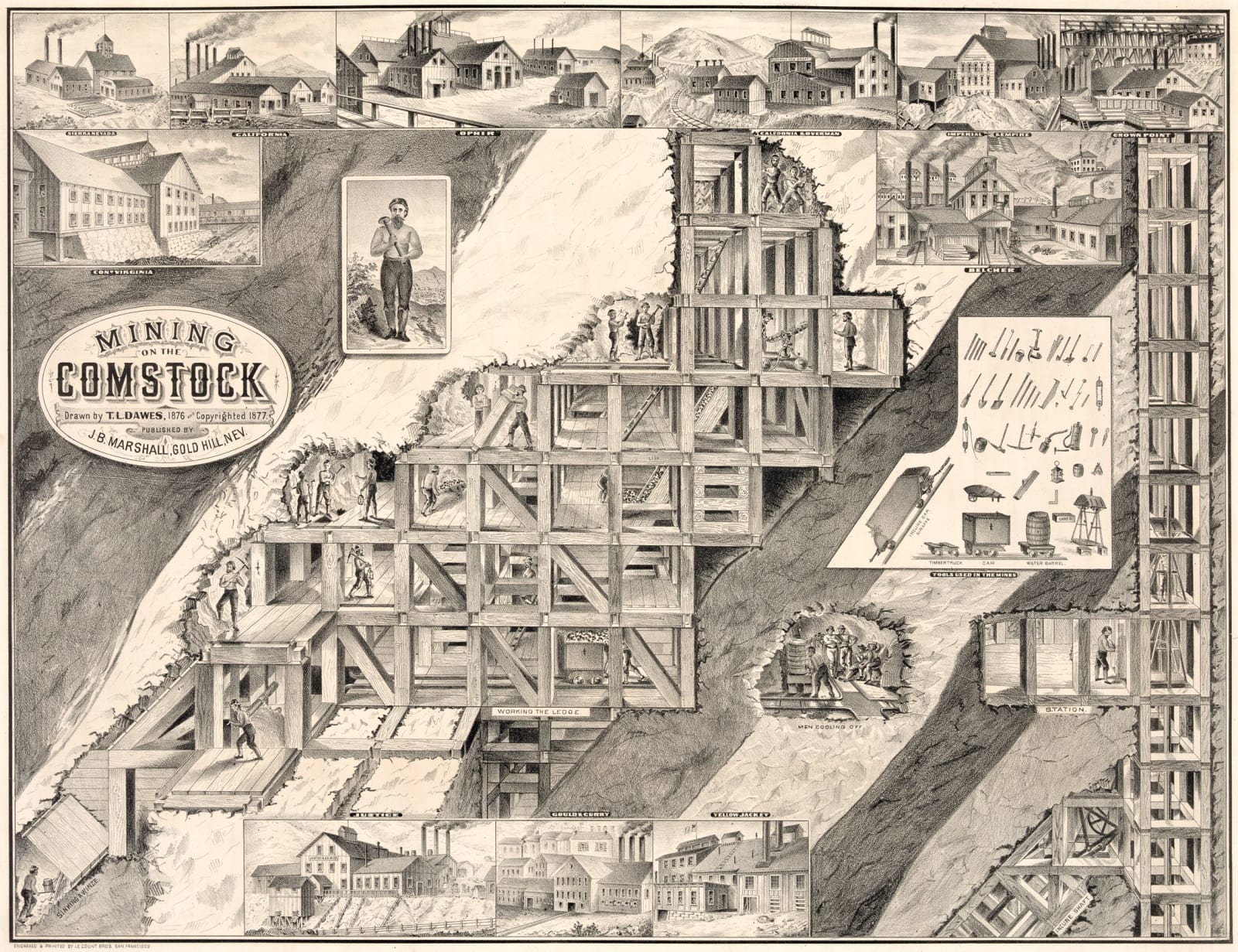
What the Chollar preserves better than any storefront above ground is the reality of the work. Comstock silver did not lie in tidy veins; it sat in great unstable masses of ore that slumped as fast as men could cut them. The mines went thousands of feet down into rock so hot that miners stripped to the waist and rested in chambers cooled with ice hauled underground, while water boiling up from below was pumped out by the millions of gallons. The work was brutal and often short—cave-ins, scalding floods, and fires in the timbered tunnels killed and maimed steadily, making the Comstock's mines among the deadliest workplaces in the country. The men who took the risk were largely Irish and Cornish immigrants, organized early into one of the West's strongest miners' unions, which held the daily wage at four dollars: good money, paid for in danger most people above never saw.
Reaching that ore at depth took an invention made here. As the soft ground defeated ordinary bracing, a German engineer named Philipp Deidesheimer devised square-set timbering—interlocking wooden cubes that could be stacked in any direction like a honeycomb, holding back rock nothing solid could. It made the deep Comstock possible and was copied in deep mines around the world. It also ate lumber by the millions of board feet, and that hunger stripped the forests of the Carson Range and Lake Tahoe nearly bare; the mine below and the clear-cut slopes above were two ends of one machine. The Chollar ran ahead of its time in other ways too: the Nevada Mill built here in 1887 was the first operation on the Comstock to generate and use electric power, carrying the mine from candlelight to current in a single working lifetime.
The tour is the genuine article, which means it is not a polished attraction. The four-hundred-foot adit is a real mine—low enough that most adults stoop, wet and muddy underfoot, the walls still streaked with the sticky blue-gray clay the first prospectors cursed before anyone knew it was nearly solid silver. Hardhats are required. The route follows the old ore-car rail past the marks of hand-drills and timber joints fitted in near-total darkness, ending in a stope—a mined-out chamber—braced by the original square-set frames. Near the end the guide lights a candle and kills the lights, and for a moment you stand in the exact dark men worked in by the shift. It is Comstock history with the polish left off—the ground itself rather than a museum behind glass.
One planning note: the Chollar opens seasonally, roughly late spring into October, and as a hundred-and-sixty-year-old relic it has at times closed for repair when hard winters damage the timbers and swell the walls. Confirm hours at the Virginia City Visitor Center on C Street, which sells tickets and can tell you which mine is running—the Best & Belcher tour, reached through the back of the Ponderosa Saloon a few blocks away, stays open year-round if the Chollar is shut. Either way, going underground is the part of a Virginia City visit the wooden sidewalks only hint at: the silver that built a state came up out of holes like this one, cut by hand, in the dark, for a wage.
Visitor Info
On the Map
Stories featuring this place
Go deeper into the history and character of this stop
Nearby
The closest stops worth working into your route
Historical markers nearby
Roadside plaques and monuments within a short detour