 Ken Lund / CC BY-SA 2.0
The Story
The Comstock took two things off Lake Tahoe: its timber, and its water. The timber went down the lumber flumes from Glenbrook & Spooner Summit; the water went up — over a mountain range, under its own pressure, in what was for a time the most audacious pipeline on earth. By the early 1870s the springs under Virginia City had failed, and the richest silver district in America was a desert town with nothing to drink. The fix, drawn up by a Prussian engineer named Hermann Schussler, was to reach across to the Sierra's east slope and simply carry the water home.
The obstacle was that a range stood in the way, and beyond it lay the deep trough of Washoe Valley. Schussler's answer was an inverted siphon: a riveted wrought-iron pipe that ran down one wall of the valley and back up the other, the water driven uphill by nothing but the weight of the water behind it. At the bottom of the dip the pressure passed eight hundred pounds per square inch — the highest-pressure pipeline in the world when it opened in 1873, double any before it. The pipe weighed seven hundred tons, held together by something like a million rivets, its iron shipped from Scotland and rolled in San Francisco. Men and mules laid the first seven miles across brutal country in about six weeks, and when the water reached Virginia City that August the town fired cannon and lit bonfires in the streets.
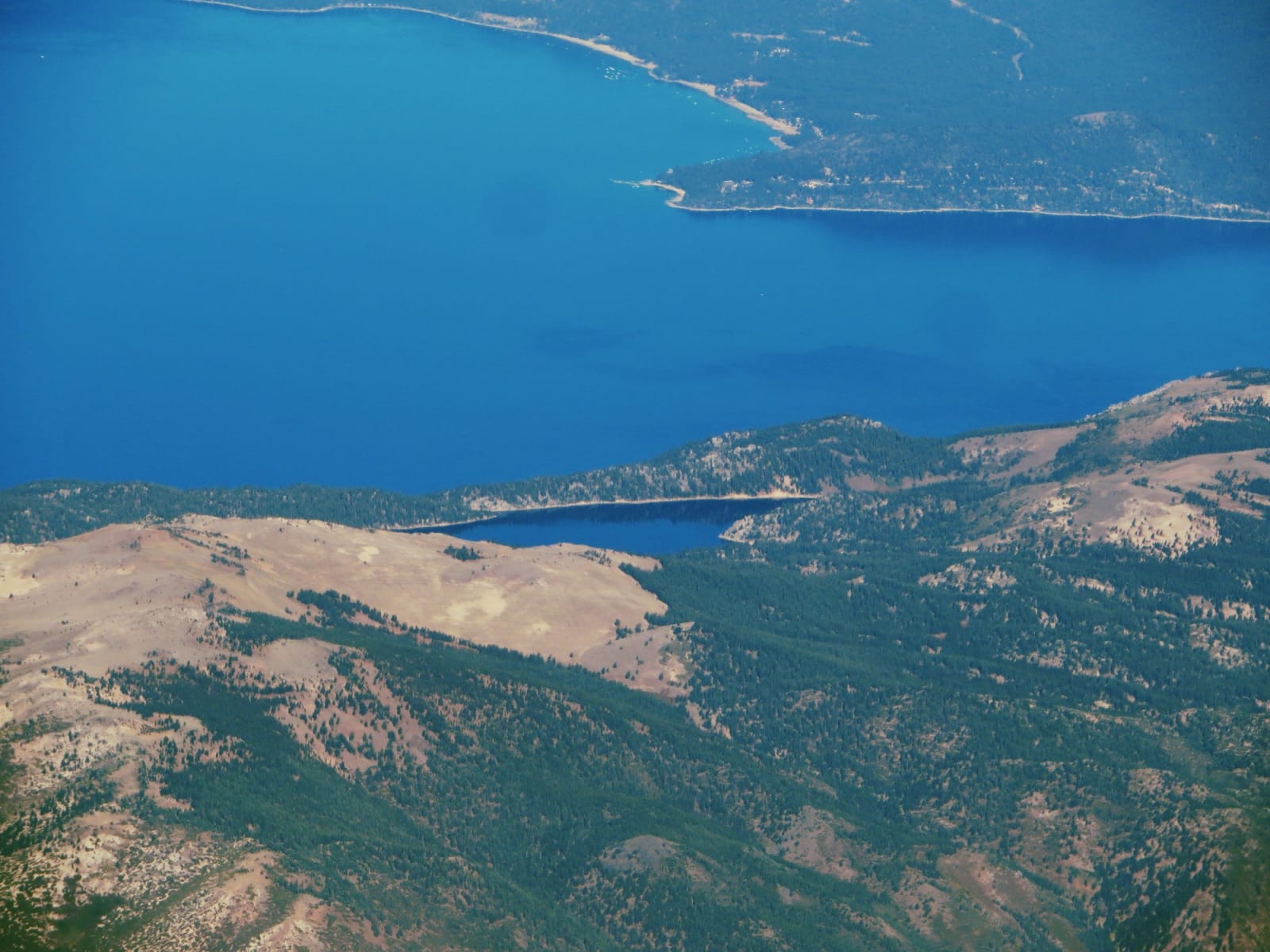
The source they finally tapped was Marlette Lake, a reservoir high in the Carson Range — first dammed in the 1860s for logging, then enlarged to feed the Comstock, its water sent through a flume and a four-thousand-foot tunnel bored clean through the mountain's spine. The remarkable part is that it never stopped. Nevada bought the whole system in 1963, and it still runs: Marlette water remains the only raw source for Virginia City, pushed through that same inverted siphon beneath the interstate and back up Washoe Valley, some of the original century-and-a-half-old pipe still in the ground. As one state engineer puts it, you don't go hunting for a leak in that line — at hundreds of pounds of pressure, it makes its own hole.
What's here now is the trail the flume left behind. When the wooden water flume was pulled out, its dead-level grade stayed, cut into the mountainside a few hundred feet above the lake — and it became the Flume Trail, one of the most famous mountain-bike rides in the country, a narrow bench with all of Tahoe falling away blue on one side. Marlette Lake itself sits at the top of the climb, closed to cars, reached only by the five-mile walk or ride up North Canyon from Spooner Lake. Its water still feeds the Comstock, and its fish now feed the state: Nevada raises Lahontan cutthroat here — the native trout that vanished from Tahoe — and ships the eggs out to restock waters across Nevada. The old earthen dam is being rebuilt as this is written, braced against the same earthquakes that keep deepening the lake below.
The gateway is Spooner Lake, at the junction of U.S. 50 and NV-28 atop Spooner Summit, where the state park charges a day-use fee and the trails begin. It is a hard day out — roughly ten miles round trip to Marlette and back, climbing to nearly eight thousand feet — and best from midsummer into fall, once the snow is gone. Come for the ride and the lake; stay for the odd fact underfoot, that the pipe running quietly beneath your tires has carried a mountain's water to a silver town for a hundred and fifty years.
Visitor Info
On the Map
A story featuring this place
Go deeper into the history and character of this stop
Nearby
The closest stops worth working into your route
Historical markers nearby
Roadside plaques and monuments within a short detour