The Story
If Virginia City is where the Comstock's silver came out of the ground, Carson City is where it turned into money and government. The town existed on paper before it existed in fact: in 1858 a former gold-seeker named Abe Curry, shut out of pricey land in Genoa, bought a ranch in Eagle Valley and laid out a town—setting aside ten acres for a capitol before there was even a territory that needed one. The gamble paid off. When Nevada Territory formed in 1861, Curry's town was named its capital; statehood in 1864 made it permanent. Curry built much of early Carson City from sandstone quarried by convicts at the state prison he ran, then died nearly broke in 1873, having willed a capital into being.
The silver made the rest. The Comstock poured out so much bullion that shipping it to the San Francisco mint grew absurd, so in 1870 the federal government opened a branch mint right here, in a squat sandstone building raised—like nearly everything official in town—from prison stone. From 1870 to 1893 the Carson City Mint struck gold and silver coins stamped with a distinctive "CC" mintmark, close to fifty million dollars' worth, now among the most prized coins American collectors chase. The ore that fed it came down from Virginia City on the Virginia & Truckee Railroad to the stamp mills strung along the Carson River at Empire, just east of town. Carson City was the place where the lode was counted, coined, and governed.
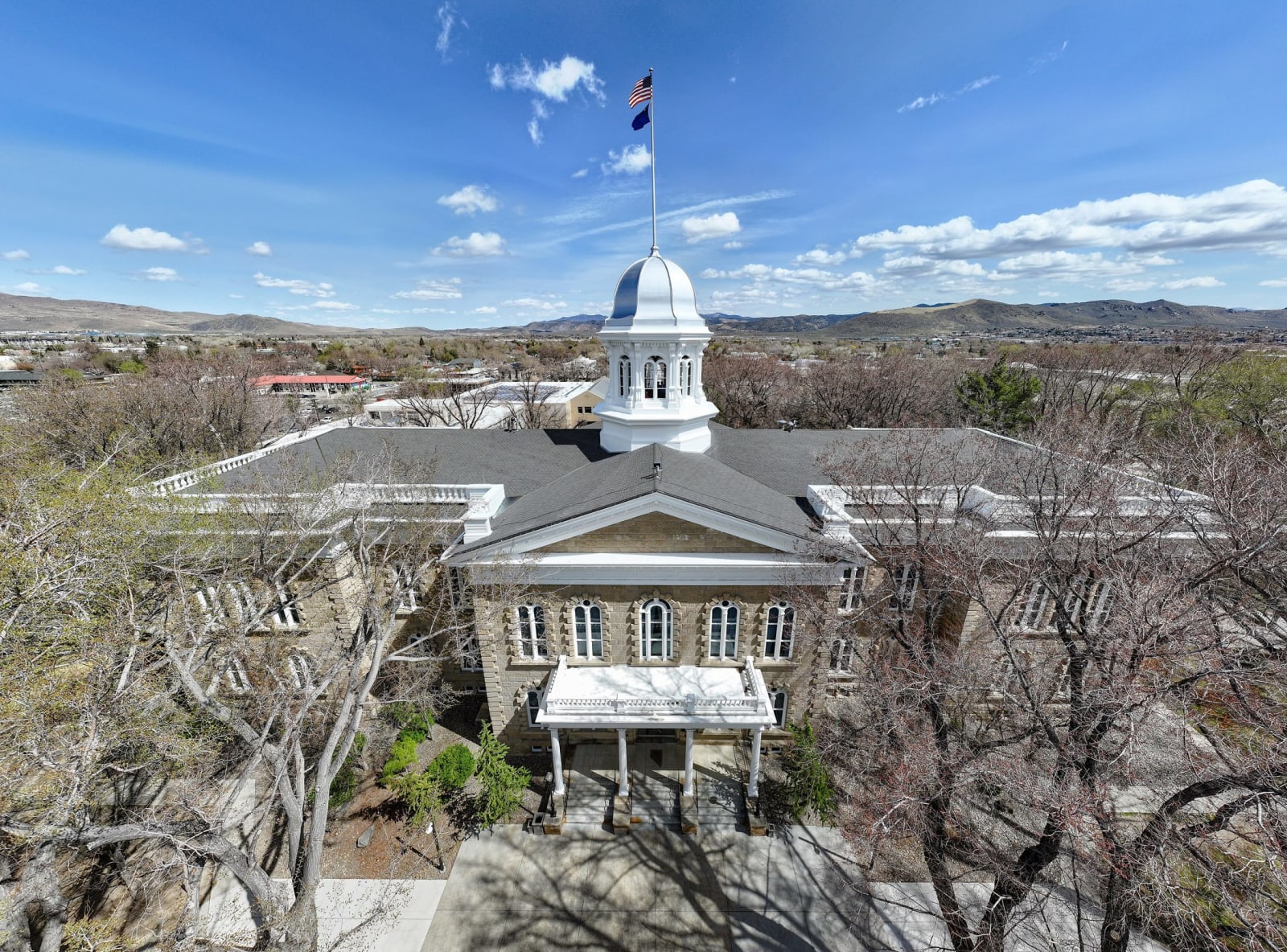
The capital it became is unusually legible, because so much of it went up at once and in stone, and so much survives. The silver-domed Capitol, finished in 1871, still holds the governor's office under a dome painted to honor the metal that built the state. The same prison sandstone went into the churches, the federal building, the orphans' home, and the mansions of the men who made fortunes off the lode and the Tahoe timber that fed it. It is a working capital rather than a museum town—the legislature still meets, the courts still sit—but its nineteenth-century bones stand everywhere aboveground.
When the Comstock faded, the capital improvised. Broke after the silver, Nevada legalized prizefighting while most of the country still banned it, and in 1897 Carson City staged the first legal world heavyweight championship bout—Bob Fitzsimmons dropping "Gentleman Jim" Corbett with his famous solar-plexus punch before thousands of spectators and three movie cameras, in what many consider the first feature-length film. It was an early sign of the scrappy reinvention that kept the small capital alive after its founding fortune ran out.
What's here now rewards a slow afternoon. The Carson City Mint is the Nevada State Museum today, and its original coin press still works: on Saturdays a docent strikes commemorative medallions on it, and for a few dollars you can have a silver blank stamped with the CC mark while you watch. The same museum holds a mammoth skeleton, the state's mineral and mining collections, and a walk-through replica of an 1860s silver mine in the basement. Across the plaza, the Capitol offers free tours and the Battle Born Hall of state history. The Nevada State Railroad Museum, a short way south, keeps original V&T locomotives and cars and runs them on summer weekends. And the Kit Carson Trail—a two-and-a-half-mile loop marked by a blue line and bronze medallions set in the sidewalk—threads the West Side Historic District past some fifty Victorian landmarks: the Bliss and Rinckel and Ferris mansions, the Governor's Mansion, the home where the Washoe weaver Dat-So-La-Lee made her famous baskets, and the Orion Clemens house where a young Sam Clemens stayed between stints reporting up the hill.
Carson City makes the natural hinge of the region. It sits where U.S. 50 comes in from the old Comstock mills to the east and U.S. 395 runs north toward Reno and south toward the Carson Valley, half an hour below Virginia City and a short climb from Lake Tahoe. Reno is forty minutes north; Genoa and Nevada's oldest ground lie just south. Stand on the Capitol plaza and the whole arrangement makes sense—the silver came down off the mountain, became coin in the sandstone mint, and built the small, dense capital that has run the state ever since.
Visitor Info
On the Map
Stories featuring this place
Go deeper into the history and character of this stop
Nearby
The closest stops worth working into your route
Historical markers nearby
Roadside plaques and monuments within a short detour