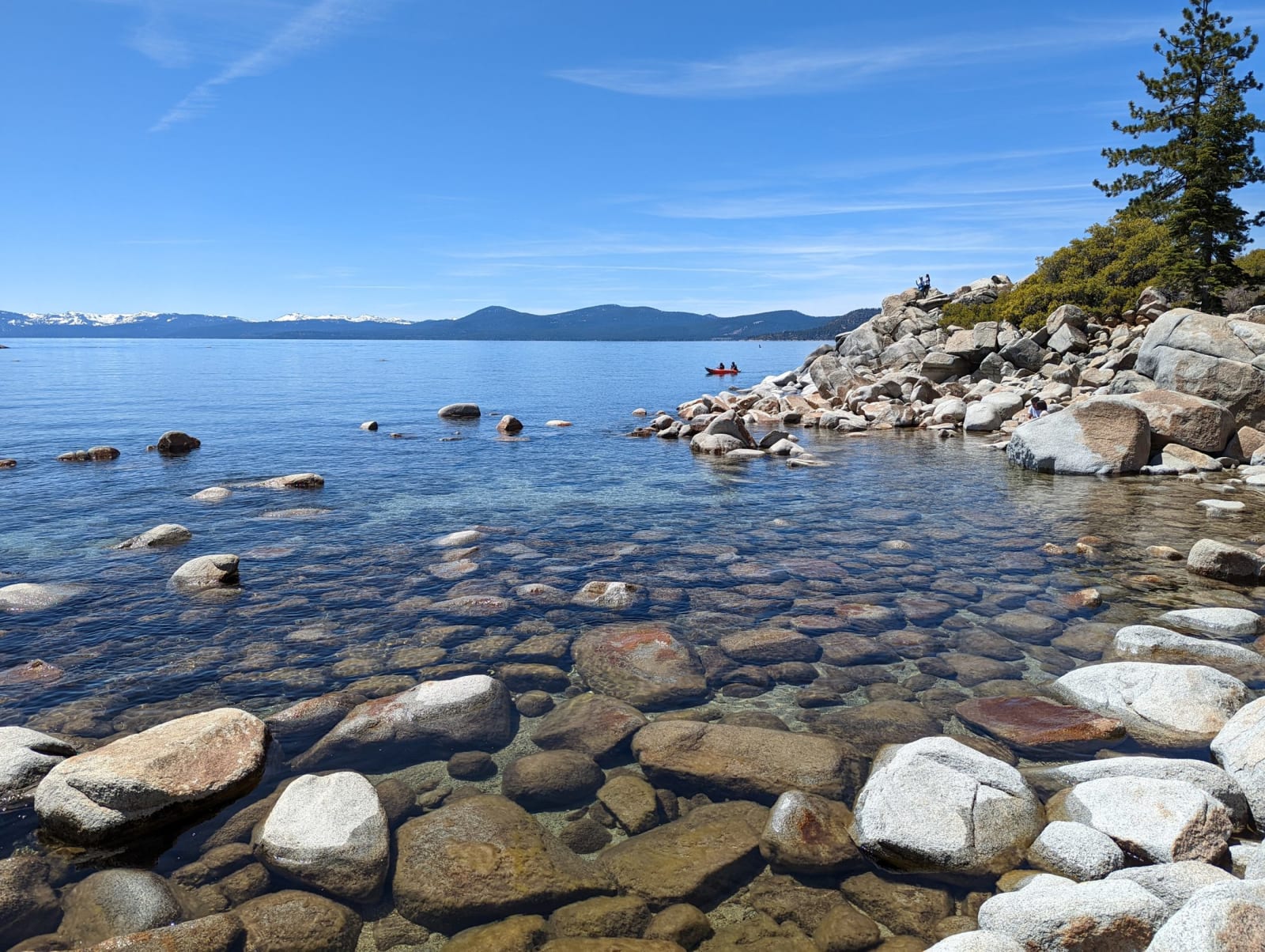
 Blake Everett Carroll / CC BY-SA 4.0
The Story
The Comstock's silver came out of the ground, but its timber came off the mountains around Lake Tahoe—and Glenbrook is where that reckoning is easiest to see. The deep mines of Virginia City needed wood on a scale that is hard to picture: millions of board feet of square-set timber to hold the tunnels open, and millions of cords of firewood to fire the boilers and hoists. The nearest great forest was the Tahoe Basin, thirty-odd miles west and a few thousand feet up, and over forty years it was very nearly cut clean to feed the lode.
Glenbrook, on Tahoe's east shore, was the heart of the operation. The first sawmill went up in 1861, towing log rafts across the lake behind a paddlewheel tug. In 1873 Duane Bliss consolidated the business into the Carson and Tahoe Lumber and Fluming Company—the largest of the Comstock timber combines, controlling more than fifty thousand acres, several sawmills, two lake steamers, two logging railroads, and five hundred men. Logs were cut all around the lake, rafted to the Glenbrook mills, sawn, then carried up a narrow-gauge railroad to Spooner Summit and tipped into a twelve-mile V-flume that rode Marlette Lake water down Clear Creek Canyon to a yard south of Carson City, where the V&T hauled it the last stretch to the mines. At its peak the Comstock swallowed roughly eighty million board feet of lumber and two million cords of firewood a year; some three hundred thousand board feet crossed Spooner Summit on a single day. Over its life the company alone took seven hundred fifty million board feet and half a million cords off the basin.
The cost is the part the postcard views of Tahoe leave out. The slopes that ring the lake today are second-growth forest, grown back over hillsides that photographs from the 1880s show shaved to stumps and bare dirt. The clarity Tahoe is famous for is partly a recovery from that era, when erosion off the stripped slopes ran straight into the water. When the timber was gone and the Comstock was failing, the company shut down in 1898—and Bliss, who had helped strip the West's most beautiful lake, turned to selling it as scenery, launching the tourism that defines the basin now. The forest came back; the old-growth giants did not.
What's here now is that recovery, with the history legible underneath. Glenbrook itself is a private gated community, not open to wander, but the public land around it is some of the finest on the lake. Lake Tahoe Nevada State Park spreads along the east shore: Spooner Lake up at the summit, the trails climbing to Marlette Lake and the old flume route, and Sand Harbor's clear coves and granite to the north. The Flume Trail, one of the most famous mountain-bike rides in the country, runs the bench where the lumber flumes once clung to the mountainside. And the little engine that did the hauling survives—the locomotive Glenbrook, the oldest working Baldwin engine in the United States, restored and running on summer weekends at the Nevada State Railroad Museum down in Carson City.
Glenbrook and Spooner sit right on U.S. 50 where it climbs out of the Tahoe Basin toward Carson City, fifteen miles west of the capital and a few minutes from Sand Harbor and Spooner Lake. It is the place in this region where the silver's true price is written on the land—not in a mine or a mansion, but in a whole forest that was spent, and a lake that has spent the century since growing back.
Visitor Info
On the Map
Stories featuring this place
Go deeper into the history and character of this stop
Nearby
The closest stops worth working into your route
Historical markers nearby
Roadside plaques and monuments within a short detour