The Story
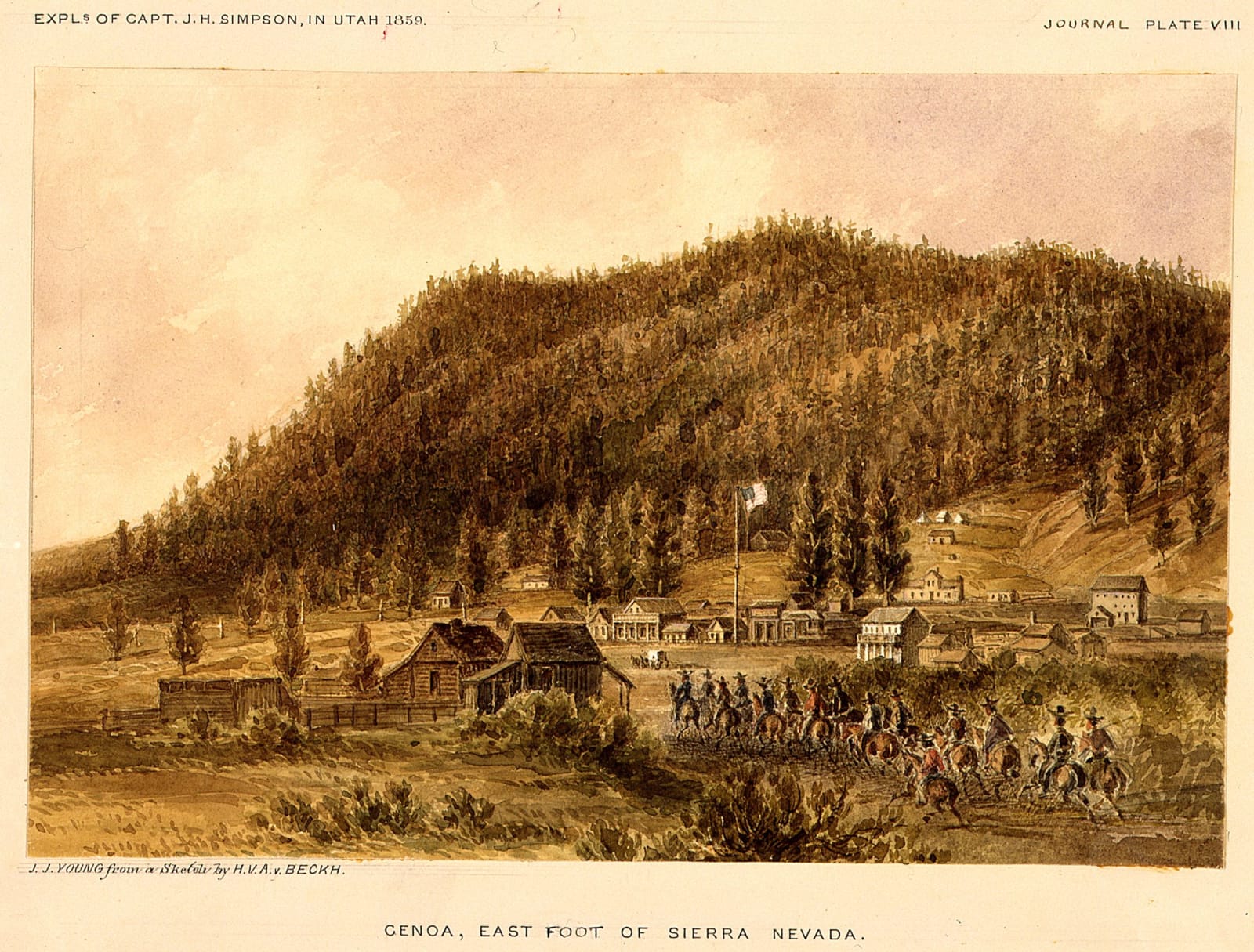
Genoa is where Nevada starts. Eight years before the Comstock made the territory rich, a party of Mormon traders pitched a log trading post in the Carson Valley, at the foot of the Sierra where the California Trail came down off the mountains—the first permanent non-Native settlement in what would become Nevada. A seasonal post went up in 1850; John Reese made it permanent in 1851. They called it Mormon Station, and in 1856 an elder renamed it Genoa, after the Italian city. For a few years in the early 1860s it served as the unofficial capital of a territory that barely existed. Then silver was struck up the hill, the capital went to Carson City, the county seat eventually moved to Minden, and Genoa was left to be what it has been ever since: a small, green, deeply old town the rush passed by.
What made Genoa, and what kept it, was the valley rather than the mines. The Carson Valley is some of the best farm and ranch ground in the Great Basin—watered by the Carson River off the Sierra snow—and the settlers who stopped here did so because the land was worth staying on. When the Comstock boomed a few miles north, the valley fed it: hay, beef, and produce hauled up to a city of twenty-five thousand that grew nothing of its own. When the silver gave out, the mining towns shrank and the ranches stayed, because people will always need to eat. The cattle outfits and hay meadows around Genoa, Gardnerville, and Minden have worked without interruption for more than a century and a half—the quiet, durable economy beneath the loud one.
The valley's isolation bred its own legends. Each winter for two decades, John "Snowshoe" Thompson carried the mail some ninety miles over the snowed-in Sierra between the Carson Valley and Placerville on homemade ten-foot skis—the only reliable winter link to California, a service he performed for years without ever being paid for it. Genoa kept its history partly because it stopped growing: the town never paved over its nineteenth-century self, and the 1910 fire that pushed the county seat away also froze it in place. Today fewer than twelve hundred people live here, many of them retired, under cottonwoods planted before statehood, with the Sierra wall rising straight up behind the rooftops.
What's here now is small and walkable and genuinely old. Mormon Station is a state historic park in the center of town—a reconstructed log stockade and trading post, the 1851 original having burned in 1910, with a museum of pioneer artifacts and the 1856 Kinsey House, one of the oldest residences in Nevada, on lawns free to wander. A block away, the Genoa Bar—"Nevada's oldest thirst parlor," in operation since 1853—still pours under a low tin ceiling hung with a century of memorabilia, having served, by its own telling, everyone from Mark Twain to Teddy Roosevelt to Johnny Cash. The Genoa Courthouse Museum keeps the town's records and relics, and on the last weekend of September the Candy Dance—a fundraiser the town has thrown since 1919 to pay for its streetlights—draws hundreds of craft vendors and most of the valley. Just outside town, the River Fork Ranch preserve protects a stretch of Carson River wetlands, and David Walley's hot springs have drawn soakers since 1862.
Genoa sits at the base of the range about fifteen miles south of Carson City and twenty-five minutes east of Lake Tahoe over the Kingsbury or Spooner grades—an easy, worthwhile detour off the U.S. 395 corridor. It is the oldest and quietest stop in this region, and the one that explains what was here before the silver, and what was still here once it was gone.
Visitor Info
On the Map
Stories featuring this place
Go deeper into the history and character of this stop
Nearby
The closest stops worth working into your route
Historical markers nearby
Roadside plaques and monuments within a short detour