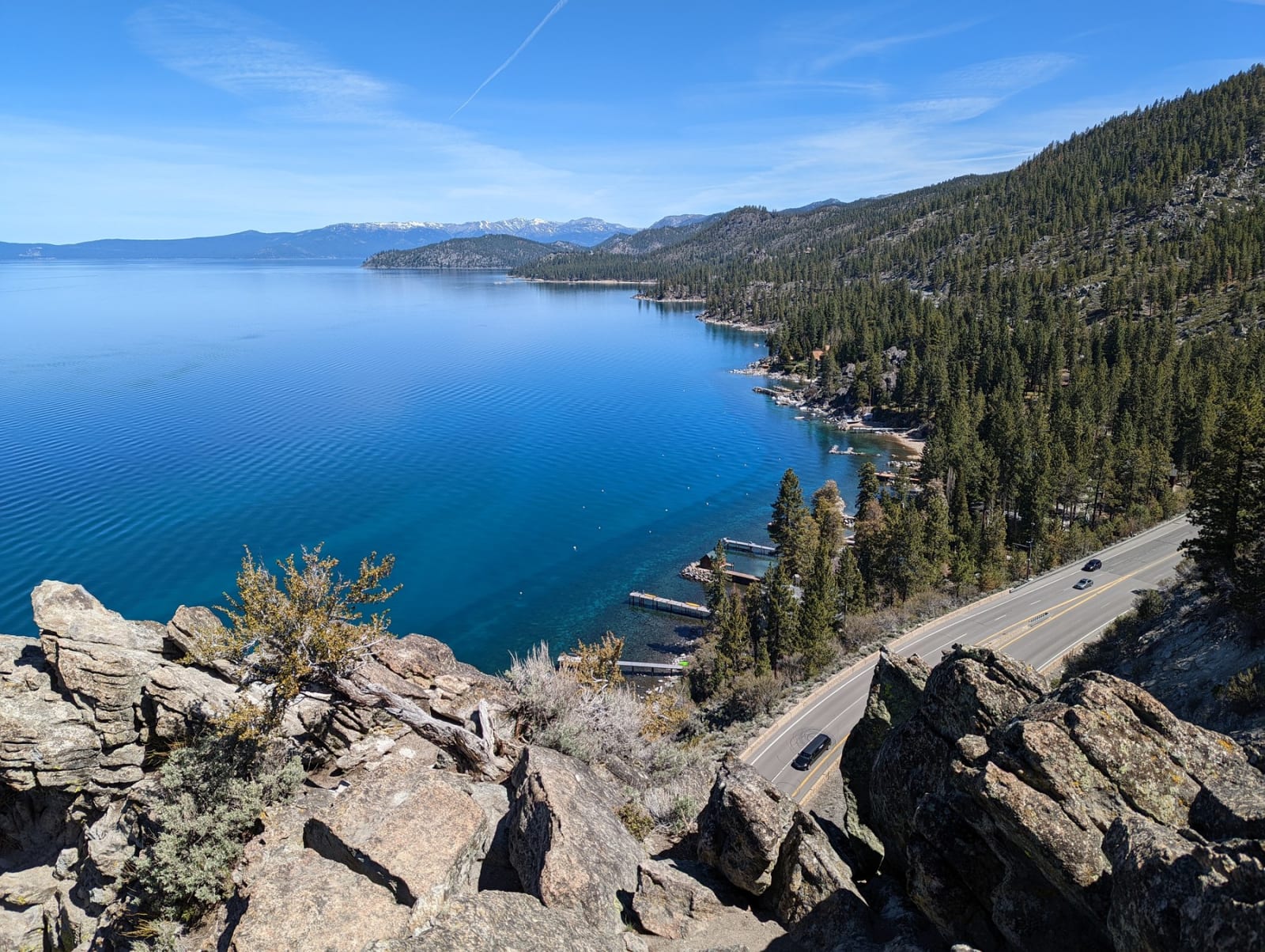
 Blake Everett Carroll / CC BY-SA 4.0
The Story
To the Wašiw — the Washoe — the tall gray column on Lake Tahoe's southeast shore is De'ek wadapush, the Standing Gray Rock, and it is not scenery. It is one of the most sacred places in their world, a linchpin of Washoe cosmology, a site of such power that by tradition only trained doctors, after long and careful preparation, were ever meant to approach it; everyone else kept their distance out of respect. For the people who summered along Da ow — the lake — for hundreds of generations, the rock was a center of the sacred, not a landmark to be climbed or photographed.
The rock itself is the worn stump of a volcano. What stands today is the andesite throat of an old vent, some two hundred and fifty feet of it, the cone that once rose above long since eroded away; the hollows that give the rock its English name were cut by waves when Tahoe stood hundreds of feet higher, at the close of the last ice age. It is, in the plainest terms, a piece of deep time — part of why the Washoe understood it as a place where the ordinary rules did not hold.
The rest is a record of what was done to it. A wagon road skirted the rock in the 1860s; then, in 1931, a crew blasted a tunnel straight through its heart, and in 1957 blasted a second — the Washoe consulted about neither. Elders remembered the shock, and feared the desecration would call a flood down from the lake. Beginning in 1987, sport climbers turned the sacred cave into one of the most popular crags in the country, drilling some fifty bolted routes and pouring masonry platforms into the rock. The Washoe fought it for years. In 2003 the Forest Service banned climbing outright and ordered the bolts, concrete, and graffiti removed; a federal appeals court upheld the ban in 2007, likening the rock's standing to that of a national cathedral, and in 2009 the last climber's peg was pulled from De'ek wadapush.
What's here now is quieter than it was. The rock is listed on the National Register as a Traditional Cultural Property, closed to climbing, and the Washoe have a growing hand in its care. Most people meet it without knowing it — as the two dim tunnels U.S. 50 threads through on the way up the east shore, a few minutes south of Glenbrook & Spooner Summit. A small state-park boat launch and picnic area sit on the water below. If you stop, the respectful thing is the simple thing: look up at the gray rock, leave it be, and know that you are passing through a church, not a scenic pull-off.
Visitor Info
On the Map
Stories featuring this place
Go deeper into the history and character of this stop
Nearby
The closest stops worth working into your route
Historical markers nearby
Roadside plaques and monuments within a short detour