The Story
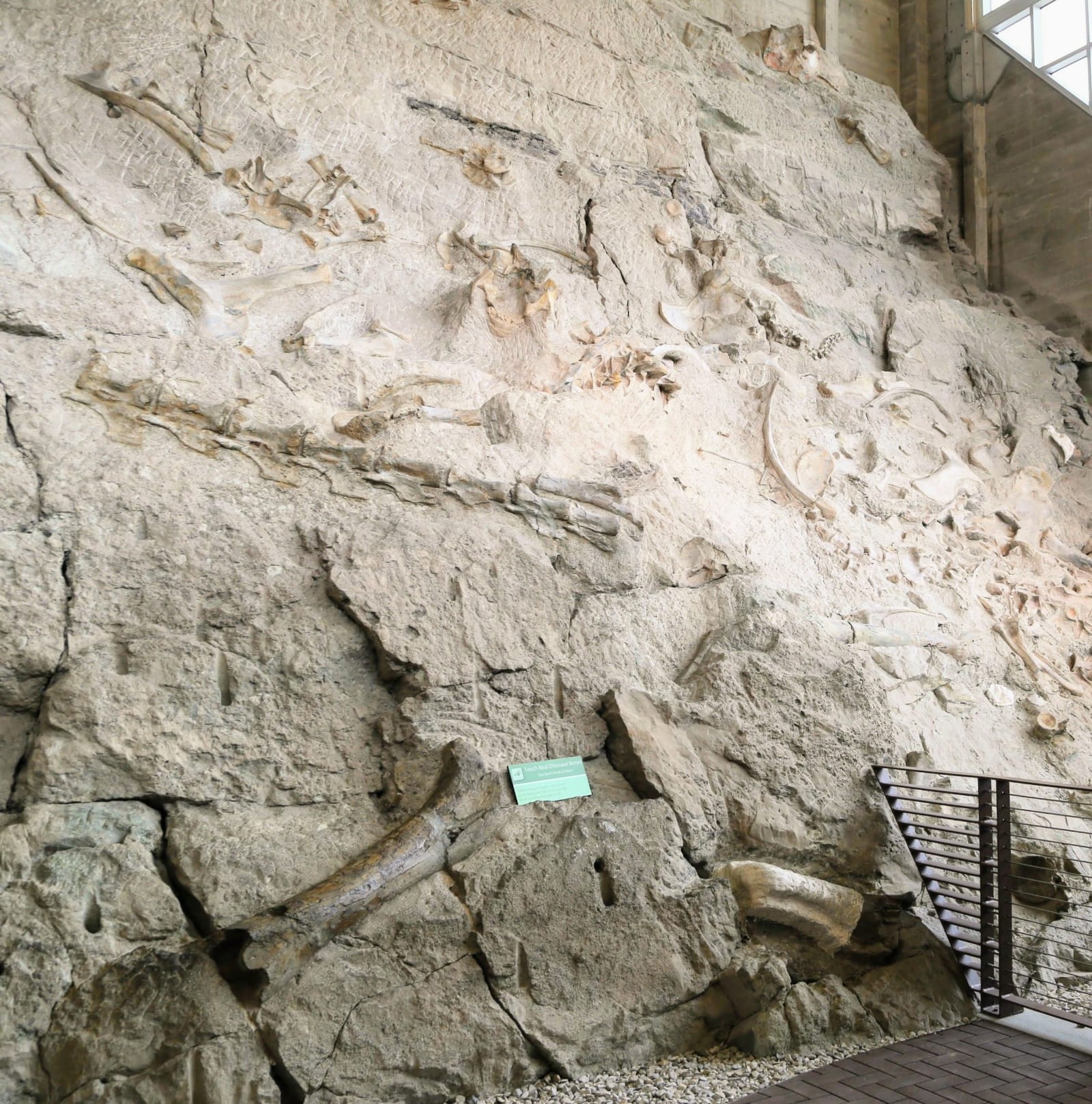
There is a moment inside the Quarry Exhibit Hall at Dinosaur National Monument when the scale of what you are looking at finally clicks. The building is constructed directly over a cliff face — a tilted wall of sandstone containing over 1,500 dinosaur bones still embedded in the rock exactly where they were buried 149 million years ago. Femurs the size of tree trunks. Skulls with teeth intact. Vertebrae lined up in sequence like beads on a string. You can reach out and touch fossils that were living bone when the Jurassic period was in full swing, and the sensation is genuinely electric.
The quarry was discovered in 1909 by Earl Douglass, a paleontologist from the Carnegie Museum, who spotted eight tail vertebrae of an Apatosaurus weathering out of a sandstone ridge. He reportedly wrote in his journal that he had found a gold mine of dinosaur bones, and he was not exaggerating. Over the following decades, excavation crews removed thousands of bones from the site — enough to assemble complete skeletons that now stand in museums across the country, including the Carnegie Museum in Pittsburgh, the Smithsonian in Washington, and the University of Utah in Salt Lake City.
But the genius of Dinosaur National Monument is what they left behind. Rather than strip-mining the quarry for every bone, the Park Service decided to leave a massive section of the cliff face partially excavated, with bones exposed but still locked in the rock. The Quarry Exhibit Hall was built around this wall like a museum constructed inside the exhibit itself. The result is one of the most visceral paleontological experiences anywhere — you are not looking at reassembled skeletons in a sterile gallery. You are looking at bones in the ground, in the position they came to rest when a Jurassic river washed their carcasses into a sandbar and buried them in sand that slowly turned to stone.
The bone bed formed in what geologists call the Morrison Formation, a layer of mudstone and sandstone deposited by rivers and floodplains during the late Jurassic, roughly 149 to 155 million years ago. The prevailing theory is that dinosaur carcasses — Allosaurus, Apatosaurus, Diplodocus, Stegosaurus, Camarasaurus, and others — accumulated at a bend in an ancient river, piling up in a natural logjam of bone. Floods buried them in sand before scavengers could scatter the remains, which is why so many skeletons here are found articulated, with bones still connected in their original arrangement.
But Dinosaur National Monument is far more than a bone quarry. The monument covers over 210,000 acres of rugged canyon country straddling the Utah-Colorado border, and most of it is wild backcountry that few visitors ever see. The Green and Yampa Rivers cut through the heart of the monument in deep, dramatic canyons — the Yampa is the last major free-flowing tributary in the Colorado River system, undammed and running wild through a canyon that rivals anything in the national parks.
River rafting through the monument is one of the great wilderness experiences in the American West. Multi-day trips through the Canyon of Lodore on the Green River or the Yampa River canyon pass through gorges a thousand feet deep, past ancient rock art panels, bighorn sheep on the cliffs, and campsites on sandy beaches that have not changed since John Wesley Powell ran these rapids in 1869. Permits are competitive — the Yampa trip is among the most sought-after river permits in the country — but commercial outfitters offer guided trips for those who cannot secure a private permit.
The monument also preserves some of the most significant petroglyph panels in northeastern Utah. The Fremont people, who lived in this region from roughly AD 200 to 1300, left images of trapezoidal human figures, bighorn sheep, and abstract designs on cliff faces throughout the monument. The McKee Springs and Cub Creek panels are particularly impressive and accessible by short walks from the road.
Dinosaur National Monument sits in a corner of Utah that most tourists overlook — the nearest city of any size is Vernal, about 20 miles to the west — and that remoteness is part of its appeal. This is not a polished, heavily managed visitor experience. It is a place where 149-million-year-old bones emerge from a cliff, where rivers run through canyons that have not changed since the last ice age, and where the distance between you and the Jurassic feels, for a moment, impossibly thin.
Visitor Info
On the Map
A story featuring this place
Go deeper into the history and character of this stop
Nearby
The closest stops worth working into your route
Historical markers nearby
Roadside plaques and monuments within a short detour