 CatRM / CC BY-SA 4.0
The Story
The McConkie Ranch Petroglyphs exist because of generosity. The rock art panels — some of the largest, most detailed, and most visually striking Fremont-culture petroglyphs in existence — are located on private ranch land in Dry Fork Canyon north of Vernal, and the ranch owners have allowed public access to the site for decades, asking nothing in return but respect for the land and the art. No admission fee. No guided tours required. Just an open gate, a trail along the cliff base, and some of the most extraordinary ancient imagery you will see anywhere in the American West.
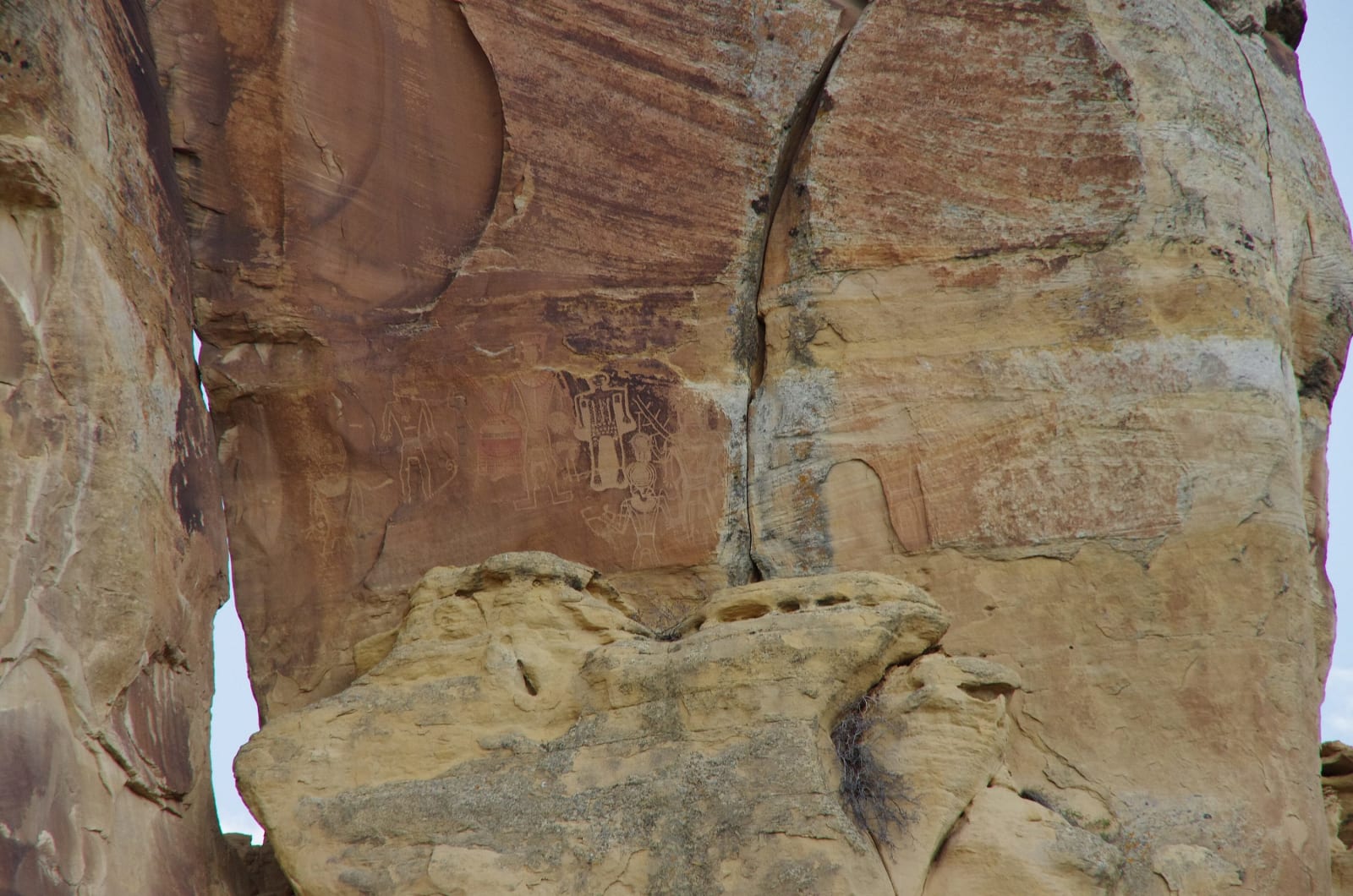
The panels stretch for over 200 feet along a sandstone cliff face, and the density and scale of the imagery is staggering. The figures are classic Fremont style — large, trapezoidal human forms with broad shoulders, elaborate headdresses, and a formal, frontal posture that suggests ceremonial or spiritual significance. Many of the figures are life-sized or larger, pecked into the dark desert varnish with a precision and consistency that indicates skilled, experienced artists working with deliberate intent. These were not casual markings. They were major cultural productions, created over time by people who understood their craft and took it seriously.
The most famous panel is dominated by a row of large anthropomorphic figures standing side by side, their headdresses rising above their heads in elaborate arrays of lines and shapes. Some figures hold shields or objects. Others appear to wear necklaces or chest ornaments. The detail is remarkable — individual fingers are visible on some hands, facial features are suggested on some heads, and the overall composition has a rhythm and balance that feels intentional rather than random. Whatever these figures represent — deities, ancestors, leaders, ceremonial participants — they were created with care and displayed prominently on a cliff face that would have been visible to anyone traveling through the canyon.
Three main panel areas are accessible from the trail — First Panel, Second Panel, and Third Panel, moving from east to west along the cliff. Each has its own character. The First Panel features the largest and most elaborate figures. The Second Panel includes hunting scenes and animal figures alongside the human forms. The Third Panel contains additional anthropomorphic figures and some of the most detailed individual images on the site. The trail between them is roughly a mile round trip, following the base of the cliff through sagebrush and juniper on a path that is informal but well-worn.
The Fremont people who created these images lived in the Uinta Basin from roughly AD 200 to 1300, practicing a mixed economy of farming and hunting that adapted to the specific conditions of northeastern Utah. Their rock art is found throughout the region — in Nine Mile Canyon, in Dinosaur National Monument, in scattered panels along canyon walls across the basin — but the McConkie Ranch panels are widely considered the finest examples of the tradition. The size, detail, and preservation of the figures set them apart from most other Fremont sites, and the accessibility of the panels — no steep hikes, no technical canyoneering, no permits — makes them available to visitors who might never reach more remote rock art locations.
The ranch setting adds a dimension that public land sites lack. You park near the ranch buildings, walk past fences and corrals, and follow a path that the ranch family has maintained for public use. The petroglyphs share the landscape with cattle, hay fields, and the daily operations of a working ranch. The juxtaposition is not jarring — it is grounding. These panels have been here for a thousand years, and the land around them has been ranched for a century, and both uses of the canyon coexist without conflict. The ranch family's decision to keep the site open reflects a relationship with the land and its history that is increasingly rare.
The site is located about 10 miles northwest of Vernal, accessed via a paved road that turns to graded dirt for the last mile. A small parking area near the trailhead accommodates a dozen or so vehicles, and interpretive signs at the start of the trail provide basic information about the Fremont culture and the rock art. There are no facilities beyond the parking area — no restrooms, no water, no shade structures. Bring what you need and take everything with you.
The most important rule is the simplest: do not touch the petroglyphs. The oils from human skin accelerate the deterioration of both the desert varnish and the pecked images, and the damage is cumulative and irreversible. Admire from a respectful distance, photograph freely, and leave the rock faces exactly as you found them. These images survived for a thousand years because the dry desert air and the sheltered cliff face protected them. They can survive a thousand more if visitors treat them with the same care the ranch family has shown for generations.
McConkie Ranch is the kind of place that restores your faith in the possibility of public access to private land. The petroglyphs are world-class. The setting is beautiful. The access is free and open. And the whole arrangement depends on a handshake between a ranch family and the public — a trust that the visitors will respect the land and the art, and that the ranch will keep the gate open. Honor your side of the deal.
Visitor Info
On the Map
Nearby
The closest stops worth working into your route
Historical markers nearby
Roadside plaques and monuments within a short detour