 elkaholic / CC BY-SA 3.0
The Story
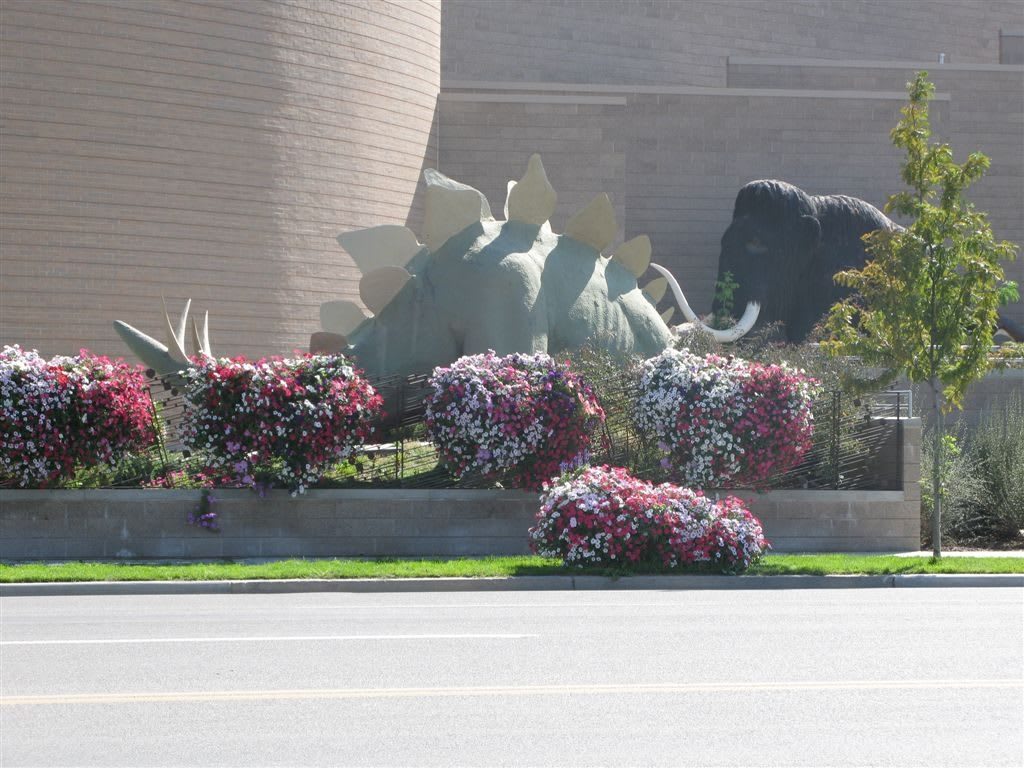
The Utah Field House of Natural History in Vernal is the museum where the dinosaurs come outside to meet you. The Dinosaur Garden — an outdoor exhibit featuring over a dozen life-sized dinosaur replicas set among native plants and rock formations — lets children walk right up to a towering Tyrannosaurus rex, stand between the legs of a Diplodocus, and develop a physical understanding of dinosaur scale that no skeleton behind glass can provide. The replicas are not anatomically perfect by current scientific standards — some reflect older reconstructions that have since been updated — but their size is accurate, and size is the thing that matters when you are six years old and a concrete Allosaurus is looking down at you from fifteen feet above your head.
The museum sits in the center of Vernal, anchoring the town's identity as the Dinosaur Capital of Utah. The indoor exhibits cover the geological and paleontological history of the Uinta Basin and northeastern Utah, with fossil specimens, dioramas, and interactive displays that trace the region's story from the Precambrian through the age of dinosaurs to the Pleistocene megafauna and the arrival of humans. The fossils are primarily from local formations — the Morrison Formation, which produces Jurassic dinosaurs, and the Green River Formation, which preserves an extraordinary record of Eocene-era fish, insects, and plants in finely laminated lake sediments.
The Eocene exhibits are worth particular attention, because the Green River Formation is one of the most important fossil deposits in the world and it underlies much of the Uinta Basin. The formation preserves an ancient lake ecosystem in exquisite detail — complete fish with scales and fins intact, insects with wing veins visible, leaves with cellular structure preserved in stone. The specimens on display are beautiful objects as well as scientific specimens, and they record a world that existed roughly 50 million years ago, when the Uinta Basin was a subtropical lake district teeming with life. The contrast between that lush, wet ancient environment and the arid desert that exists today is one of the more striking demonstrations of climate change in the geological record.
The museum also addresses the human history of the region, including the Fremont culture, the Ute people, and the more recent history of exploration, settlement, and resource extraction that shaped modern northeastern Utah. The exhibits on John Wesley Powell's 1869 expedition through the Green and Colorado River canyons provide context for the Dinosaur National Monument section of the museum, connecting the river exploration narrative to the paleontological discoveries that followed.
The Field House was established in 1948 as a state park museum, making it one of the oldest natural history museums in Utah. The building has been expanded and renovated several times, and the current exhibits reflect modern museum design standards while retaining the slightly old-fashioned charm that comes from a museum that has been serving its community for over 75 years. The staff are local and knowledgeable, and the gift shop stocks a solid selection of fossils, books, and educational materials alongside the inevitable plastic dinosaur toys.
The Dinosaur Garden is the museum's calling card and its most photographed feature. The replicas are arranged along a path that winds through a landscaped area adjacent to the museum building, with each dinosaur accompanied by interpretive signs explaining the species, its diet, its size, and its place in the ecosystem. The garden is included in museum admission and is accessible year-round, though the outdoor path can be snowy and icy in winter.
The museum functions as the unofficial visitor center for the dinosaur country of northeastern Utah. Staff can provide directions and information for Dinosaur National Monument, the Red Fleet dinosaur trackway, Fantasy Canyon, and other geological and paleontological sites in the region. For visitors planning a day or more of exploration in the Vernal area, the Field House is the ideal first stop — it provides the context and vocabulary that transform the surrounding landscapes from scenic backdrops into readable geological documents.
The museum is open daily, with modest admission fees and discounts for children and seniors. The visit — indoor exhibits and outdoor garden — takes about one to two hours, and the museum's central location in Vernal makes it easy to combine with lunch, gas, and the other practical stops that travelers in remote northeastern Utah need to make. The combination of scientific substance, family accessibility, and the sheer visual delight of life-sized dinosaurs standing in a garden makes the Field House one of the most satisfying museum experiences in rural Utah.
Visitor Info
On the Map
A story featuring this place
Go deeper into the history and character of this stop
Nearby
The closest stops worth working into your route
Historical markers nearby
Roadside plaques and monuments within a short detour