 Jon Roanhaus / CC BY-SA 4.0 via Wikimedia Commons
The Story
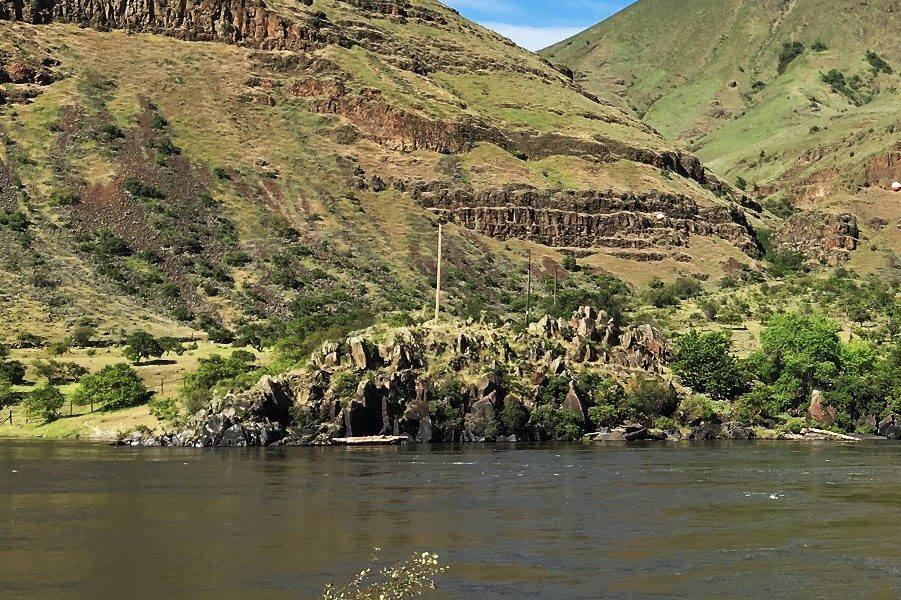
South of Asotin the Snake bends sharply enough to set an eddy turning along its banks, and on the basalt on both sides the ancestors of the Nimiipuu pecked and painted hundreds of images: densely grouped petroglyphs and a few pictographs of bighorn sheep, elk, fish, human figures and abstract designs. The place takes its English name from a panel on the Idaho bank showing bison hunted by men on horseback. Only the Washington side can be reached by road; the Idaho panels are a boat trip.
The images carry their own clues to age. Riders can be no older than the horse's arrival in Nimiipuu country a few centuries ago. Figures holding an atlatl, the throwing board used before the bow and arrow, suggest an age of at least two thousand years. The abstract dots, circles and triangles are thought to be the oldest of all, and the weathered varnish that has grown back over some of the pecked lines gives another measure; the park service puts the earliest at perhaps 4,500 years before the present.
In 1992 Congress authorized adding Buffalo Eddy and thirteen other sites to Nez Perce National Historical Park, carrying it beyond Idaho into Washington, Oregon and Montana. The park counts the images sacred to the Nez Perce and protected by federal law. A short trail with interpretive signs leads from Snake River Road to the Washington panels: look and photograph, and touch nothing.
Visitor Info
On the Map
Nearby
The closest stops worth working into your route
Historical markers nearby
Roadside plaques and monuments within a short detour