The Story
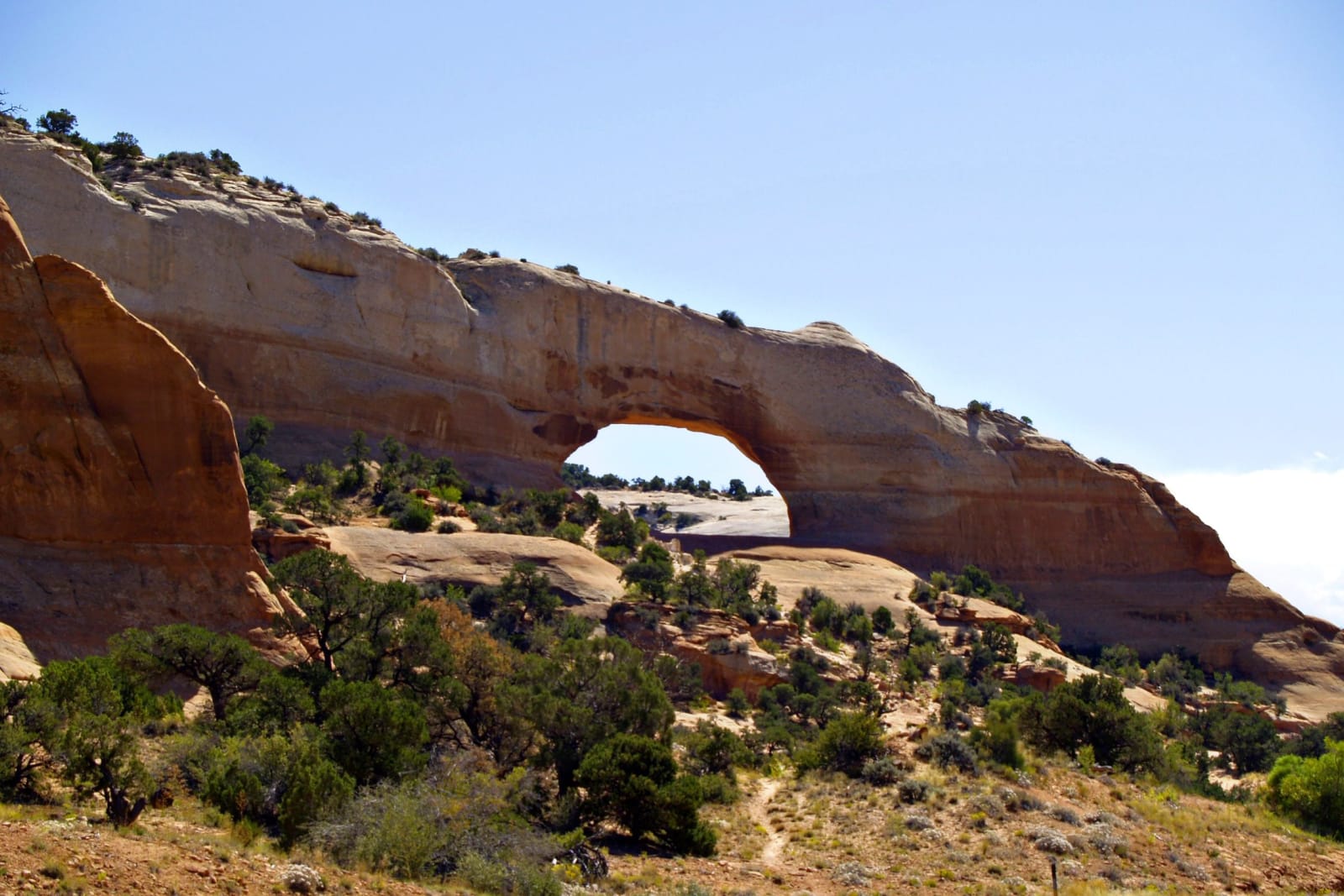
Wilson Arch is the freebie. Most of Utah's great natural arches require a hike, an entrance fee, or both. Wilson Arch requires you to glance to the right while driving south on US-191 between Moab and Monticello. The arch sits directly above the highway, visible from the road, accessible from a pullout, and photogenic from the moment you step out of your car. It is 91 feet wide, 46 feet high, and framed against the sky with the effortless grace of a geological formation that has had millions of years to get its proportions right.
The arch is carved from Entrada Sandstone, the same formation that produced the arches in Arches National Park 25 miles to the north. The Entrada was deposited as coastal sand dunes and tidal flats roughly 150 to 180 million years ago, during the Jurassic period, and its combination of soft, erodible layers and harder, more resistant layers makes it the ideal medium for arch formation. Water seeps into vertical fractures in the rock, freezes, expands, and gradually widens the cracks into fins. As the fins narrow, portions of the softer rock dissolve and flake away, hollowing out alcoves on both sides that eventually meet in the middle, creating an opening. Wilson Arch is the product of this process operating over millions of years on a single fin of Entrada Sandstone that happened to stand beside what would eventually become a highway.
The pullout at the base of the arch accommodates a dozen or so vehicles and includes a short trail — barely a quarter mile — that climbs to the base of the opening. The walk takes five minutes, and the view from beneath the arch looks out across the sage flats and mesas of the northern San Juan County landscape, with the Abajo Mountains visible in the distance. The arch is large enough to frame a meaningful slice of sky, and standing beneath it you can see the texture of the rock overhead — the cross-bedding patterns of ancient dunes, the iron oxide staining that gives the Entrada its warm salmon and tan colors, and the fracture lines that will eventually widen and bring the arch down.
Wilson Arch is named after Joe Wilson, a local rancher who worked the land nearby in the early twentieth century. The name is unofficial — the arch has no formal designation from the Bureau of Land Management or any geological survey — but it has been used locally for long enough that it appears on maps and in guidebooks without question. There is something appropriate about a roadside arch being named after a rancher rather than an explorer or a politician. Wilson Arch is not grand or famous or remote. It is a working landscape feature, sitting beside a working highway, named after a working rancher.
The arch's greatest asset may be its accessibility. Arches National Park requires a timed entry reservation during peak season. Corona Arch requires a three-mile hike. Landscape Arch is a two-mile walk from the trailhead. Wilson Arch requires you to park your car and walk for five minutes. For travelers with limited mobility, families with small children, or anyone who simply wants to see a large, beautiful natural arch without committing to a major excursion, Wilson Arch delivers the experience with minimal barriers.
The light on Wilson Arch is best in the late afternoon, when the western sun hits the east-facing opening and illuminates the interior of the arch in warm tones. Morning light is flatter but produces a nice contrast between the shadowed arch and the bright sky behind it. The arch faces roughly east, so sunset photographers are better served elsewhere, but the late-afternoon window — roughly 3 to 5 PM depending on the season — produces the golden glow that makes Entrada Sandstone look like it is lit from within.
Wilson Arch is also a useful geological preview for travelers heading south from Moab toward Natural Bridges, Monument Valley, or the Bears Ears region. The Entrada Sandstone that forms the arch is part of the same sequence of rock layers that produces the landscape features throughout southeastern Utah, and understanding how the arch formed — the fractures, the fins, the differential erosion — gives you a vocabulary for reading the landscapes you will encounter for the rest of your drive.
There is no charge to visit Wilson Arch. There is no visitor center, no gift shop, no interpretive program. There is a pullout, a short trail, and a 91-foot natural arch that has been standing beside this stretch of desert for longer than humans have existed. It asks nothing of you but five minutes of your time, and it gives you one of the most satisfying roadside stops in Utah. Some people drive past it without stopping, which is their right. But the people who pull over, walk to the base, look up through the opening at the sky, and take a single photograph — those people have just had an experience that captures the essence of Utah geology in the most efficient package possible.
Visitor Info
On the Map
Nearby
The closest stops worth working into your route
Historical markers nearby
Roadside plaques and monuments within a short detour