The Story
Sheep Creek Canyon Geological Loop is a 13-mile drive through 600 million years of Earth history, and the road does not let you forget it for a single mile. The rock layers along this narrow canyon road have been tilted, folded, and in some places turned completely vertical by the same forces that built the Uinta Mountains, creating a roadside cross-section through geological time that is as dramatic as anything in a museum and infinitely more visceral. You are not looking at a diagram. You are driving through it.
The loop road turns south off Highway 44 between Manila and the Flaming Gorge Dam, dropping into Sheep Creek Canyon through a landscape that shifts in color, texture, and age with every bend. The oldest rocks — Precambrian-age quartzite and shale over a billion years old — appear near the eastern end of the loop, their dark, dense surfaces representing a time when the only life on Earth was single-celled organisms floating in ancient oceans. As you drive west, the rock layers get progressively younger, passing through Cambrian, Ordovician, Mississippian, and Pennsylvanian formations in rapid succession. Interpretive signs along the road identify the major formations, but even without them the visual transitions are unmistakable — each layer has its own color, its own texture, its own response to erosion, and the boundaries between them are often knife-sharp.
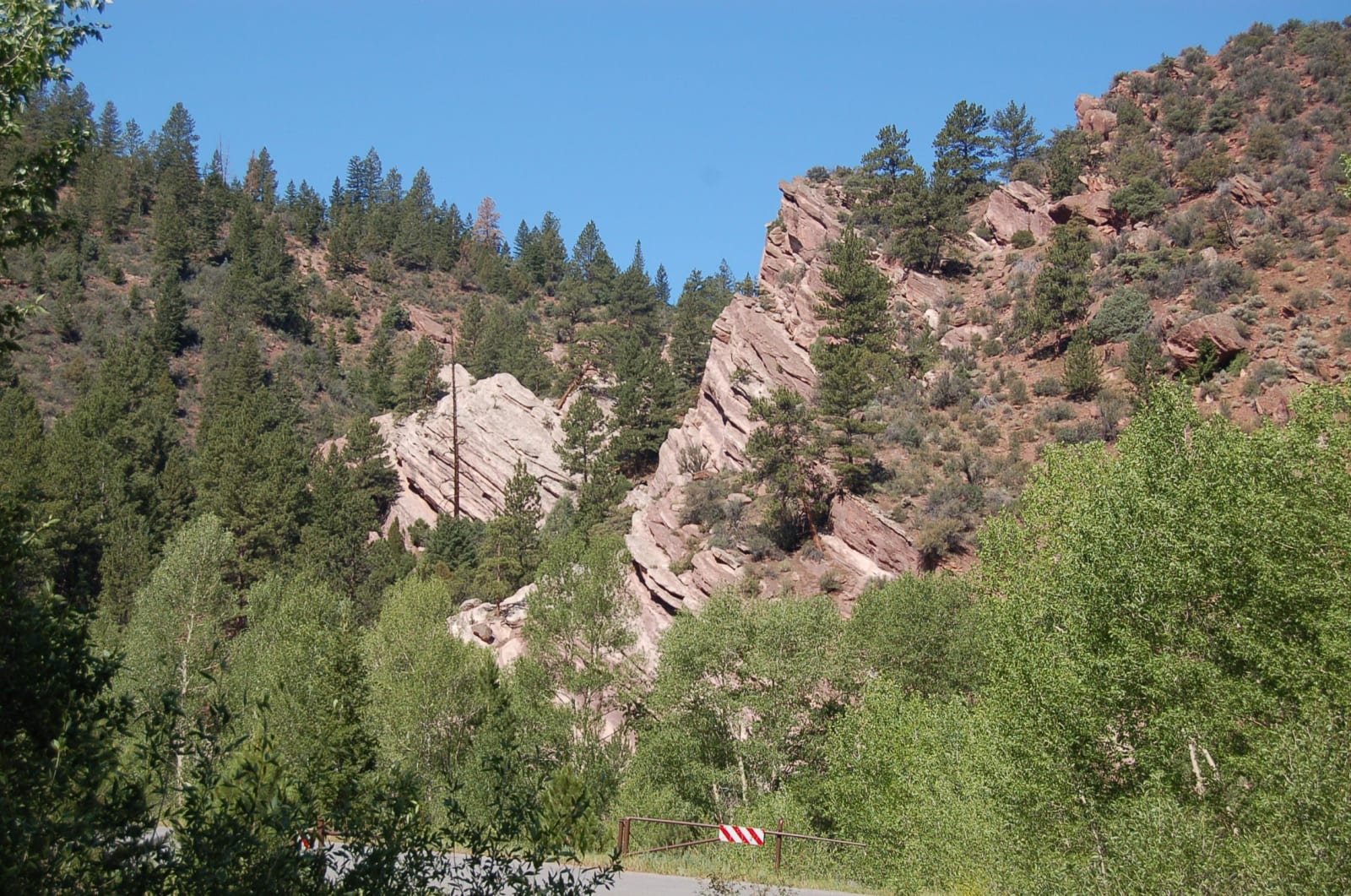
The most visually striking feature is the tilting. The Uinta Mountains are an anticline — a massive upward fold in the Earth's crust — and the forces that created the fold rotated the rock layers along its flanks from horizontal to steeply inclined. In Sheep Creek Canyon, several formations have been tilted nearly 90 degrees, so that layers that were originally deposited flat on an ancient seafloor now stand on edge like books on a shelf. Driving past these vertical strata, you can see individual beds of limestone, sandstone, and shale running straight up and down, each one representing a distinct period of deposition separated from its neighbors by millions of years. The visual effect is startling — the rock looks like it has been grabbed and twisted by a giant hand, which is not far from what actually happened, just over a much longer timescale.
The Palisades, a wall of vertical Mississippian-age limestone near the western end of the loop, is the most dramatic single formation along the route. The beds stand like fence posts — tall, thin, and perfectly parallel — creating a wall of ribbed rock that catches the light in patterns that shift throughout the day. The limestone is gray and cream colored, dense with the compressed remains of marine organisms that lived in a warm, shallow sea roughly 340 million years ago. Fossils are visible in some of the exposed surfaces — crinoid stems, brachiopod shells, and coral fragments that record a tropical ocean ecosystem utterly unlike the mountain landscape that now surrounds them.
The canyon has a harder story too. On the stormy night of June 9, 1965, a debris flow of water, mud, rock and trees came down Sheep Creek and through the Palisades campground, destroying it and killing seven members of one family who were camped there. Geologists trace it to about a mile upstream, where the rain-swollen creek undercut part of an old landslide and brought it down into the channel. The Forest Service made the old campground Palisades Memorial Park, open for day use only, and a bronze memorial set on a boulder remembers them. A bouldery levee the flow left behind still lies west of the picnic area, with twisted pipe from the campground caught in it.
Wildlife is abundant in the canyon. Bighorn sheep — the creek's namesake — are sometimes spotted on the rocky slopes above the road, their sure-footed climbing abilities perfectly matched to the steep, broken terrain. Mule deer browse the canyon bottom. Raptors ride the thermals above the rim. And the creek itself supports a population of trout that draws anglers into the canyon's more accessible sections.
The loop road is paved and passable in a standard vehicle, though it is narrow in places and the curves are tight enough to demand attention. RVs and large trailers should exercise caution, and a few sections near the canyon floor can be affected by rockfall, especially after heavy rain or freeze-thaw cycles. The road is typically open from late spring through early fall, with snow closing the higher sections in winter.
Sheep Creek Canyon Geological Loop is the kind of experience that geology professors dream of taking their students on — a continuous, uninterrupted drive through hundreds of millions of years of rock record, with every major formation labeled and accessible from the roadside. But you do not need a geology degree to appreciate it. You need only the willingness to drive slowly, stop at the interpretive signs, and let the scale of the timescale sink in. Six hundred million years. Compressed into 13 miles. Tilted on edge so you can see every layer. The Earth wrote its autobiography in this canyon, and the road gives you a front-row seat.
Visitor Info
On the Map
Nearby
The closest stops worth working into your route
Historical markers nearby
Roadside plaques and monuments within a short detour