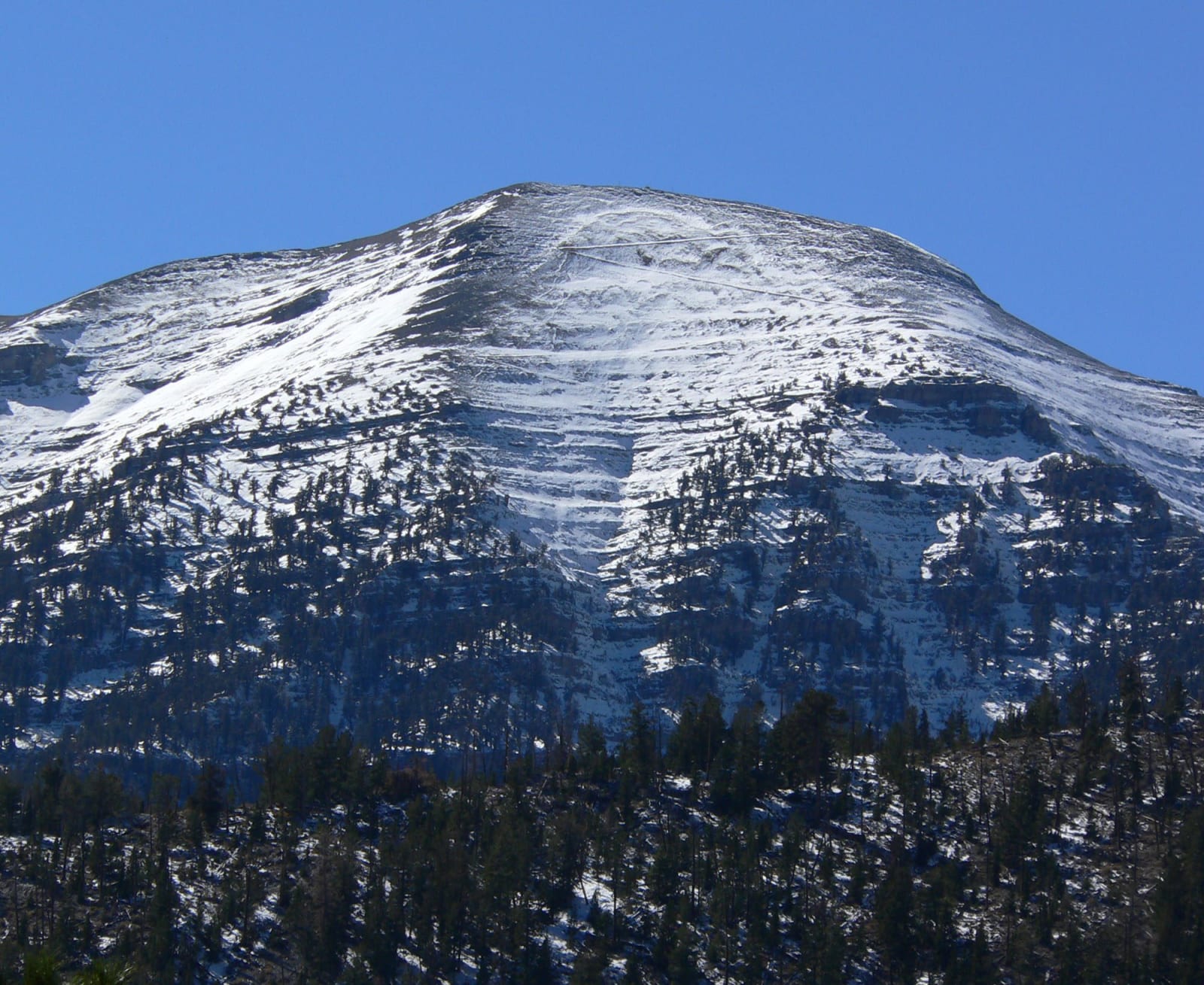
 Stan Shebs / CC BY-SA 3.0
The Story
Thirty-five miles northwest of the Las Vegas Strip, the desert does something improbable: it climbs to nearly twelve thousand feet and turns alpine. Mount Charleston — Charleston Peak, properly — tops out at 11,916 feet, the highest point in the Spring Mountains and in all of Clark County, and the most topographically prominent peak in Nevada. On a clear day its snow-streaked summit is visible from the Strip, hovering over the neon like a rumor of a different climate. The Southern Paiute, who have known this range for countless generations, call it Nuvagantu — where snow sits.
The mountain is what ecologists call a sky island: a high, cool, forested world marooned in an ocean of hot Mojave desert. Drive up from the valley and you pass through something like seven life zones in under an hour — Joshua trees and creosote at the bottom giving way to piñon and juniper, then ponderosa and fir, then wind-scoured bristlecone and bare alpine rock at the top. The change is so compressed that it has been likened to traveling from Mexico to the Canadian Arctic in a single afternoon, and the temperature follows: the high country runs fifteen to twenty degrees cooler than the valley, which is precisely why Las Vegans have always fled here when the summer turns murderous.
The bristlecone pines deserve their own mention. The Spring Mountains hold one of the largest groves in the Intermountain West — some eighteen thousand acres of them — and bristlecones are the oldest individual living things on Earth, gnarled and wind-twisted survivors that can exceed three thousand years of age. The range is biologically strange in other ways too: it is the only home of the Palmer's chipmunk, found nowhere else on the planet, and shelters the only herd of Rocky Mountain elk in Clark County, isolated up here with everything else that needed the cool and the water.
Geologically, the mountains are close kin to Red Rock Canyon on their eastern flank — in fact Red Rock sits inside the same 316,000-acre Spring Mountains National Recreation Area. The pale gray summits are ancient marine limestone, hauled thousands of feet into the sky by the same thrust faulting that put old rock over young at Red Rock, then carved into canyons, cliffs, and the occasional waterfall.
There is a darker story up here as well. Near the summit lie the scattered remains of a military plane that crashed in a November 1955 blizzard, carrying engineers and technicians bound for Groom Lake — Area 51 — to work on the top-secret U-2 spy plane. All fourteen aboard died, their mission so classified that the crash went largely unacknowledged for decades; a Silent Heroes of the Cold War memorial now stands at the mountain's gateway.
Today the high country is reached by a loop of three highways through Kyle Canyon and Lee Canyon, with trailheads, picnic areas, campgrounds, and a small ski area scattered along the way. Mary Jane Falls and the long climb to Charleston Peak are the marquee hikes; Lee Canyon offers the quickest snow from the city in winter. It is the rare place where you can leave a hundred-and-ten-degree casino floor and stand, an hour later, in pine shade with snow still tucked in the gullies — the same desert, turned inside out by altitude.
Visitor Info
On the Map
Stories featuring this place
Go deeper into the history and character of this stop
Nearby
The closest stops worth working into your route
Historical markers nearby
Roadside plaques and monuments within a short detour