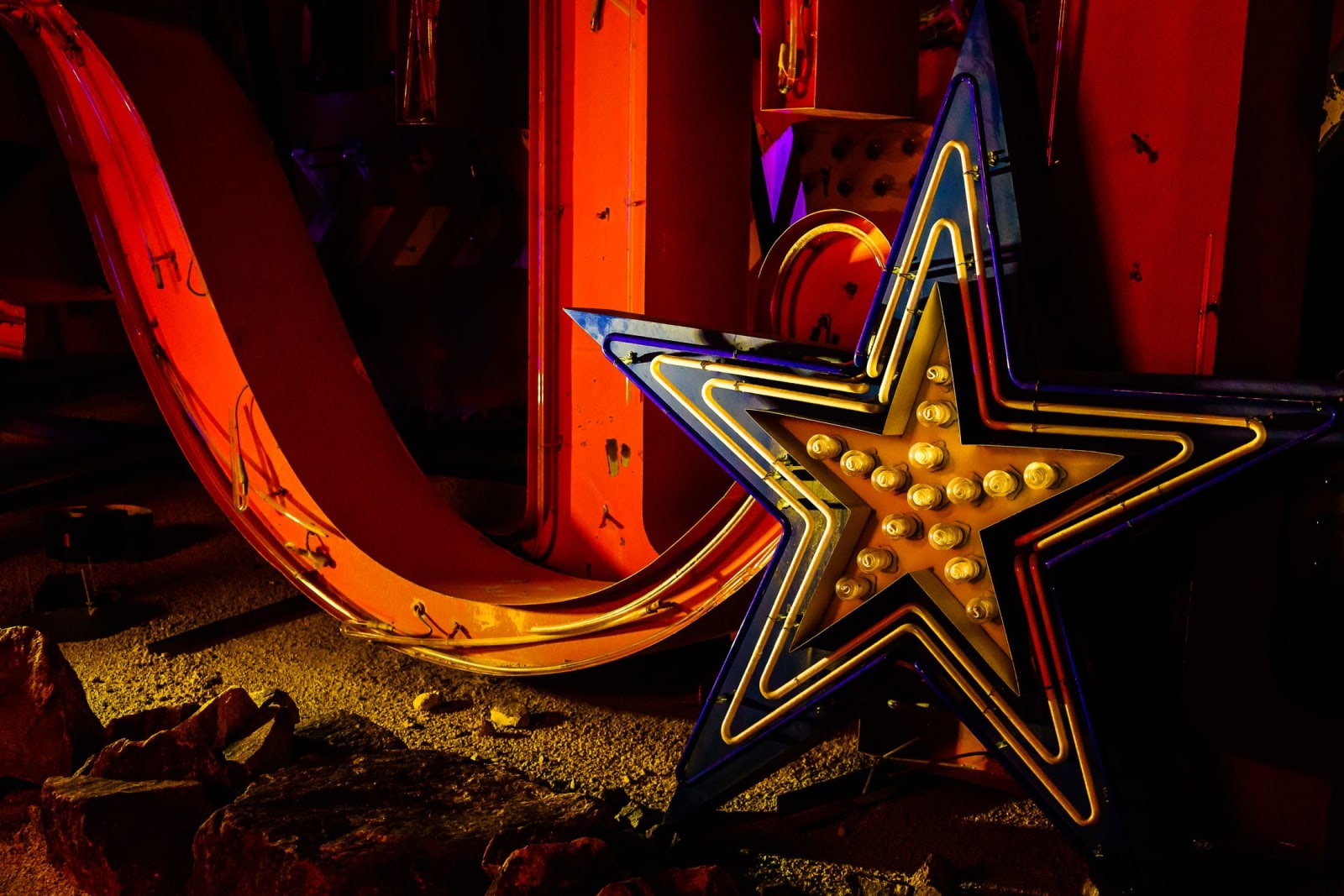
 Dale Cruse / CC BY 2.0
The Story
Las Vegas is a city that erases itself on schedule — imploding its casinos when they age out and rebuilding bigger on the rubble — which makes the Neon Museum something close to its conscience. Just north of Fremont Street downtown, in a fenced outdoor lot, more than two hundred and fifty rescued signs lean and tower and rust in the sun: the cast-off marquees of Las Vegas, gathered in one place and saved from the scrap heap. Everyone calls it the Neon Boneyard, and the name fits.
Neon came to Las Vegas in the 1920s and exploded in the 1930s, and by mid-century the glowing sign had become the city's native art form — the thing that made a dusty highway town legible at seventy miles an hour after dark. Most of it was built by a single firm, the Young Electric Sign Company, which kept its own graveyard of discarded signs for decades. When that lot was set to close around 2000, the city handed the fledgling museum land of its own, and the rescued signs began to accumulate where they sit today.
The collection reads like a roll call of vanished Vegas: the Stardust, the Sahara, the Lido de Paris, a sliver of the Flamingo, the eighty-foot Hard Rock guitar that cost some three hundred and fifty thousand dollars to bring back to life. Restoring a single sign runs anywhere from ten to a hundred thousand dollars and takes months, so many of the pieces remain dark and weathered, lit at night by ground lights instead of their own tubes — which, if anything, makes them more affecting. At dusk the yard glows in a mix of living neon and ghost light, and the effect is genuinely moving.
Even the entrance is a rescue. The museum's shell-shaped visitor center is the salvaged 1961 lobby of the La Concha Motel, a swooping piece of Googie space-age architecture designed by Paul Revere Williams — the celebrated architect to the stars and the first African-American Fellow of the American Institute of Architects. When the motel faced the wrecking ball in 2005, the lobby was sawed into eight pieces and trucked three and a half miles up the Strip to become the museum's front door.
The museum opened to the general public in 2012 and has been bursting at the seams ever since, drawing some two hundred thousand visitors a year. Tours are timed and frequently sell out, so book ahead, and go at or after sunset if you can — both to dodge the desert heat and to see the restored signs at their best. It pairs naturally with a walk down Fremont Street, the original neon canyon, and with the modern spectacle of the Strip, whose discarded light ends up, eventually, here.
Visitor Info
On the Map
A story featuring this place
Go deeper into the history and character of this stop
Nearby
The closest stops worth working into your route
Historical markers nearby
Roadside plaques and monuments within a short detour