 Eric Kilby / CC BY-SA 2.0
The Story
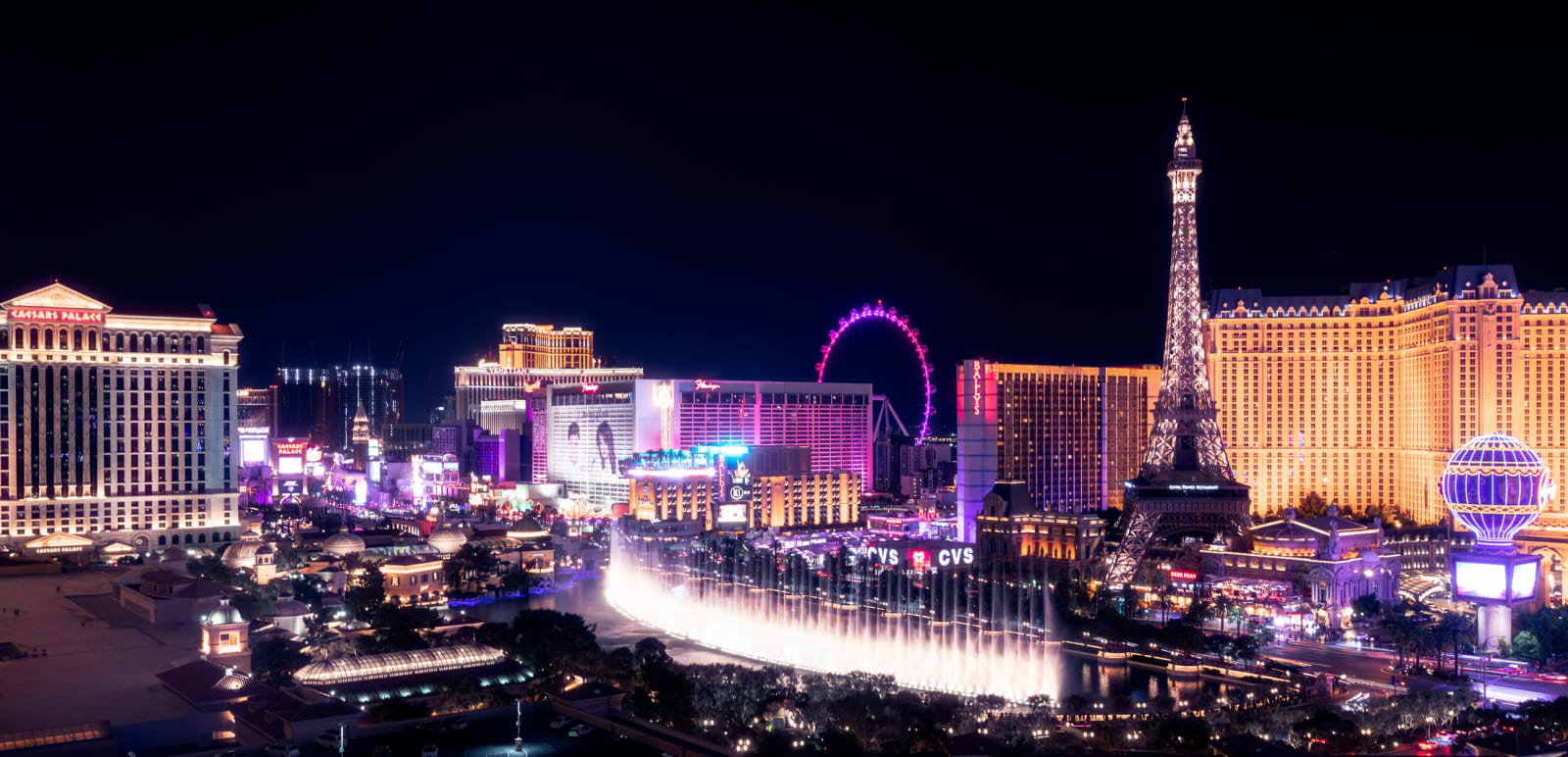
The Las Vegas Strip is four and a quarter miles of engineered spectacle — a corridor of megaresorts, fountains, replica landmarks, and enough wattage to be visible from space, strung along Las Vegas Boulevard south of the old downtown. It is the most famous street in America and, by most measures, the most artificial, a place built entirely to separate visitors from their money in the most pleasant way possible. It is also, in a detail that delights anyone who learns it, not actually in Las Vegas.
The Strip sits just past the city limits, in the unincorporated towns of Paradise and Winchester, and that is no accident. When the City of Las Vegas tried to annex the casino corridor in 1950 to tax it, the resort owners — led by the Flamingo's Gus Greenbaum — outmaneuvered the mayor by lobbying Clark County to grant the area town status instead. The casinos have stayed pointedly outside the city ever since. The bright sign that reads Welcome to Fabulous Las Vegas stands, with a straight face, in a town called Paradise.
The boulevard began as Highway 91, the dusty two-lane to Los Angeles, and it was a Los Angeles policeman who gave the Strip its name, after the Sunset Strip back home. The first gambling licenses on the road went out in 1931 — the very first to Alice Morris of the Red Rooster club, which is why University of Nevada historians like to point out that the Strip had a founding mother, not the founding father of legend. The first true resorts, the El Rancho Vegas in 1941 and the Last Frontier the year after, were dude-ranch Western affairs, all wagon wheels and cowboy kitsch.
Then came the Flamingo, and with it the myth. The resort was actually the brainchild of Billy Wilkerson, founder of The Hollywood Reporter, who ran out of money and took on mob financing; the gangster Bugsy Siegel muscled his way into control, blew the budget from one million dollars to six, opened the place the day after Christmas in 1946, and was shot dead in Beverly Hills six months later. He did not invent Las Vegas — he was the fifth casino and third resort on the Strip — but the Flamingo's sleek, modern glamour set the template that buried the Old West theme for good.
Everything after is escalation. Caesars Palace raised the stakes in 1966, the corporate megaresorts swallowed the old mob holdings, and the Strip became an arms race of spectacle — a black-glass pyramid, a half-scale Eiffel Tower, the canals of Venice with their gondoliers, an erupting volcano, and the Bellagio's dancing fountains pulling crowds to the curb every fifteen minutes. The buildings are advertisements for themselves, and the whole boulevard is best understood not as architecture but as a single, continuous, open-air show that never closes.
It is loud, crowded, expensive, and entirely unreal, and that is precisely the point; the trick is to meet it on its own terms. Walk it after dark, when the heat breaks and the lights do their work, cross on the pedestrian bridges, and let the sensory overload wash past. For most road trips through southern Nevada the Strip is the overture — the bright, ringing chord you arrive on before the car points out toward the red silence of Valley of Fire and the desert that the neon makes you forget is even there.
Visitor Info
On the Map
A story featuring this place
Go deeper into the history and character of this stop
Nearby
The closest stops worth working into your route
Historical markers nearby
Roadside plaques and monuments within a short detour