The Story
Red Rock Canyon is the wild country that begins where Las Vegas ends — a 195,000-acre sweep of the Mojave managed by the Bureau of Land Management, its great striped escarpment rising abruptly some seventeen miles west of the Strip. More than three million people a year come to drive its loop, climb its walls, and watch the light move across rock that turns from cream to rust to deep red as the day goes on. The casinos are close enough to see from the high points, which only sharpens the strangeness of standing in genuine desert wilderness with the skyline shimmering on the horizon.
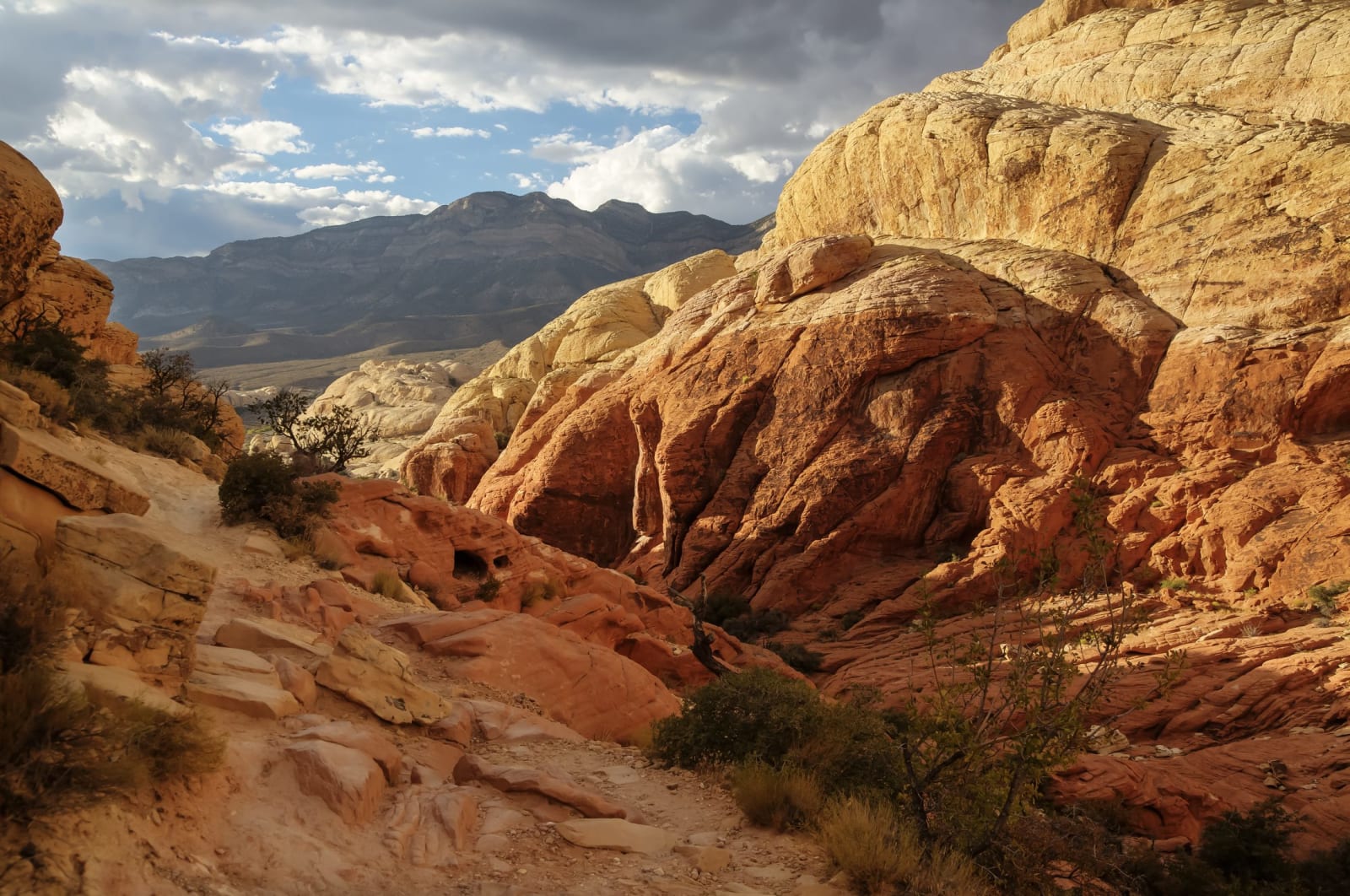
The red in the name is the same Aztec Sandstone that lights up Valley of Fire an hour to the northeast — the lithified remains of Jurassic sand dunes roughly 180 to 190 million years old, stained by iron oxide that rusted between the grains. Here it forms cliffs that rise as much as three thousand feet, sheer enough to make Red Rock one of the premier rock-climbing destinations in the country. But the sandstone is only half the story, and arguably the less interesting half.
The marquee feature is the Keystone Thrust, and it is one of the clearest examples of its kind anywhere on Earth. Around sixty-six million years ago, the slow collision of tectonic plates shoved a slab of ancient gray limestone up and over the much younger red sandstone — older rock riding on top of younger, the reverse of the usual order, in plain view along thirteen miles of the escarpment. Look at Turtlehead Peak or the high gray caps above the Calico Hills and you are looking at the literal overlap, half-a-billion-year-old limestone sitting on dunes less than half its age. Geologists come from around the world to see it; you can take it in from the road.
The thirteen-mile Scenic Loop Drive is the spine of a visit, a one-way road that threads past every major trailhead and overlook. The Calico Hills blaze near the start, all swirled red and white sandstone made for scrambling. Sandstone Quarry still holds the cut blocks of a turn-of-the-century quarrying operation that never quite paid off. Ice Box Canyon stays cool and shaded when the open desert bakes, and the deep slots of Pine Creek and Oak Creek canyons hide seasonal water and the foundations of old homesteads. Calico Tanks climbs to a hidden water pocket with a sudden view back toward the city.
People have relied on this place for far longer than Las Vegas has existed. The springs and shaded alcoves drew the Southern Paiute and, before them, the Ancestral Puebloans, who left petroglyphs and pictographs and the charred rings of agave roasting pits — best seen at Willow Springs and along the Red Spring boardwalk. In the nineteenth century the Old Spanish Trail ran past the canyon's mouth, and travelers between Santa Fe and Los Angeles filled their water kegs at the same springs; some of the wagon ruts are still faintly visible.
The higher elevation makes Red Rock a few degrees cooler and a good deal wetter than the valley floor, and the desert here is correspondingly alive — close to two hundred bird species, bighorn sheep on the cliffs, wild burros along the road, and the threatened desert tortoise that the whole conservation effort is partly built to protect. The visitor center keeps a resident tortoise named Mojave Max, whose emergence from his burrow each spring is the subject of an annual guessing contest among Clark County schoolchildren — a small, charming civic ritual built around a reptile's sense of timing.
Fall through spring is the season, when the days are mild and the low sun does its work on the rock; summer highs push past a hundred and the canyons turn genuinely dangerous for the unprepared. During the busy months — roughly October through May — a timed-entry reservation is required to drive the Scenic Loop, and it is worth booking ahead rather than gambling on a same-day slot. Start at the visitor center, where the exhibits and the tortoise enclosure set up everything beyond, then drive the loop slowly and save at least one short walk for the golden hour. Red Rock and Valley of Fire make a natural pair of bookends to Las Vegas, the two best reasons to point the car away from the neon.
Visitor Info
On the Map
A story featuring this place
Go deeper into the history and character of this stop
Nearby
The closest stops worth working into your route
Historical markers nearby
Roadside plaques and monuments within a short detour