 Alberto-g-rovi / CC BY 3.0
The Story
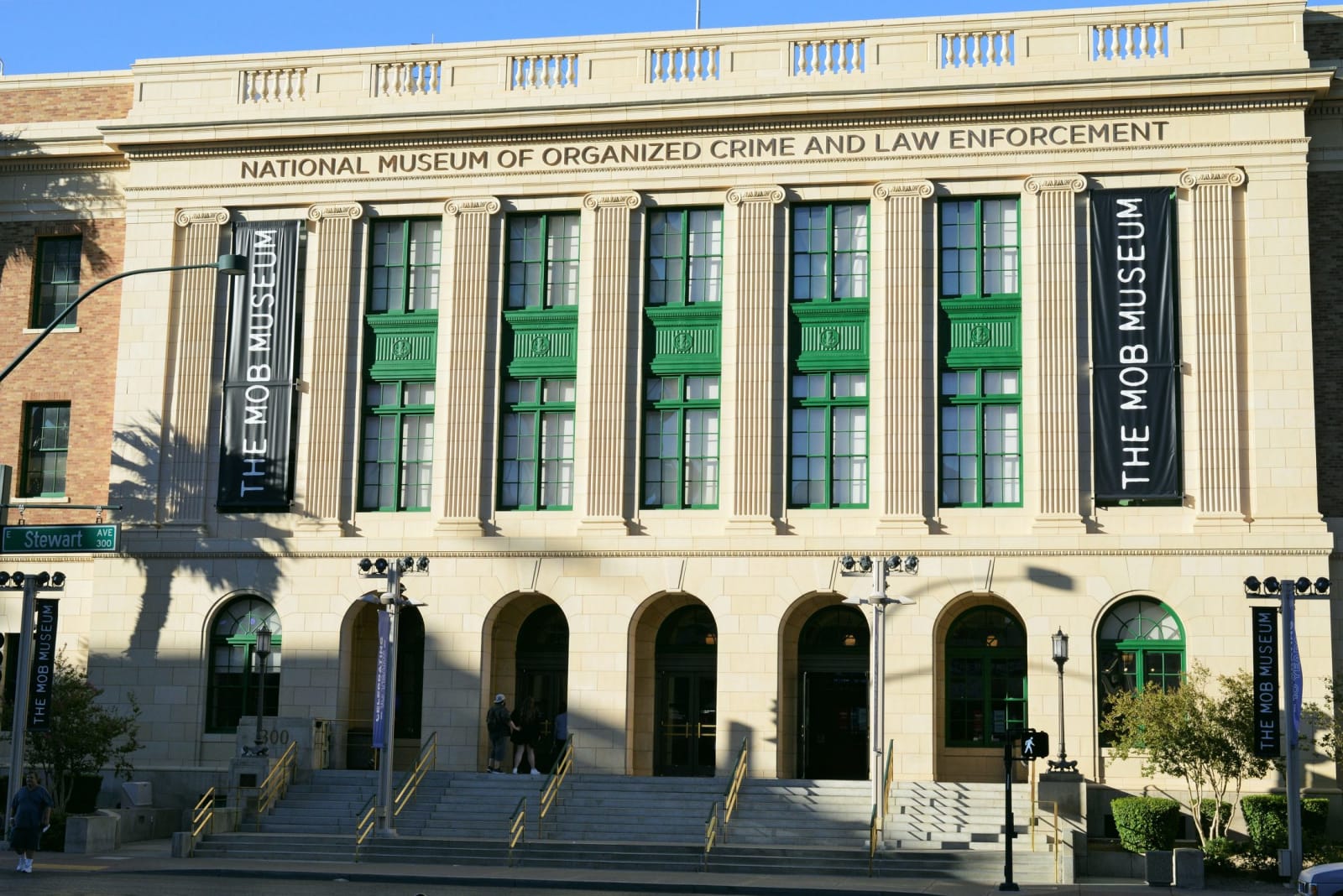
Las Vegas was, to a real degree, built with mob money — and the Mob Museum is the city's clear-eyed reckoning with that fact, mounted in the one building downtown where the reckoning first happened in public. Officially the National Museum of Organized Crime and Law Enforcement, it occupies the former federal courthouse and post office on Stewart Avenue, two blocks north of Fremont Street, and it does not flinch.
The building itself is the first artifact. Built in 1933, it was the first federal structure in Las Vegas — a dignified neoclassical pile from the era when Washington built courthouses to look like temples of justice — and it is now on the National Register of Historic Places. Its second-floor courtroom is the centerpiece, because in November 1950 it hosted one of the travelling hearings of the Kefauver Committee, the U.S. Senate's investigation into organized crime. Those hearings were televised nationally, and an estimated thirty million Americans watched mobsters and their associates squirm under questioning — for most of the country, the first real look at how deep the rot ran. The courtroom has been restored to its 1950 appearance, down to the original benches.
From there the museum traces the whole arc: Prohibition and the bootleggers it minted, Al Capone's Chicago, the syndicates that financed Las Vegas's early casinos — Bugsy Siegel and the Flamingo out on the Strip, the quiet art of the casino "skim" — and the long, grinding law-enforcement campaign that eventually broke their grip. It is careful, evidence-based history rather than glamorization, balancing the gangsters against the agents who chased them.
The artifacts earn the trip. The undisputed star is the actual brick wall from the 1929 St. Valentine's Day Massacre in Chicago — the bullet-pocked masonry against which seven men were lined up and shot — reassembled here. Around it sit FBI wiretap rigs, a replica electric chair, a firing-range simulator, Bugsy Siegel's sunglasses, and a vault stacked with cash to explain the skim. The museum opened on February 14, 2012, a date chosen with deliberate nerve: the eighty-third anniversary of the massacre whose wall it now displays.
There is a final, very Vegas irony to the place. Its great champion was Oscar Goodman, the longtime defense attorney who made his name representing mob figures before he was elected mayor — the man who defended the mob helping build the museum that explains it. Downstairs, in a basement called the Underground, a working speakeasy and distillery turn out the museum's own moonshine. Plan on a couple of hours, and pair it with a walk down Fremont Street and the modern spectacle of the Strip, both of which this building quietly explains.
Visitor Info
On the Map
A story featuring this place
Go deeper into the history and character of this stop
Nearby
The closest stops worth working into your route
Historical markers nearby
Roadside plaques and monuments within a short detour