Drive US-89 down the floor of Sanpete Valley and you are driving through what was, for the better part of a century, the most Danish place in America. The towns look the part — cream-colored limestone, steep-pitched roofs, a tidiness that feels imported — and the names on the older headstones read like a Copenhagen phone book. The locals had a word for the whole stretch: Little Denmark. They were not exaggerating by much.
A church that went fishing in Scandinavia
The story starts a long way from Utah. In 1850, Latter-day Saint missionaries reached Denmark and found an enormous catch — thousands of converts across Denmark, Sweden, and Norway, drawn to a young American faith that promised a gathering place in the mountains. The church had a machine for moving them: the Perpetual Emigrating Fund, a revolving loan that covered a convert's passage on the understanding that he would repay it once established and so free the next emigrant in turn. Families sold what they had, sailed from Liverpool, and then — this is the part that still stops you — crossed the last thousand miles of plains on foot, many of them pulling handcarts, to reach a desert valley most had never heard of.
A great many of them ended up here. By 1870, four-fifths of the population of Sanpete Valley — the heart of what is now Central Utah — was first- or second-generation Scandinavian, and fully a third of all the Danes in the territory lived in this one county. Manti, the valley's first town, picked up the nickname Copenhagen. Spring City, bolstered by some forty Danish families, simply went by Little Denmark — and in time the name spread to cover the whole valley.
Built to last, in the local stone
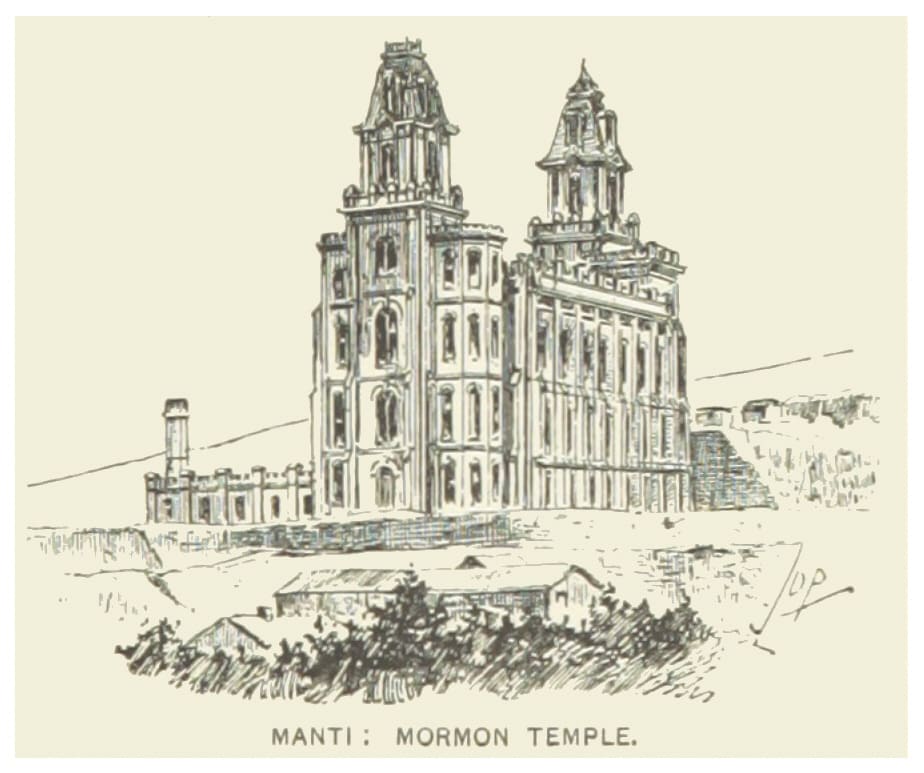
What the Scandinavians brought, besides their numbers, was craft. They were stonemasons and carpenters and cabinetmakers, and they built in the cream-colored oolite limestone quarried straight out of the hills — a stone soft enough to cut easily and hard enough to outlast its builders. The Manti Temple, finished in 1888 on the same hill the first settlers had burrowed into for shelter, is the masterpiece: its two ninety-five-foot spiral staircases climb to the upper floors with no central support, the work of Scandinavian hands. But the skill is everywhere once you start looking — in the 1872 co-op store at Ephraim, a two-story Greek Revival building Danish immigrants are said to have finished like the inside of a ship; in the meetinghouses and tidy gridded streets of every town down the line.
Nowhere is it kept better than Spring City, where the entire town is listed on the National Register of Historic Places — one of only two places in the country so recognized, the other being Colonial Williamsburg. Walk its streets and you are walking a nineteenth-century Scandinavian-American village preserved nearly whole, which is exactly why artists and preservationists have quietly taken it over.
The accent that stayed
The culture outlasted the immigration that made it. The novelist Virginia Sorensen, who grew up in Manti early in the twentieth century, remembered being walked around the temple grounds as a girl by neighbors with Danish surnames and Danish accents, who pointed out the staircases their countrymen had built; the town of her childhood had a Danish pasture, a Danish ditch, and a bakery with a pretzel hung over the door. The valley sent up Danish-Americans of real consequence — Anthony H. Lund, who arrived in Ephraim as a young immigrant in 1862 and climbed to the highest councils of the church — and a dry, deadpan Scandinavian humor that Sanpete folklorists are still writing down.
Some of it survives on the calendar: Ephraim throws its Scandinavian Festival every Memorial Day weekend, and Mount Pleasant, Fairview, and the rest keep their own heritage days. But the better record is the one you drive past without buying a ticket — a whole valley of pale stone buildings, raised by people who crossed an ocean and a continent and then set about building, in the Utah desert, a careful copy of the home they had left.
But the valley the Danes made into home had been someone else's first — and how it stopped being theirs is the harder half of the same history.