The Story
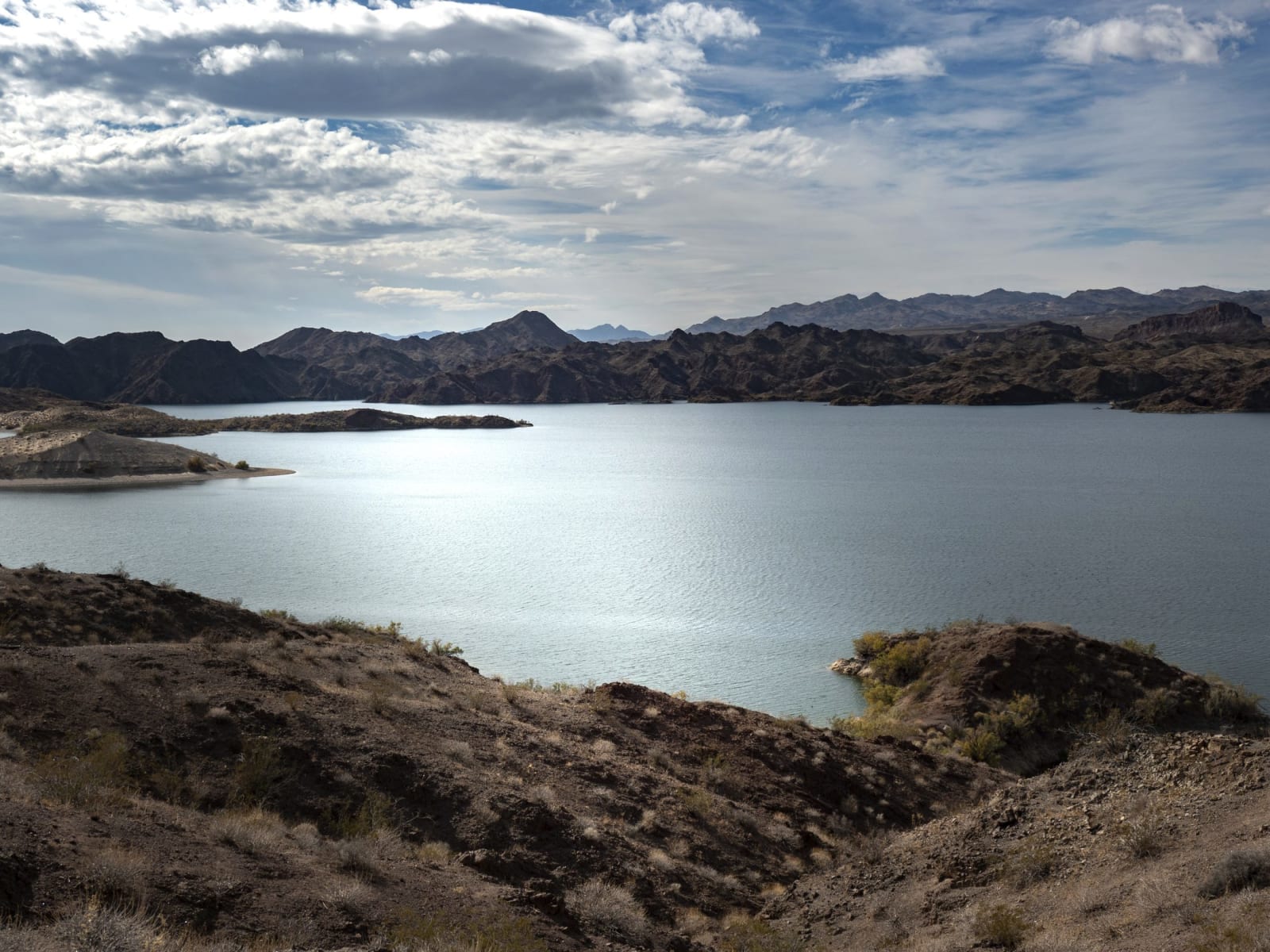
Lake Mead is what Hoover Dam made — the vast blue reservoir that backed up behind the dam as the Colorado River was stoppered in the 1930s, drowning a hundred miles of canyon and desert and creating, when full, the largest reservoir in the United States. It sprawls across the Nevada-Arizona border just east of Las Vegas, its hundreds of miles of shoreline wrapped in raw desert mountains, and it anchors the Lake Mead National Recreation Area — the first national recreation area ever established, set aside in 1936 and now one of the most-visited units in the entire park system.
The numbers are hard to hold in the head. At capacity the lake stretches more than a hundred miles, plunges over five hundred feet deep, and holds enough water to bury the state of Connecticut ten feet under. That water is the lifeblood of the modern Southwest: it irrigates millions of acres of farmland and supplies some twenty-five million people across three states, tribal nations, and Mexico, and Southern Nevada draws very nearly all of its water from it. The lake exists to be used, and it is used very hard.
Which is the other half of the story, and the one written plainly on the rock. Lake Mead has not been full since 1983, and a megadrought that set in around the year 2000 has drawn it down to historic lows — by the summer of 2022, the surface had fallen to its lowest point since 1937, when the lake was still first filling. The evidence is the bathtub ring, a bleached mineral band on the canyon walls that marks where the water used to be, in places more than a hundred and fifty feet above the current line. It is the most legible drought gauge in the country, and a sobering thing to stand beside.
As the water has retreated, it has given things back. The most haunting is St. Thomas, a Mormon farming town settled in 1865 at the confluence of the Muddy and Virgin rivers — a real place, with a schoolhouse and an ice cream parlor and some five hundred residents, that was slowly swallowed as the reservoir filled. The last holdout rowed away from his front door in 1938, and the town sat sixty feet underwater for decades. Drought has since raised it from the dead more than once; today you can hike a loop through the foundations, the steps of the schoolhouse and the wall of the ice cream parlor standing in open desert where boats once passed overhead.
For all that, Lake Mead is still first and foremost a playground. Boaters, anglers, swimmers, paddlers, and water-skiers work the coves and marinas; the Historic Railroad Trail, graded for the rail line that once hauled material to the dam, runs the shoreline past tunnels blasted for the construction trains; and the paddle-wheeler Desert Princess still cruises to the foot of Hoover Dam. The receding water has also turned up stranger things — a sunken World War II–era B-29 bomber, lost boats, and, more than once in recent years, human remains the drought disturbed after half a century.
The recreation area is enormous and open year-round, though the desert around the water turns ferocious in summer; spring and fall are kindest. The Alan Bible Visitor Center near Boulder City is the place to orient, and the Lakeshore and Northshore roads make for a long, quiet scenic drive with the blue water on one side and red rock on the other. Hoover Dam sits at the lake's southwestern corner, and the two are best seen together — the wall that made the lake, and the lake that is slowly testing the limits of what the wall was built to hold.
Visitor Info
On the Map
A story featuring this place
Go deeper into the history and character of this stop
Nearby
The closest stops worth working into your route
Historical markers nearby
Roadside plaques and monuments within a short detour