 MrUweS / CC0 via Wikimedia Commons
The Story
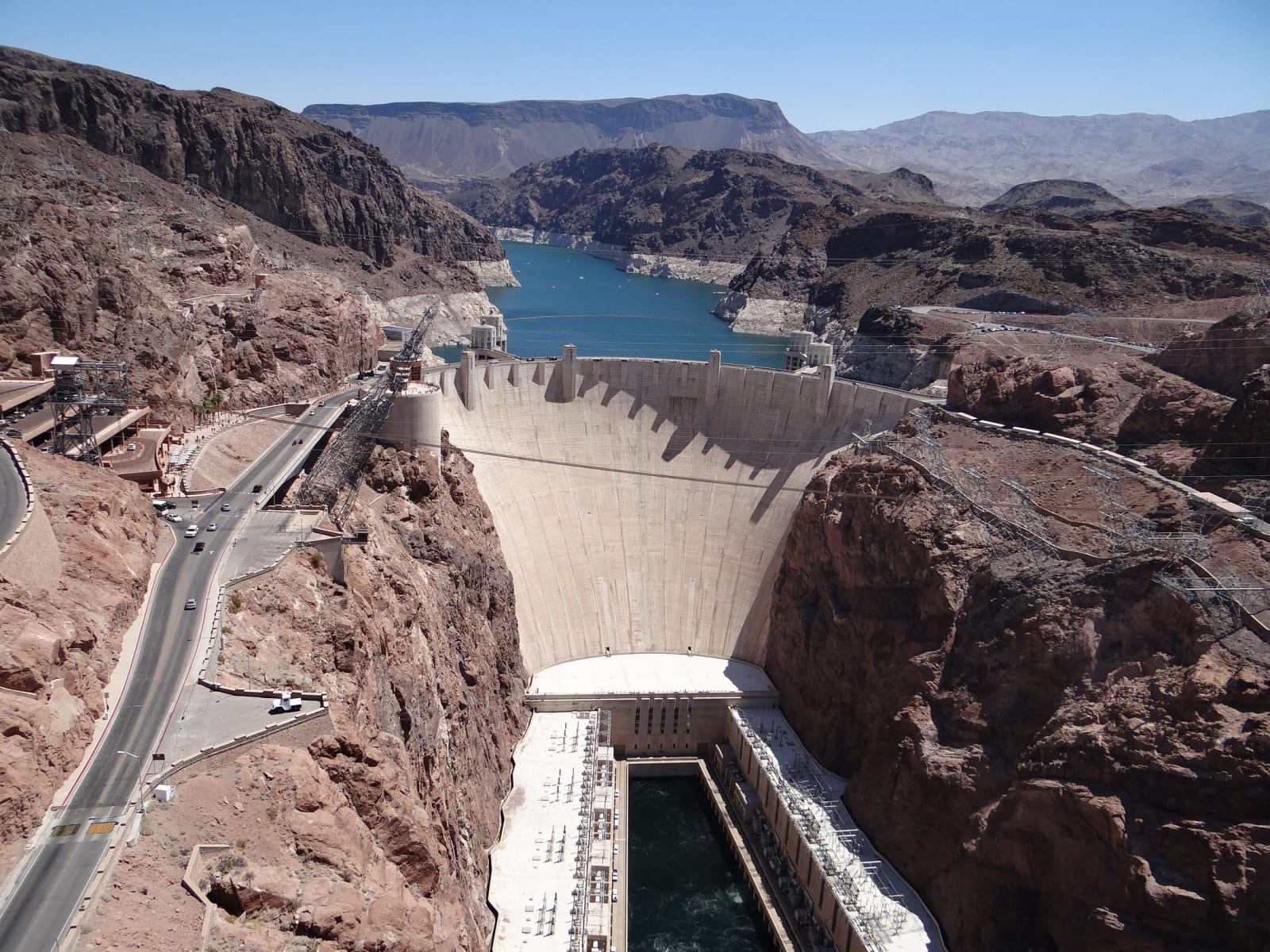
Hoover Dam is the kind of thing that has to be seen at scale to be believed — a 726-foot wall of concrete wedged into the black volcanic walls of Black Canyon, holding back the entire Colorado River on the line between Nevada and Arizona, about thirty miles southeast of Las Vegas. When it was finished in 1935 it was the tallest dam on Earth and the largest concrete structure ever built, and it remains the most-visited dam in the world, with some seven million people a year walking its crest. Nearly a century on, it has lost none of its capacity to make a person feel very small.
The dam exists because the Colorado was, for most of recorded history, ungovernable — a river that flooded catastrophically in spring and dwindled to nothing in late summer, and that in 1905 broke its banks entirely and poured into California for two years, creating the Salton Sea. Taming it required first a treaty: the Colorado River Compact of 1922, brokered in Santa Fe by then–Commerce Secretary Herbert Hoover, divided the river's water among seven states. The Boulder Canyon Project Act followed in 1928, and in 1931, at the very bottom of the Great Depression, a consortium called Six Companies won the construction contract with a bid of just under forty-nine million dollars.
The first problem was the river itself, which had to be moved before anything could be built in its bed. Crews bored four diversion tunnels — two through each canyon wall, each fifty-six feet across — and in November 1932 the Colorado was shunted aside and sent roaring around the site. With the riverbed dry, excavation reached bedrock and the first bucket of concrete was placed in June 1933.
What rose from there was a mass of concrete so enormous — more than six and a half million tons — that it created its own engineering crisis. Concrete generates heat as it cures, and a block this size, left alone, would have taken an estimated hundred and twenty-five years to cool, cracking itself apart in the process. The solution was to lace the dam with some 590 miles of one-inch pipe and pump refrigerated water through it, drawing the heat out artificially as the structure went up in interlocking columns. The last bucket was poured in May 1935.
Roughly twenty-one thousand people worked on the dam over its construction, in heat that regularly topped a hundred and twenty degrees in the canyon, and more than a hundred of them died doing it. The government built Boulder City from scratch a few miles away to house the workforce — a planned, tidy, alcohol-free town, in deliberate contrast to the saloons and gambling halls of Las Vegas, which sat twenty-eight miles up the road and did a roaring business every payday.
Even the name was contested. Interior Secretary Ray Wilbur christened it Hoover Dam at the 1930 groundbreaking, honoring the sitting president; when Franklin Roosevelt took office his administration pointedly went back to calling it Boulder Dam, and for more than a decade the structure had two names depending on who was talking. Congress finally settled the matter in 1947, restoring Hoover Dam as the official name, and there it has stayed.
Today the dam still does the work it was built for. Its seventeen turbines generate enough power for well over a million homes across Nevada, Arizona, and Southern California, and the reservoir it created — Lake Mead, the largest in the United States — supplies water to some twenty-five million people, though the white bathtub ring on its walls marks just how far drought has drawn the water down in recent decades. The dam was named a National Historic Landmark in 1985, and in 2010 the soaring Mike O'Callaghan–Pat Tillman Memorial Bridge opened just downstream, lifting the highway nine hundred feet above the river and, not incidentally, giving visitors the single best vantage point on the dam itself.
Getting there is easy: US-93 runs from Boulder City to the dam, where you can park and walk the crest on foot, crossing from Nevada into Arizona in the middle of the river. Don't rush past the details — the dam is a quiet masterpiece of Art Deco design, from Oskar Hansen's thirty-foot bronze Winged Figures of the Republic on the Nevada side to the terrazzo floors inlaid with a celestial map fixing the date of its dedication. The powerplant and dam tours go inside the structure and down to the generators; the visitor center explains the rest. It is open year-round, and while summer turns the canyon into a furnace, the engineering does not care what month it is — and neither, mostly, do the crowds.
Visitor Info
On the Map
A story featuring this place
Go deeper into the history and character of this stop
Nearby
The closest stops worth working into your route
Historical markers nearby
Roadside plaques and monuments within a short detour